Pot Life

Pot life is the working time after 2 components are mixed during which the mix can still be degassed, poured and flowed into the tool.

Every Pot Life article of the Vacuum Casting Resources, newest first, each written from published standards, research and makers’ data.

Meaning

Pot life is the working time after 2 components are mixed during which the mix can still be degassed, poured and flowed into the tool. For casting resins it runs in minutes. For mold silicone it runs to about an hour and a half. Every step between mixing and venting the chamber has to fit inside it.

Reference Cup

A printed pot life describes one cup of one mass at one temperature. Sika measures its grades with a gel timer, PX331 on 200 g (7.1 oz) at 23 °C (73 °F). Renishaw states its grades on 100 g (3.5 oz) at 25 °C (77 °F). PX 223 HT is stated on 90 g (3.2 oz). A casting room mixing a different mass or temperature works outside the printed condition.
Read More

Values by Grade

The resin pot lives on file run from 5 to 20 minutes. Renishaw 8020-2 gives 300 seconds and Renishaw 8263 gives 360 seconds. PX331 gives 6 minutes, PX 223 HT 6 to 7 minutes and PX522 8 minutes. PX523 gives 20 minutes on 162 g (5.7 oz), the longest on any sheet in these resources.

Mass Effect

More mass traps more reaction heat, so a big mix gels ahead of the reference cup. That is why the sheets tie each figure to a mass. Pot lives for bigger shots are not printed. A block of PX523 that needs a pour near 350 g (12.3 oz) is twice the reference cup. The room then measures how much of the 20 minutes remains in practice.

Temperature Effect

Warmth shortens the window. Renishaw 6230 gives 6 minutes at 25 °C (77 °F) and 3 minutes 40 seconds at 35 °C (95 °F) for the same cup. Warm resin runs thinner but for a shorter time. A long thin cavity therefore does not fill better by heating alone. No sheet gives a flow length, only viscosity and pot life.

Step Order

The clock decides the order of the casting steps. Each resin component is degassed on its own, about 10 minutes at vacuum, before anything is mixed. Once polyol and isocyanate meet, a mix that still needed degassing would be racing its own gel. Mixing under vacuum then takes 45 seconds to 4 minutes, depending on the grade.

Window Content

The resin pot life has to hold the mixing, the pour and the return of air to the chamber. Renishaw asks that the chamber be vented before the pot life ends. The returning air pushes resin into thin sections while it still flows. An unfilled corner shows that the resin stiffened before venting. PX523’s manual process fits 2 mixings and a vacuum until the bubbles stop inside its 20 minutes.

Silicone Clock

Mold silicone runs on a longer clock. Vacusil 2000 gives 90 minutes at 23 °C (73 °F). Wacker defines the end of pot life for its silicone as the moment the mix reaches 60,000 mPa·s (60,000 cP). The first degassing, the pour and the second degassing all fit inside that time. Silicone that stiffens before its second degassing usually leaves voids on the cavity wall.

Volume per Pour

A short window caps the resin volume of a single pour. An ABS-like resin weighs 1.2 to 1.35 g/cm³ (75 to 84 lb/ft³). A cup of 200 g (7.1 oz) therefore holds roughly 150 to 165 cm³ (9 to 10 in³). A cavity that needs more is filled in sequence, or a slower grade is chosen. Between the clear grades, 8 minutes on PX522 against 20 on PX523 favors PX523 for long flow paths.

Pour Record

The time from the start of mixing to venting the chamber can be written into each batch record. Set against the printed pot life at the component temperature, it shows how much margin each pour had. A clock and a thermometer are all the check needs.
Vacuum Casting Defects in a Batch Traced to Their Cause

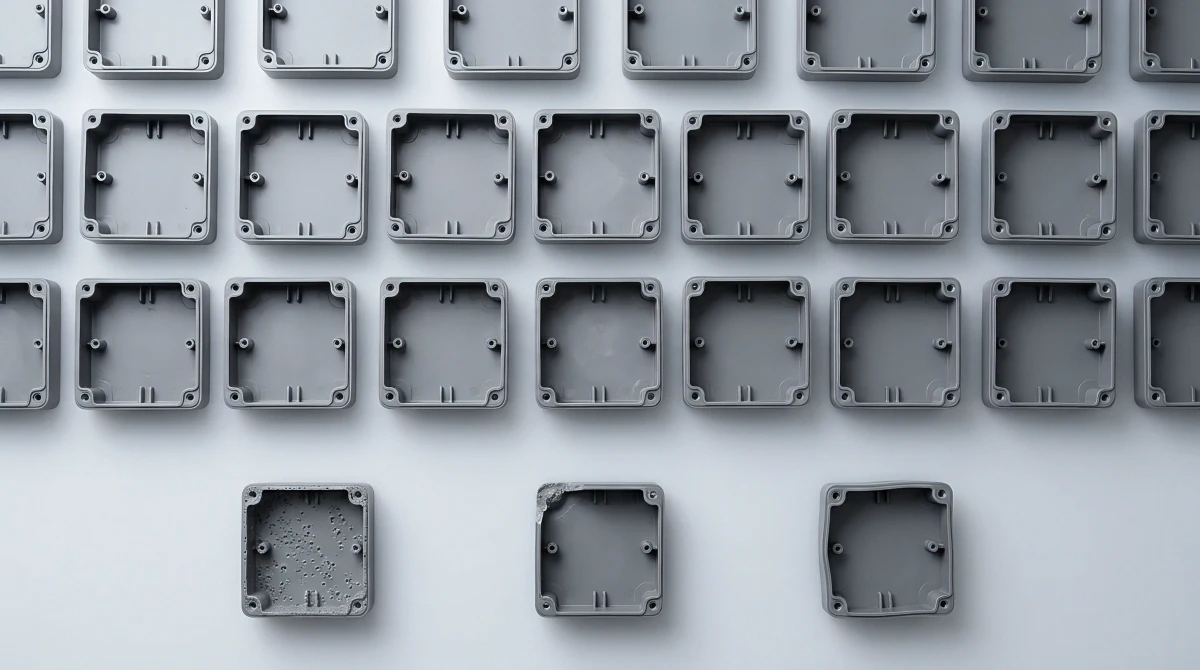
A vacuum casting defect points to its cause by where it sits on the part and which castings of the batch show it, from one wet pour to a mold near its end.

The List of Casting Defects and the Cause Behind EachVacuum casting defects trace to six causes: moisture in the components, air folded in during mixing and pouring, a mixing ratio upset by weighing or crystallization, a mold or master fault copied into every part, a cure or demold cut short, and a silicone mold wearing out over the run. The table pairs the defects named in the opened documents with those causes and with what a buyer or inspector sees.

Color Matching a Vacuum Cast Batch to a RAL or Pantone Reference

A vacuum cast color is fixed as a weighed recipe on an approved first article, measured with an agreed formula and tolerance, and repeated for every pour.

How a Vacuum Cast Batch Is Matched to a RAL or Pantone ColorA vacuum cast batch is matched to a reference by pigmenting each pour with a paste dosed within the resin maker's limit, casting a first part, measuring it against the reference under agreed conditions, adjusting the recipe, and then holding that recipe for every pour, with parts checked against the approved first article. Renishaw describes the casting system as producing typically 30 to 50 color-matched parts from a single mold, which is the batch size the recipe has to stay steady over.

Painting and Texturing Vacuum Cast Parts After Demold

A cast urethane part is painted only after its release agent is washed off and its surface keyed, with flexible coatings on parts that bend.

Painting Vacuum Cast Parts Step by StepA vacuum cast part is painted by removing the release agent, keying and degreasing the surface, applying an adhesion promoter where the substrate calls for one, priming, and then applying the color and clear coats, with flexible additives in every layer when the part bends. The car refinish makers write the sequence most completely, because they paint new plastic parts every day.

Overmolding and Inserts in Vacuum Casting Step by Step

Inserts in a cast part are held by knurls and undercuts, located on pins in the silicone, and surrounded by resin mixed and poured under vacuum.

The Vacuum Casting Steps for a Part With InsertsA vacuum cast part with molded-in inserts is made in eight steps: the insert is chosen and shaped for mechanical retention, the master is prepared so the mold can locate it, the insert's surface is prepared, it is placed in the opened silicone mold, the mold is closed and preheated, the resin is degassed and mixed under vacuum, the mold is filled and vented, and the part is cured and demolded around the insert. An overmolded part adds a second mold and a second pour.

Making the Master Pattern for Vacuum Casting From SLA or CNC

The master is finished, sealed and fitted with its parting line, gate and risers before the silicone is poured, because the mold copies every mark into the batch.

What the Master Pattern Has to Deliver Before the Silicone Is PouredA master pattern for vacuum casting is the physical original from which the silicone mold is cast, and the mold reproduces it so faithfully that every cast part inherits its shape, its surface and its faults. Loughborough University's vacuum casting guide puts it plainly: the mold replicates the master extremely faithfully, so the master's surface finish and accuracy are what the moldings will have.

Flatness and Warp of Large Vacuum Cast Parts

Large vacuum cast panels stay flat through a uniform thin wall, a slow cure, a conformer in post-cure and a temperature kept well below heat deflection.

What Sets Flatness and Warp on a Large Vacuum Cast PartFlatness on a large vacuum cast part is set by five conditions: the heat the resin releases as it cures, the wall thickness against the grade's maximum, how evenly and how long the part cures before demold, whether it is supported during post-cure, and the temperature it later works at. No resin maker, guide or study opened for this piece prints a flatness or warp tolerance for vacuum cast parts.

Rubber-Like Polyurethane Resins From Shore 30 A to 90 A

A rubber-like urethane is specified by grade, hardness method and a tested service temperature, because hardness alone leaves strength and heat behavior open.

Rubber-Like Vacuum Casting Grades and the Hardness Each CoversRubber-like vacuum casting resins are two- or three-component polyurethanes that cure in a silicone mold to an elastomer, with a Shore A hardness chosen for the part. The variable-hardness systems reach the range by adding a third component to a fixed A:B pair.

PP-Like and PE-Like Polyurethane Casting Resins for Vacuum Casting

PP-like and PE-like urethanes trade stiffness for elongation by grade, and their heat figures depend on cure, so the first cast part is tested in its real duty.

What PP-Like and PE-Like Mean on a Casting Resin Data SheetA PP-like or PE-like grade is a two- or three-component polyurethane formulated so that a part cast in a silicone mold behaves, in hand and in a snap fit, more like polypropylene or polyethylene than like a stiff ABS replica. The makers say so in their own words.

Silicone Molds, Pours and Lead Time for a Vacuum Cast Batch

A batch needs one silicone mold per set of copies, per resin and per color, and pours run one at a time through the chamber.

How Many Silicone Molds a Vacuum Cast Batch NeedsThe tool count is the quantity divided by the copies one tool gives, rounded up. Renishaw states that a mold can produce up to 50 parts before retooling and typically between 30 and 50 colour matched parts.

Degassing Silicone and Resin in Vacuum Casting

Each resin component is evacuated alone for about ten minutes, the silicone twice, and the air returns before the pot life ends.

Why Silicone and Resin Are Degassed Under VacuumMixing puts air into any liquid. Stirring two viscous components together folds the surface into the bulk, and a general guide from the mold supplier ArtMolds puts the air picked up by mixing at 5 % to 20 % of the volume, calling it the primary cause of bubbles in cast parts.

Wall Thickness Limits for Vacuum Cast Polyurethane Parts

Each casting resin carries a maximum thickness printed by its maker, and every property on its sheet describes a specimen of one stated thickness, not the whole part.

Maximum Casting Thickness as the Maker Prints ItSeveral Sika sheets print a line titled maximum casting thickness, and Sika's text for PX522 and PX523 words the same idea as parts until 10 mm or until 100 mm thickness by vacuum casting in silicone molds. Renishaw's resin sheets for 6230 and 8263 print no such line.

Shore Hardness Standards for Cast Polyurethane Parts

Shore hardness is a control number tied to a scale, a temperature, a cure state and a reading time, and a drawing callout needs all four.

Hardness Standards Behind a Cast Polyurethane Shore ValueThree documents appear most often around cast polyurethane. ISO 868 is the plastics method named on the resin sheets, ASTM D2240 is the American test method that reaches rubber and some plastics, and ISO 48-4 is the rubber method that covers softer grades.

Silicone Rubber for Vacuum Casting Molds

Mold silicone is an addition-cure rubber chosen for hardness and resin resistance, checked against every material it touches, and treated as a consumable.

Silicone Rubber as the Mold Material in Vacuum CastingA mold silicone is a two-component liquid rubber that is poured round a master, cured at room temperature or a little above, and cut open to release the master. Renishaw describes Vacusil 2000 as a two-component addition-cure liquid silicone rubber designed for mold making, curing at room temperature to a translucent, high-strength elastic rubber, and names vacuum casting of polyurethane resins among its uses.

Clear Polyurethane Casting Resin for Vacuum Casting

A clear polyurethane grade is chosen by section thickness first, and its post-cure has a printed ceiling that protects the color of the part.

How Clear a Casting Resin Is in Datasheet NumbersOn a datasheet, clear is a claim with two numbers behind it at most. PX522 is described as water clear, with a coefficient of light transmission of 89 percent measured by the laboratory LNE, and PX523 prints a refractive index of 1.511.

ABS-Like Polyurethane Casting Resins for Vacuum Casting

An ABS-like polyurethane resin is a stiff thermoset named for its use, and its datasheet numbers depend on post-cure, thickness and test method.

Why a Polyurethane Resin Is Called ABS-LikeThe phrase is a maker's shorthand, not a standard. Sika describes its SikaBiresin PX331 as having mechanical properties similar to thermoplastics like filled ABS, and Renishaw lists its 6230 as having properties similar to ABS.

Send the Drawing of Your Cast Part

Send the 2D drawing and the 3D file, with the quantity and the stage of the project. An engineer replies within 1 working day.

The quote form, the mutual NDA and the private folder for your files are on Protolis Atelier, with Vacuum Casting chosen.

Request a Quote