Meaning
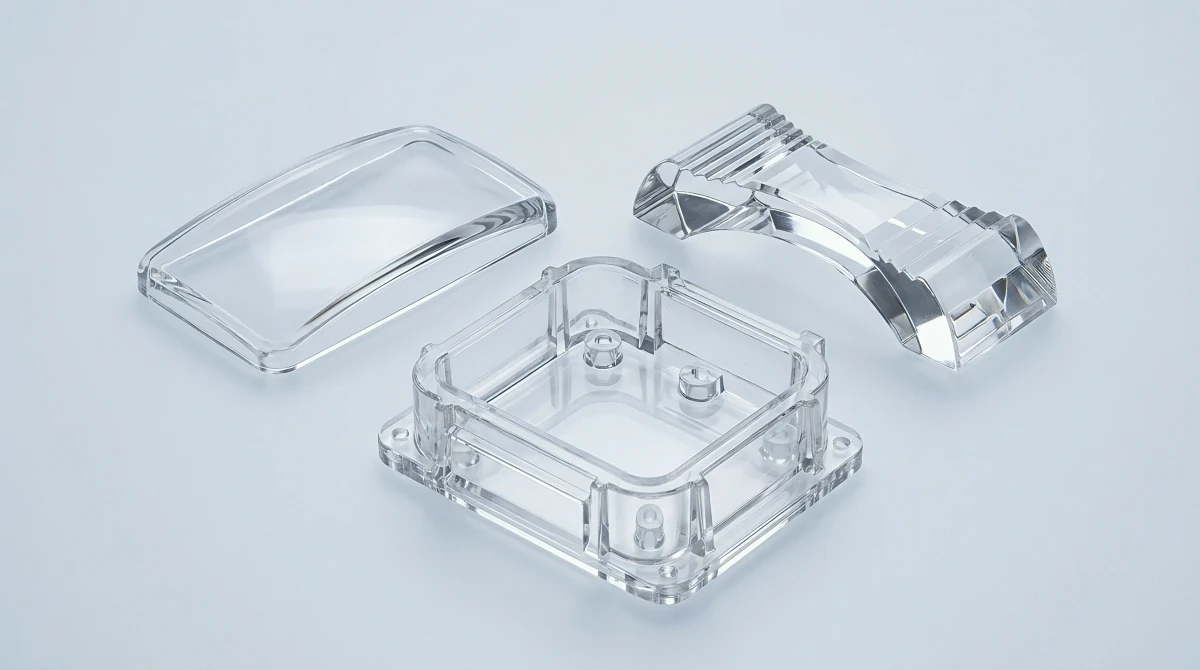
A clear part is a transparent cast copy, such as a lens cover or a display window, whose look is part of its function. It is cast in a clear grade and shows every flaw that an opaque part hides. A bubble, a bow or a yellow tint is a visible defect in it. Its cure, support and handling are therefore planned with the look in mind.Bubble Visibility
Bubbles hidden in an opaque part glint in a transparent one. In a lens, a bubble is a lens of its own. The degassing steps carry more weight here than on any other part. Here more than anywhere, the buyer asks to see the degassing record.Read More
Yellowing Limit
Heat beyond a limit tints a clear part yellow. Sika’s PX523 sheet caps the cure at 7 days at 70 °C (158 °F) or 48 hours at 80 °C (176 °F). It also caps 16 hours at 100 °C (212 °F), which is exactly its own post-cure. A reworked part, or one forgotten in the oven over a weekend, can exhaust that margin. A clear part cast beside a colored one inherits the longer schedule unless the oven loads are separated.Shape Support
Any bow picked up during 16 hours at 100 °C (212 °F) distorts the view through the part. No polishing removes a bow. A conformer that survives 100 °C (212 °F) without marking the surface belongs on its tooling list.Frame Fit
Fit in a frame has to be confirmed before tooling goes far. PX522 prints a shrinkage of 0.7 %, which on a 60 mm (2.36 in) cover is about 0.42 mm (0.017 in). Whether its test bar was post-cured goes unstated. A measured first article, or the maker’s answer, comes before the master is cut.Unanswered Questions
No clear sheet on file states how clarity changes with thickness. None quantifies yellowing or describes behavior in damp conditions or against cleaning fluids. A drawing that needs a defined clarity states the thickness and the measurement it expects.