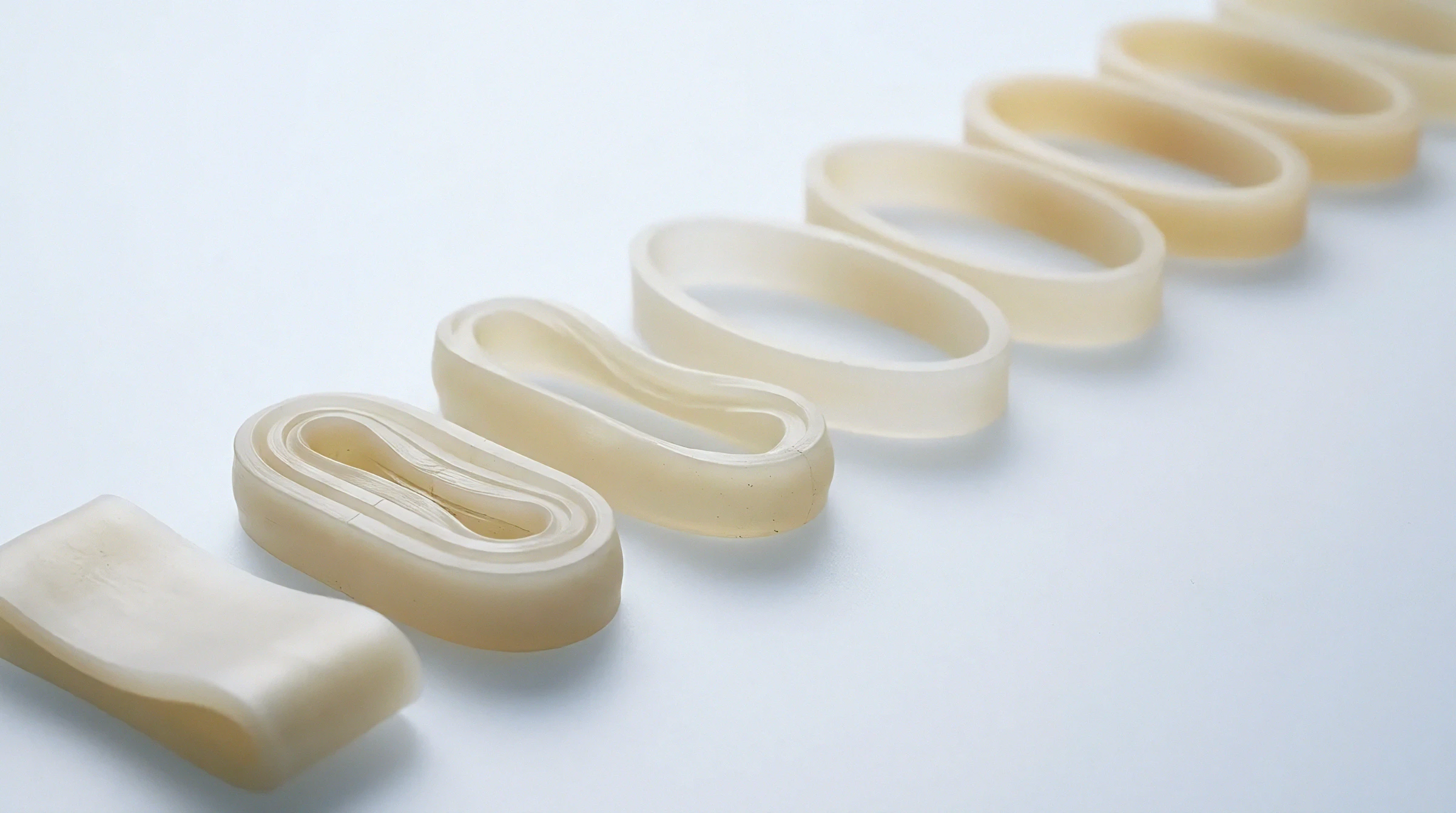
On Renishaw’s resin chart a single grade, 8891, fills the hardness cell with “20 A – 90 A”. The mixing ratio beside it reads 100:100 for the A and B components and 0 to 300 parts for a third, C component. Sika’s tooling brochure describes its PX840 the same way: a fixed polyol to isocyanate ratio, an extender added at 0 to 500 parts, and one system to cover the whole Shore A range.
So the buyer who asks for a gasket at Shore 40 A and a grip at Shore 80 A may be asking for one resin family at two dosages. What changes with the dosage, what the sheets print for each hardness, and how hot the part can run are the three things a cast urethane material properties sheet answers only in part. This piece reads the sheets on file side by side.
Rubber-Like Vacuum Casting Grades and the Hardness Each Covers
Rubber-like vacuum casting resins are two- or three-component polyurethanes that cure in a silicone mold to an elastomer, with a Shore A hardness chosen for the part. The variable-hardness systems reach the range by adding a third component to a fixed A:B pair. Fixed-hardness grades sit at one point in it.
| Grade | Hardness | Mixing ratio by weight | Tensile strength | Elongation at break | Working and demold times | Source note |
|---|---|---|---|---|---|---|
| Renishaw 8891 | 20 A to 90 A | A:B:C 100:100:0 to 300 | 2 to 17 MPa (290 to 2,470 psi) | 270 to 330 % | pot life 200 to 360 s, 100 g at 25 °C (3.5 oz at 77 °F); demold 1.0 h at 70 °C (158 °F) | combined resin chart |
| Sika PX840 | all A range; A 95 in the table | A:B:C 100:100:0 to 500 | 15 MPa (2,180 psi) | 680 % | pot life 11 to 14 min; demold 120 min | three components, easy to tint, low aggressiveness on silicone molds |
| Sika PX761 | A 63 | A:B 100:45 | not printed | 800 % | pot life 8 to 12 min; demold 60 to 90 min | “molded rubber” aspect, abrasion resistance |
| Huntsman Ureol 5231 | A 65 | not summarized | not summarized | not summarized | pot life 5 to 6 min, 650 g at 25 °C (1.4 lb at 77 °F); demold 1 to 2 h at mold 40 to 70 °C (104 to 158 °F) | simulates rubber, good tear, max wall 20 mm (0.79 in); 2004 summary |
Renishaw’s chart also prints, for 8891, a mixed viscosity of 470 cPs for A, 170 for B and 90 for C, and a typical shrinkage of 1.0 %. That figure sits at the top of the chart’s range for its resins, which starts at 0.2 % for several rigid grades, and it matters when the master is scaled.
The Renishaw brochure lists 8891 as a “20 A to 90 A variable hardness rubber type” and mentions a separate Vario Vac module for flexible components and highly filled, viscous materials. Sika recommends PX840 with its SI291 silicone. In both catalogs the rubber-like grade is cast in the same chamber, under the same vacuum, as the rigid grades.
Rubber-like vacuum grades come in two kinds: variable systems such as 8891 and PX840, where a third component sets Shore A across the range, and fixed grades such as PX761 at A 63. The C component also changes viscosity, working time and shrinkage, so a hardness change is a process change too.
What Changes Between Shore 30 A and Shore 90 A
The variable systems print their properties as a range or at one dosage, so the shape of the trade-off across hardness has to be read from a maker who prints every step. Mearthane’s Durethane S table does that for a family of solid industrial polyurethanes. These are hot-cast elastomers made to order, not vacuum casting resins, but the table shows how far one chemistry moves between 30 A and 90 A when the test methods are held constant.
| Grade | Hardness | Tensile strength | Elongation | Tear strength, die C | Compression set |
|---|---|---|---|---|---|
| DS230A | 30 A | 6.9 MPa (1,000 psi) | 625 % | 14.0 kN/m (80 pli) | 8 % |
| DS240A | 40 A | 13.8 MPa (2,000 psi) | 675 % | 21.9 kN/m (125 pli) | 6 % |
| DS250A | 50 A | 22.1 MPa (3,200 psi) | 775 % | 30.6 kN/m (175 pli) | 5 % |
| DS260A | 60 A | 25.9 MPa (3,750 psi) | 850 % | 35.0 kN/m (200 pli) | 5 % |
| DS270A | 70 A | 34.5 MPa (5,000 psi) | 800 % | 43.8 kN/m (250 pli) | 30 % |
| DS280A | 80 A | 48.3 MPa (7,000 psi) | 550 % | 70.0 kN/m (400 pli) | 35 % |
| DS390A | 90 A | 35.9 MPa (5,200 psi) | 430 % | 70.0 kN/m (400 pli) | 32 % |
Read down the table and three tendencies appear that a buyer can carry to any rubber-like grade, with the caution that each family has its own numbers.
- Tensile and tear rise with hardness. From 30 A to 80 A the tensile strength grows roughly sevenfold and the die C tear about fivefold in this family.
- Elongation peaks in the middle. It climbs to 850 % at 55 A to 60 A and falls back to 430 % at 90 A.
- Compression set does not follow hardness smoothly. In the grades of Table 2 it is 5 to 8 % up to 60 A, then 30 to 35 % from 70 A. The sheet’s legend lists MDI ether, TDI ether and TDI ester backbones across the family without tying them to grades, so the jump is a reading of the table, not an explanation.
Mearthane prints its range as 20 A to 70 D across the family, and also lists 30 A grades with tensile as low as 1.7 MPa (250 psi). Two grades at the same hardness can therefore differ by a factor of four in strength, which is the strongest argument for asking for the specific grade’s sheet rather than a hardness alone.
Renishaw’s 8891 range of 2 to 17 MPa (290 to 2,470 psi) fits this picture: the soft end of a variable system is weak, the hard end is several times stronger. The chart does not print which dosage gives which value, so a part specified at a given hardness gets its tensile figure from a bar cast at that dosage. A rubber-like casting imitates a seal or grip whose production version is often molded rubber or silicone, so the cast part answers questions of fit and hardness while the long-term set and heat figures belong to the production compound.
Hand-Cast Elastomer Sheets That Print Full Test Data
The fullest single data sets for rubber-like urethanes on file come from hand-cast elastomers sold for molds, fixtures and repairs. They are not vacuum casting grades, and the sheets say what they are made for. Still, they show which properties a complete elastomer sheet carries and under which standards.
Sika UR350 with UR360. A two-component elastomeric casting resin for semi-flexible molds, Shore 85 A (84 A after 15 s). It prints tensile strength 17 MPa (2,470 psi) and elongation 810 % to ISO 37, tear strength 83 kN/m (474 lbf/in) to ISO 34, Bashore resilience 42 %, linear shrinkage 3 mm/m (0.3 %) on a 250 × 50 × 3 mm bar, a glass transition of −65 °C (−85 °F) to ISO 11357 and a service temperature of −40 to 80 °C (−40 to 176 °F). All after 16 h at 70 °C (158 °F).
WEICON Urethane 60. A room-temperature curing repair and coating urethane at Shore 60 A, printing tensile strength 5 MPa (725 psi) and elongation 1,250 % to ISO 37, tear resistance 10 kN/m (57 lbf/in), and a temperature resistance of −60 to +90 °C (−76 to +194 °F). The sheet adds that the material stays flexible down to −60 °C (−76 °F).
Sika TCC-5000 series. A US flyer lists one A component with B components for 50 A, 60 A, 70 A, 80 A and 90 A, with elongations of 500, 600, 500, 400 and 300 % and a pot life of 15 to 20 minutes for 150 g (5.3 oz), for flexible molds, nesting fixtures and forming pads.
Two lessons carry over to vacuum grades. The rubber standards named on these sheets, ISO 37 for tensile and ISO 34 for tear, differ from the ISO 527 named for tensile values on rigid vacuum grades. And a complete elastomer sheet prints a temperature line, which the vacuum casting charts on file mostly do not.
For rubber-like urethanes, the sheet worth asking for prints hardness with its dwell time, tensile and elongation to ISO 37, tear to ISO 34, compression set with its temperature, and a service temperature. Hardness alone leaves strength open by a factor of four.
The Maximum Applicable Temperature of a Rubber-Like Part
A rubber-like part has two temperature limits, and they come from different measurements. The lower limit is set by the glass transition.
Covestro’s cast polyurethane brochure explains that hard plastics are used below their glass transition temperature and elastomers above it, where they are soft and flexible. Below it, the elastomer turns hard and brittle. The aim in formulation, in the brochure’s words, is an elastomeric zone as long and flat as possible.
The upper limit is where the part stops doing its job under load and time. For rigid grades, buyers often take the heat deflection temperature as a proxy, and the ISO 75-1 scope warns against it: results do not necessarily represent maximum applicable temperatures, because time, load and surface stress in service differ from the test, and the data are not intended for design. Elastomer sheets on file do not print a heat deflection value at all. They print a service range or a compression set at temperature.
| Material | Printed figure | Kind of figure |
|---|---|---|
| Sika UR350 with UR360, 85 A | −40 to 80 °C (−40 to 176 °F) | service temperature |
| Sika UR350 with UR360, 85 A | −65 °C (−85 °F), ISO 11357 | glass transition, low limit of the elastomeric zone |
| WEICON Urethane 60, 60 A | −60 to +90 °C (−76 to +194 °F) | temperature resistance |
| Mearthane Durethane S, 30 A to 90 A | 5 to 35 % after 22 h at 70 °C (158 °F) | compression set, ASTM D395 method B |
| Renishaw 8891, 20 A to 90 A | none printed on the chart | not stated |
| Sika PX840 and PX761 | none printed in the brochure | not stated |
The vacuum casting grades a buyer is most likely to receive, 8891, PX840 and PX761, carry no service temperature in the documents on file. That is the gap the thin line in a quote often hides. A seal or grip that sits in a warm housing has its limit set by the part, not by the resin chart.
A practical order of work follows from Table 3.
- Write down the highest and lowest temperatures the part sees, and the load or squeeze it carries at each.
- Compare the low end with the glass transition if the maker prints one. A part used near or below it loses its rubbery behavior.
- Ask the maker of the chosen grade for a service range or a compression set at temperature. Where none exists, the compression set of a comparable family, such as Table 2’s jump from 5 % to 35 % above 60 A, shows how much a harder grade can take a set at 70 °C (158 °F).
- Cast a first article in the chosen grade and dosage, hold it squeezed or loaded at the highest temperature, and measure the set or change in shape afterward.
Casting Rubber-Like Grades in a Silicone Mold
Rubber-like grades bring their own handling points into the chamber, and the sheets on file name several of them.
Working time is short for some and long for others. The 8891 chart gives 200 to 360 s for 100 g at 25 °C (3.5 oz at 77 °F), the 2004 summary gives 5 to 6 minutes for 650 g (1.4 lb) of Ureol 5231, and PX840 allows 11 to 14 minutes. Demold times follow the same spread, from 1 hour at 70 °C (158 °F) for 8891 to 120 minutes for PX840.
Mold aggressiveness is part of grade choice. Sika lists low aggressiveness on silicone molds among the reasons to choose PX840, and its SI291 silicone is the one it pairs with it.
The reason it matters is spelled out in Loughborough University’s vacuum casting guide: polyurethane resins chemically affect the silicone rubber, making it harder and stiffer with each casting until the mold breaks, cracks or crumbles, and the guide expects no more than about 20 moldings from one mold. A soft part with deep undercuts asks more of a tired mold than a rigid one, since it has to be pulled out of the cavity it has stiffened. Wall limits differ too: the Huntsman summary gives 20 mm (0.79 in) as the maximum wall for Ureol 5231, four times the 5 mm (0.20 in) it gives for several rigid PP-like grades.
Moisture handling is the same discipline as for rigid grades, with a twist from the chemistry. Covestro contrasts TDI-based systems, not sensitive to moisture and easy to mix, with MDI-based systems, very sensitive to moisture and requiring precise processing. The Sika UR350 sheet asks for material, processing and mold temperatures of 18 to 25 °C (64 to 77 °F) for its hand-cast use, mixing at no more than 300 rpm, and closing containers at once to keep moisture out.
A rubber-like grade is chosen as a process as well as a material: its pot life, demold time, wall limit and effect on the silicone mold all vary between grades of the same hardness.
Choosing a Rubber-Like Grade for a Part
The sheets support a short decision sequence for a buyer specifying a cast urethane by hardness.
- Fix the hardness with its method. Sheets print Shore A at a stated dwell, such as 85 A at 1 s and 84 A at 15 s on UR350. A drawing note that names the scale and the reading time avoids an argument over two points.
- Ask for the grade, not only the hardness. Table 2 shows a fourfold spread in tensile strength between grades at 30 A. A variable system such as 8891 or PX840 has a different strength at each dosage.
- Ask for the temperature line. Where the vacuum grade prints none, the first article carries the test.
- Plan for shrinkage. The 1.0 % Renishaw prints for 8891 is at the top of its chart’s range, and the master is scaled for it.
- Check the second material. A soft grip or seal is often cast over or against a rigid part. Overmolding and insert placement set that order of work.
When a rubber-like part is needed in a few dozen to a few hundred copies, with hardness set per order, it suits low-volume vacuum casting, and the same grades can carry a seal or grip through bridge production until a molded elastomer tool is ready.
Sources and Further Reading
- Renishaw vacuum casting resins and silicone rubbers, H-5800-0030-07-A, Renishaw
- Vacuum casting in the Loughborough Design School, a guide for final year students, R. Bibb, Loughborough University
- Brochure: Vacuum casting systems, H-5800-0110-03-A, issued 10.2017, Renishaw
- Move your business forward with SikaBiresin and SikaBlock solutions, tooling and composites, Sika
- SikaBiresin UR350 UR360, product data sheet, version 01.01, 12-2025, Sika
- Urethanes, casting and fastcast systems, flyer 2019, Sika Advanced Resins
- WEICON Urethane 60, technical data sheet, issued 18.02.2026, WEICON
- Durethane S, TechSpecs, Mearthane Products Corporation
- Cast polyurethanes, a versatile range of high-performing products, Covestro
- Development and evaluation of a vacuum casting process, F. C. Aggenbacht, M.Tech. dissertation, 2004, Central University of Technology, Free State
- EVS-EN ISO 75-1:2020, plastics, determination of temperature of deflection under load, part 1, scope, Estonian Centre for Standardisation and Accreditation