Meaning
A post-cure is the timed heat treatment a cast part receives in an oven after it leaves the silicone tool. It completes the chemistry the short in-mold cure began. On Sika’s sheets the printed properties belong to the part after this step. Renishaw’s resin sheets on file list no post-cure, so their figures belong to the part as demolded.Schedules by Grade
Sika prints a schedule for each grade. PX205 takes 16 hours at 80 °C (176 °F). PX331 takes 1 hour at 70 °C (158 °F), then 16 hours at 80 °C (176 °F). PX522 takes 4 hours at 80 °C (176 °F), then 16 hours at 100 °C (212 °F). PX523 takes 16 hours at 100 °C (212 °F). PX 223 HT climbs in 3 steps, ending with 12 hours at 110 °C (230 °F). Across the Sika grades the schedules run from 14 to 20 hours.Read More
Property Gain
The footnotes on a Sika property table name the post-cure behind each figure. Sika states that more cure after demolding lifts the final mechanical values. A copy shipped straight from the 45-minute demold is therefore a different material state from the table. Its hardness, stiffness and heat resistance sit below the printed values by an amount no sheet states. ISO 75-2 notes that annealing a specimen generally raises its deflection temperature, and a post-cured thermoset behaves the same way.Softening Proximity
Several schedules run at or above the glass transition printed on the same sheet. PX522’s final step reaches 100 °C (212 °F), above its printed 95 °C (203 °F). PX523’s schedule meets its own 100 °C (212 °F) transition exactly. PX205, PX522 and PX523 are post-cured above their own heat deflection. The part survives because it carries only its own weight, far below the 1.80 MPa (261 psi) of the test.Part Support Need
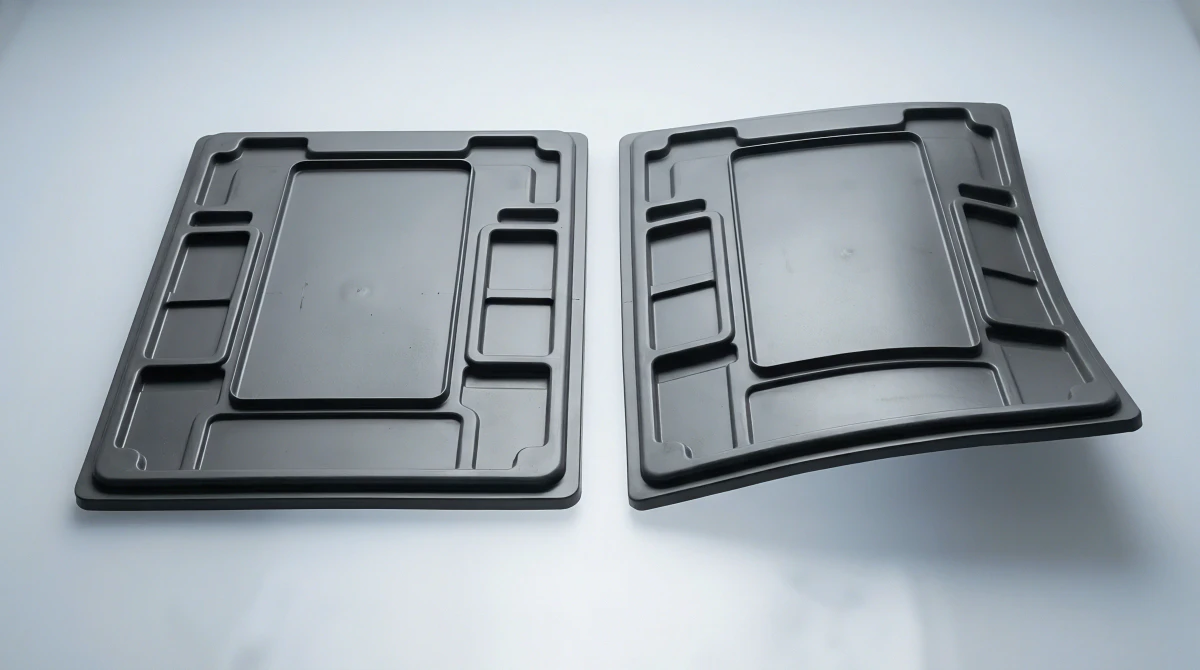
The risk in the oven is slow sag or bow. A conformer is Sika’s answer where shape and weight put the part at risk. PX 223 HT’s sheet makes oven support a requirement. Its schedule rises in steps that stay below the 120 °C (248 °F) glass transition of the finished material. The sheet does not say why, and support is the instruction it gives.Upper Limit
More post-cure is not always better. PX523 caps the cure at 16 hours at 100 °C (212 °F) against yellowing, exactly its own schedule. It also caps 48 hours at 80 °C (176 °F) and 7 days at 70 °C (158 °F). A second cycle at 100 °C (212 °F) passes the limit, and so does a long weekend at 80 °C (176 °F).Size and Hardness Effect
The post-cure changes the numbers a buyer measures. PX 223 HT prints 0 % shrinkage after its schedule. The bar measures 250 × 50 × 3 mm (9.84 × 1.97 × 0.12 in). The PX205 shrinkage bar was read after 16 hours at 80 °C (176 °F). A part measured as cast does not match the same part measured after post-cure. Hardness taken before the post-cure reads under the printed Shore D.Maker Practice
Sika and Renishaw treat the step differently. Renishaw prints none for 6230, 8263 and 8020-2. Sika prints 14 to 20 hours and measures afterward. An ABS-like grade from one maker set beside one from the other is a demolded part beside a long oven treatment. Even one sheet can mix cures. PX523’s electrical figures follow 16 hours at 80 °C (176 °F) and a day at room temperature, unlike its mechanical ones.Cure Record
The hours at each temperature are the evidence that a delivered part matches its sheet. A part that received only the first step has not reached the printed glass transition. A flame rating cannot be extended to a post-cure the maker did not test. A batch record that names the schedule lets a later batch be compared directly.Delivery Timing
Where a post-cure applies, delivery of the final copy slips to the following morning or later. A grade with a long schedule is cast in groups, one oven load a day. On the Renishaw grades without post-cure, the last demold ends the production run. A buyer who needs the printed values and a short delivery chooses between those 2 kinds of grade.