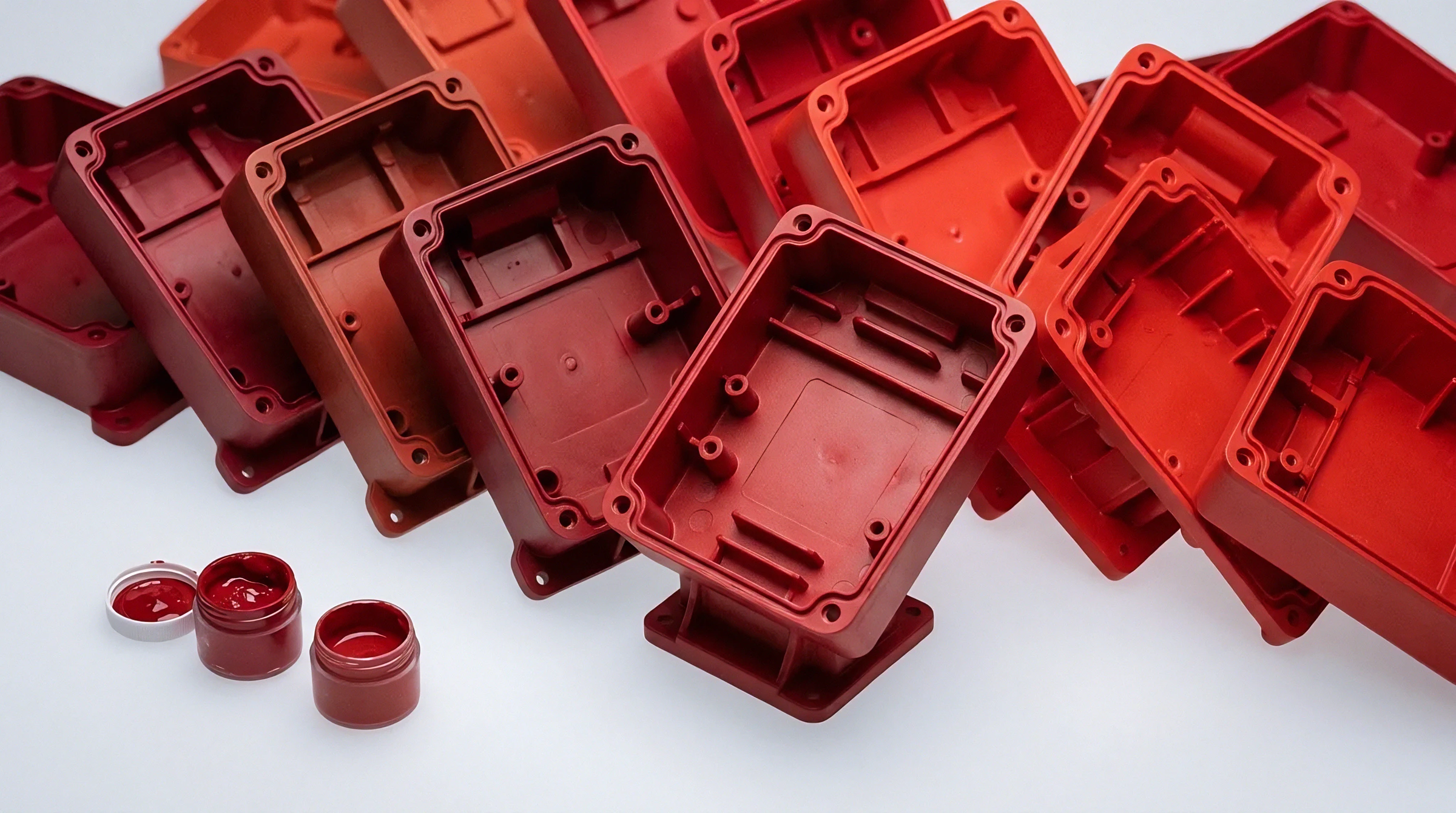
Renishaw’s resin sheets cap pigment at 2 % of the total weight. On a 100 g (3.5 oz) pour that is 2 g (0.07 oz) of paste, and a weighing slip of a tenth of a gram changes the dose by 5 %. Every pour in a vacuum cast batch is mixed separately, and every one is colored separately. That single fact sets the problem of matching vacuum casting plastics to a RAL or Pantone reference: the color is not made once for the batch, it is made again for every part.
The makers of casting resins and color pastes print how much colorant to use, where to add it and what it does to the resin. Color standards bodies print how a difference between two colors is measured and agreed. Read together, they give a buyer a workable way to specify a color for a cast batch and to check it part by part.
How a Vacuum Cast Batch Is Matched to a RAL or Pantone Color
A vacuum cast batch is matched to a reference by pigmenting each pour with a paste dosed within the resin maker’s limit, casting a first part, measuring it against the reference under agreed conditions, adjusting the recipe, and then holding that recipe for every pour, with parts checked against the approved first article. Renishaw describes the casting system as producing typically 30 to 50 color-matched parts from a single mold, which is the batch size the recipe has to stay steady over.
The reference itself comes in two common forms. Pantone sells plastic chips and a Pantone Matching System plastic standard chips collection, physical references made in plastic. RAL colors appear on the color paste sheets themselves: COELAN lists its pastes as approximately RAL 1013, 2004, 3000, 7001, 8016, 9005 and 9010, and R&G names a paste for RAL 6001. The word “approximately” on the COELAN sheet is the honest starting point: a stock paste is near a RAL color, not on it, and the cast part’s color also depends on the resin it is mixed into.
A cast batch is colored pour by pour, so matching a RAL or Pantone reference means fixing a recipe on a first article and repeating it exactly for every part from every mold.
Colorant Dosage Limits From Resin and Paste Makers
The limits differ widely between makers, and they are stated in different ways, so a recipe is written in the terms of the resin actually used.
| Maker and product | Dosage printed | Where it is added | Note on the sheet |
|---|---|---|---|
| Renishaw vacuum casting resins (8045, 8040, 8060-2) | no more than 2 % of total weight | into cup A, before degassing | grades described as pigmentable |
| Sika SikaBiresin Color Paste in UR132 and UR419 | maximum 1 % | into component B, stirred in before mixing with A | UR419 lists customized colors with the paste |
| Polytek PolyColor dyes in Kast-Series resins | up to 0.5 % of total mixed weight for black, brown, blue, green, red, yellow; up to 2 % for white and fleshtone | into Part B before Part A is added | dyes give any color |
| COELAN Colour Paste for COELAN liquid plastics | approximately 10 % | into the liquid plastic, mixed at no more than 300 rpm | colors approximately RAL; opacity varies by color |
| R&G universal color paste | 2 to 5 % in laminating and casting resins; up to 3 % in condensation-cure silicone | stirred in | not suitable for addition-cure silicone |
Three points in the table bear on a vacuum cast batch.
- The basis differs. Renishaw and Polytek state percentages of total weight; Sika’s limit is printed as a maximum in its elastomer sheets. Before a recipe is scaled from one resin to another, its basis is checked.
- The addition point is part of the recipe. Renishaw adds pigment to cup A, Sika and Polytek to the B side. Moving it changes when the pigment meets the isocyanate and how well it disperses before the pot life starts.
- White and pale colors need more. Polytek’s split between 0.5 % for strong colors and 2 % for white reflects how much colorant pale shades take, and the resin’s own color shows through when the dose is low.
Sika’s tooling brochure adds which paste goes with which resin. It lists a SikaBiresin Colour Paste range for epoxy and polyurethane systems, in white, black, green, red, blue, yellow, dark blue, pink and orange, and a separate CP Color range for coloring and pigmenting polyurethane vacuum casting resins, specific to its PX range. Several PX grades are described as easily colored with CP pigments; one, PX226, as very easy to color with all kinds of pigments, non water based.
What the Base Resin Does to the Color
A paste meets a resin that already has a color, and the sheets on file show how far from neutral those can be. Renishaw’s 8060-2 cures slightly yellow and translucent; its 8045 grades range from white to translucent; its 8040 cures white and opaque. Sika’s PX523 is water clear, PX 223 HT black, PX205 beige to dark beige. A target pastel on a beige or yellowish base is a different recipe from the same target on white.
Opacity is the second effect. Loughborough University’s vacuum casting guide lists, among the process’s disadvantages, that adding colorant to certain resins can make opacity difficult to achieve. COELAN notes that its colors offer varying levels of opacity and that several layers may be needed, which in a cast part means a higher dose or a different pigment. Polytek’s clear Poly-Optic bulletin goes the other way: dyes give clear, colored castings, a translucent tint rather than an opaque color.
The pigment chemistry explains why. A 2004 vacuum casting dissertation from the Central University of Technology, Free State, distinguishes soluble colorants (dyes) from insoluble ones (pigments), gives pigment particle sizes of 0.01 to 1 µm, and contrasts inorganic pigments, with high light and heat stability and high opacity but low tinting strength, with organic pigments, with high tinting strength and low opacity. An admixture of the two is often used. A recipe that has to be opaque and strong in hue usually ends up as such a mix.
Color also moves after casting. Sika’s PX523 sheet sets curing limits to prevent yellowing of the cast part: no more than 7 days at 70 °C (158 °F), 48 hours at 80 °C (176 °F) or 16 hours at 100 °C (212 °F). Polytek warns that its Kast-Series plastics yellow and chalk in sunlight and are to be painted or sealed for exterior use. A color approved on day one is approved after the full cure, and a part for outdoor use is judged after exposure, or painted.
The cast color is paste plus base resin plus cure. A yellowish or beige base, a clear base and a white base each need their own recipe for one RAL or Pantone target, and a long or hot cure can move the result.
Measuring the Difference Between a Cast Part and the Reference
A visual match under the shop light is the start, but a batch needs a number that two parties can agree on. Two standards set out how that number is computed.
The CIELAB space, specified in ISO/CIE 11664-4 as published by the Estonian standards body, gives each color three coordinates, with correlates of lightness, chroma and hue, and includes methods for computing the Euclidean distance between two colors as a measure of perceived difference. It applies to colors seen as belonging to a reflecting or transmitting object, which covers both an opaque cast part and a translucent one.
ASTM D2244 then covers the calculation of color tolerances and small color differences between opaque specimens such as plastic plaques, from instrument readings under daylight illumination. Its scope lists five ways of expressing the difference.
| Formula | Named in D2244 as | Condition from the standard |
|---|---|---|
| CIELAB ΔE*ab | CIE 1976 opponent-color space | the base scale; differences in different scales are not likely to be identical |
| CMC | CMC tolerance units | tolerances compared only within one system |
| CIE94 | CIE94 tolerance units | tolerances compared only within one system |
| DIN99o | color difference formula of DIN 6176 | tolerances compared only within one system |
| CIEDE2000 ΔE00 | CIEDE2000 color difference units | highly recommended for differences of 0.0 to 5.0 ΔE*ab units, including plastics |
The standard’s conditions are as useful to a buyer as its formulas. For product specification, purchaser and seller agree on the permissible tolerance between test specimen and reference and on how it is calculated.
Each material and condition of use may need its own tolerance, because gloss, texture and how close the specimens sit affect how a measured difference relates to acceptability. Instrumental tolerances are to be correlated with a visual appraisal, by the companion practice ASTM D1729. And because the equations were optimized for daylight, a color judged under another light needs a visual check for metamerism, by ASTM D4086, where two specimens look alike under one light and different under another.
For a cast part, gloss and texture come from the master, since the silicone copies the master’s surface finish. A chip with a different gloss from the casting can read as a different color even when the pigments agree, which is why D2244’s caution about gloss and texture belongs in the color agreement.
Where Color Drifts Within a Vacuum Cast Batch
Because each part is its own pour, a batch has more places for color to drift than a molded run fed from one blend. The documents on file point to each of them, and an inspector who knows where they are can tell a recipe fault from a process fault.
| Source of variation | How it moves the color | Document |
|---|---|---|
| Pour size and cup loss | resin left in the cup shifts the mix; small pours magnify a weighing slip in the paste | Renishaw sheets; Aggenbacht dissertation |
| Addition point and dispersion | paste in the wrong component, or streaks left by short mixing | Renishaw sheets; Sika UR132; COELAN |
| Base resin color | yellowish, beige, white or clear bases shift the same paste | Renishaw sheets; Sika brochure |
| Dose against opacity | a low dose on a pale shade lets the base show through | Polytek Kast-Series; Loughborough guide; COELAN |
| Cure and post-cure | long or hot cures can yellow a clear or pale part | Sika PX523 |
| Light exposure after delivery | yellowing and chalking in sunlight | Polytek Kast-Series |
| Surface gloss and texture from the master | the same pigment reads differently on a glossy and a matte surface | ASTM D2244 |
| Viewing light | two parts alike in daylight can part under shop light (metamerism) | ASTM D2244 |
Read as a diagnosis, the table separates three patterns. A single off-color pour is almost always a weighing or mixing fault in that pour. When a whole mold’s output shifts together, that points to the master’s gloss or the mold’s surface, and a slow drift across days points to a new resin lot or the cure.
Color in a vacuum cast batch drifts pour by pour. One off part points to that pour’s weighing or mixing, a whole mold’s parts to the surface, and a slow drift to the resin lot or the cure.
Translucent and Clear Colored Parts
Not every colored casting is opaque. Polytek’s Poly-Optic bulletin describes clear castings tinted with dyes to give clear, colored parts, and Sika lists customizable colors among the benefits of its water-clear PX523. Renishaw’s 8045 family cures from white to translucent, and its 8060-2 cures slightly yellow and translucent, so a pale tint on those grades shows the base through it.
For such parts the CIELAB standard still applies; its scope covers colors seen as belonging to a transmitting object as well as a reflecting one. What changes is the reference. A translucent tint is judged through a stated thickness, since a thicker wall looks deeper, and it is judged against a reference of similar translucency rather than an opaque chip. The thickness is part of the color specification, in the same way that ASTM D635 makes thickness part of a burning result.
Pigment and the Rate of Burning of Flame-Rated Grades
Color and flammability meet on fire-rated parts. ASTM D635, the horizontal burning test, states that the rate of burning and other burning phenomena are affected by density, pigments, anisotropy and specimen thickness, and that results are compared only for specimens of similar thickness. Its scope describes the method as a small-scale laboratory screening procedure for the relative rate of burning of plastic bars, and states that correlation with flammability under actual use is not implied.
That matters when a flame-rated casting resin is colored. Sika describes its PX331 as self-extinguishing, FAR 25 certified and UL 94 V0 at 3 mm, and in the same brochure as easily colored with CP pigments. The rating belongs to the specimens the maker tested. A pigment dose chosen to hit a RAL color is a change the burning tests themselves name as an influence, so a colored, flame-rated part is confirmed with the resin maker, or tested, at the color and thickness it will be delivered in.
Holding a Color Across the Batch
Once a recipe is approved, the batch is a matter of repeating it. The documents on file support a short plan.
- Fix the recipe by weight. Paste, A and B by weight for one pour size, with the addition point. Renishaw allows for cup loss when weighing, the resin left behind in cup A after tipping, and the dissertation notes that below about 50 g (1.8 oz) of resin that loss changes the mix enough to alter its properties. Small pours are where a color drifts.
- Mix the paste in fully. COELAN asks for slow mixing, at no more than 300 rpm, until homogeneous and free of streaks. Sika adds its paste to component B and stirs before adding A.
- Cast and approve a first article. After the full cure and post-cure, measured against the physical reference under the agreed conditions and formula.
- Check by mold and by resin lot. Parts from each new mold and from each new can of resin or paste are checked against the approved first article, not only against the chip, since that is where a shift enters.
- Keep a retained sample. The approved first article is kept as the batch’s working reference.
Each pour in this plan is its own small batch of color, which is the nature of the process. For colored parts in tens to a few hundred copies, held to a recipe and a first article, the work fits low-volume vacuum casting, and the same recipe and retained sample carry the color through bridge production until the molded part takes over.
Sources and Further Reading
- Brochure: Vacuum casting systems, H-5800-0110-03-A, issued 10.2017, Renishaw
- Data sheet: polyurethane resin 8045, H-5800-0802-04-A, Renishaw
- Data sheet: vacuum casting resin 8040, H-5800-0060-03-A, Renishaw
- Data sheet: vacuum casting resin 8060-2, H-5800-0597-03-A, Renishaw
- Move your business forward with SikaBiresin and SikaBlock solutions, tooling and composites, Sika
- SikaBiresin UR419, product data sheet, version 01.01, 03-2026, Sika
- SikaBiresin UR132, product data sheet, version 03.01, 07-2026, Sika
- SikaBiresin PX523, product data sheet, version 02.01, 11-2026, Sika
- COELAN Colour Paste, technical data sheet, issue 2015-01-20, Kemper System
- Universal Epoxy Colour Paste Emerald green (RAL 6001), R&G Faserverbundwerkstoffe
- Kast-Series urethane resins, technical bulletin, Polytek Development Corp.
- Poly-Optic 14-Series casting resins, technical bulletin, Polytek Development Corp.
- Development and evaluation of a vacuum casting process, F. C. Aggenbacht, M.Tech. dissertation, 2004, Central University of Technology, Free State
- Vacuum casting in the Loughborough Design School, a guide for final year students, R. Bibb, Loughborough University
- EVS-EN ISO 11664-4:2011, colorimetry, part 4, CIE 1976 Lab* colour space, scope, Estonian Centre for Standardisation and Accreditation
- ASTM D2244, standard practice for calculation of color tolerances and color differences from instrumentally measured color coordinates, scope and significance, ASTM International
- ASTM D635-22, standard test method for rate of burning of plastics in a horizontal position, scope and significance, ASTM International
- Color standards, plastics, Pantone