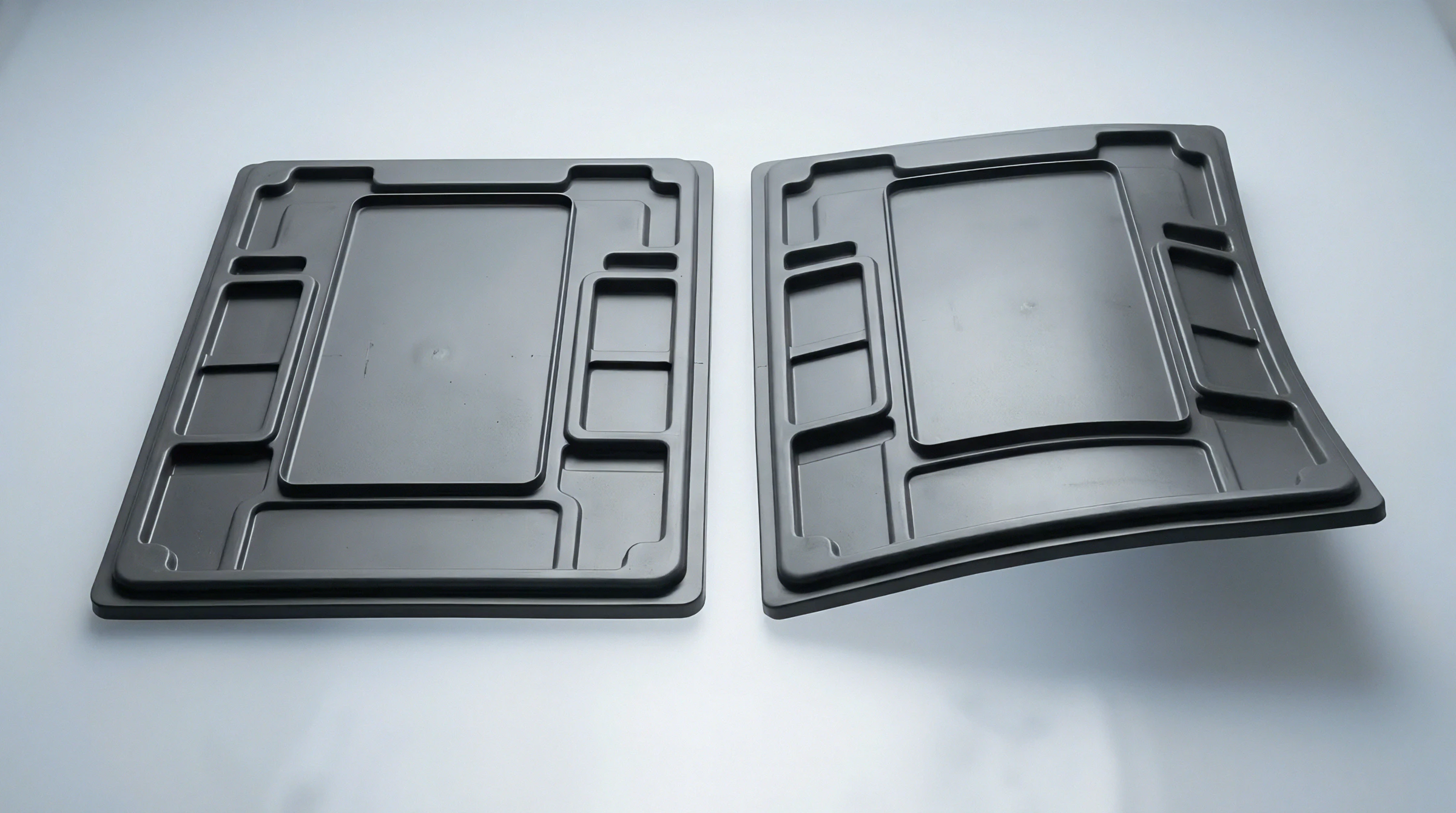
Polytek’s bulletin for its Kast-Series casting resins prints linear shrinkage as small as 0.0002 in/in, and explains in a footnote where it comes from: shrinkage is primarily caused by gelling while hot, then cooling. Its clear-resin bulletin adds the consequence for thick work. Slowing the cure reduces exothermic heating, which can cause distortion, waviness and shrinkage, especially in castings more than 12.7 mm (0.5 in) thick.
Those two sentences describe how a large flat vacuum cast part goes out of flat. The resin heats itself as it cures, the heat is uneven across a big section, and the part sets while it is hot and contracts as it cools. Then the oven, the demold and the post-cure each add their own chance to bend it. This piece reads what the makers print about each cause, what the standards offer for writing a flatness requirement, and what no document on file gives: a published flatness value for vacuum casting tolerances.
What Sets Flatness and Warp on a Large Vacuum Cast Part
Flatness on a large vacuum cast part is set by five conditions: the heat the resin releases as it cures, the wall thickness against the grade’s maximum, how evenly and how long the part cures before demold, whether it is supported during post-cure, and the temperature it later works at. No resin maker, guide or study opened for this piece prints a flatness or warp tolerance for vacuum cast parts. What they print are the limits and figures behind those five conditions.
That absence is itself information for a buyer. A flatness requirement on a large cast panel is not something the caster can look up and confirm; it is a requirement written on the drawing, designed for by choosing grade and wall, and shown on the first article.
| Grade | Maximum casting thickness | Linear shrinkage, with specimen | Thermal expansion | Note on shape during cure |
|---|---|---|---|---|
| Sika PX205 | 5 mm (0.20 in) | 7 mm/m (0.7 %), bar 3 × 50 × 250 mm (0.12 × 2.0 × 9.8 in) | not printed | conformer recommended in post-cure, depending on geometry and weight |
| Sika PX331 | 5 mm (0.20 in) | not printed | not printed | conformer recommended in post-cure, depending on geometry and weight |
| Sika PX522 with PX521 | 10 mm (0.39 in) | 7 mm/m (0.7 %), bar 500 × 50 × 5 mm (19.7 × 2.0 × 0.20 in) | not printed | conformer recommended in post-cure, depending on geometry and weight |
| Sika PX523 | 100 mm (3.9 in) | not printed | not printed | demold time and cure tied to thickness; conformer recommended |
| Sika PX 223 HT | 5 to 10 mm (0.2 to 0.4 in) | 0 % after post-cure, bar 250 × 50 × 3 mm in silicone mold | 115 ppm/°C (64 ppm/°F), ISO 11359-2 | part supported in the oven during post-cure |
| Sika PX 1000 | 5 mm (0.2 in) | 0.1 % | 100 × 10⁻⁶/°C (56 × 10⁻⁶/°F) | not printed |
| Renishaw resins (chart) | not printed | 0.2 to 1.0 %, “according to wall thickness” | not printed | 8060-2 sheet notes a high exotherm |
Three things stand out. Maximum casting thickness is small for most rigid grades, 5 to 10 mm (0.2 to 0.4 in), and a large part that stays inside it is a thin-walled part, which is exactly the shape that bends. Shrinkage is printed on one bar each, not on a panel. And every Sika rigid sheet on file, plus the PX 223 HT sheet, says something about holding the part’s shape during post-cure.
No opened document prints a flatness tolerance for vacuum cast parts. The sheets print the conditions that cause warp, a wall limit, a shrinkage on one bar, a need for support in the oven, and those set the flatness a design can expect.
Exotherm and Wall Thickness
The chemistry explains why thick and uneven sections warp. A polyurethane cures by an exothermic reaction, and a thick section heats itself more than a thin one. Polytek prints the peak temperature its clear resins reach in a 1 lb (454 g) mass.
| Grade | Maximum exotherm | Pot life, 2 lb (907 g) mix |
|---|---|---|
| Poly-Optic 1410 | 129 °C (265 °F) | 15 min |
| Poly-Optic 1411 | 109 °C (228 °F) | 9 min |
| Poly-Optic 1411 ES7 | 38 °C (100 °F) | 420 min |
| Poly-Optic 1412 | 113 °C (235 °F) | 8 min |
| Poly-Optic 1420 | 155 °C (311 °F) | 15 min |
| Poly-Optic 14-70 | 88 °C (190 °F) | 15 min |
The long-pot-life 1411 ES7 is the instructive line. Polytek recommends it for large pours where extra working time or minimal shrinkage is required, and its exotherm peaks at 38 °C (100 °F) against more than 100 °C (212 °F) for its faster siblings. The bulletin also offers a retarder to slow other grades, for the stated reason that slower cure reduces the exothermic heating behind distortion and waviness. Its Kast-Series bulletin works from the other side: an accelerator increases exotherm and with it shrinkage, while a neutral-density filler, added up to about 50 % by weight, lowers exotherm and reduces shrinkage.
The vacuum casting sheets carry the same warning in their own terms. Renishaw’s 8060-2 sheet notes that the product generates a high exotherm. Sika’s maximum casting thicknesses are where the maker draws the line for each grade. Loughborough University’s vacuum casting guide sums up the process view: vacuum casting is not meant for large, bulky, thick-sectioned or heavy parts.
For a large flat part, the design levers follow directly: a uniform wall inside the grade’s maximum thickness, no local thick bosses or ribs that heat more than the panel around them, and a slow, low-exotherm grade where the section cannot be thin.
Cure, Demold and Post-Cure Support
Most warp on a large cast part is made after the resin has set but before it is strong. Polytek’s bulletins say it in identical words for several product lines: castings should remain in the mold until thoroughly cured, and parts demolded too soon may be subject to deformation. They add that thin castings, or thin sections of castings, take longer to cure than thick ones, so the thin web of a large panel is the last part to be ready.
The post-cure is the second risk. Sika’s PX 223 HT sheet states that after demold the part has to be supported in the oven to maintain its shape during post-cure, and that its geometry or mass should not present a deformation risk. The schedule it gives is 1 hour at 70 °C (158 °F), 1 hour at 100 °C (212 °F) and 12 hours at 110 °C (230 °F), so a large thin part spends many hours hot with nothing but its support holding it flat. Sika’s German sheets for PX205, PX331, PX522 and PX523 recommend a conformer, a support shaped to the part, during post-cure, depending on the part’s geometry and weight.
Loughborough’s guide lists, among the disadvantages of vacuum casting, that parts can warp if not cured properly. The 2004 vacuum casting dissertation from the Central University of Technology, Free State, adds a warning about the mold itself: large molds may need supports to prevent distortion under their own weight, and the frame for casting a mold has to be stiff enough that the mold does not deform while the silicone vulcanizes. A silicone mold that sags puts its sag into every casting.
Warp on a large flat casting is mostly made between gel and full strength: a part demolded early, a thin web still curing, or a post-cure without a conformer. The sheets name each step, and the support is part of the process.
How Shrinkage Varies Across a Part
A flat panel stays flat only if it shrinks evenly, and the evidence is that it does not. The Free State dissertation cast tensile specimens from a machined steel original and measured every dimension ten times. As mold and cure temperatures changed, the lengths and the diameters of the same specimen moved in opposite directions: in one series all lengths shrank more and all diameters less, in another the lengths came closer to size while the diameters moved further away. The author expected the long thin section to change most, and found no clear overall pattern.
Two features of that result matter for a large part. Shrinkage depends on direction and section, so a panel with ribs one way and a plain web the other can contract differently along and across. And the scatter in the cast specimens was much larger than in the steel original, which means a single measurement of a large cast part says less than the same measurement on a machined part.
Shrinkage figures alone make the scale plain. Over a 500 mm (19.7 in) panel, 0.7 % is 3.5 mm (0.14 in) of contraction and 0.08 % is 0.4 mm (0.016 in). The Polytek tooling resins at 0.0002 to 0.0008 in/in (0.02 to 0.08 %) and Sika’s PX 223 HT at 0 % after post-cure sit at the low end; PX205 and PX522 at 7 mm/m (0.7 %) and Renishaw’s grades at up to 1.0 % at the high end. Any difference in shrinkage between the two faces of a panel, or between a rib and the web, becomes bow.
Warp at the Maximum Applicable Temperature
A part that leaves the casting room flat can still warp in use, when it runs warm. The sheets give three kinds of figure for this, and none of them is a service limit for a loaded panel.
| Figure | Values on file | What it is |
|---|---|---|
| Heat deflection temperature, ISO 75 | 55 °C (131 °F) for PX205; 85 °C (185 °F) for PX522 and PX523; 90 °C (194 °F) for PX331 | a comparison under a fixed load and heating rate; ISO 75-1 states it does not necessarily represent a maximum applicable temperature |
| Hardness at temperature | Renishaw 8040, Shore D 70 at 23 °C (73 °F), 64 at 60 °C (140 °F), 37 at 80 °C (176 °F) | the softening of the material as it nears and passes its 65 °C (149 °F) heat deflection |
| Service temperature | −40 to 80 °C (−40 to 176 °F) for Sika UR390 and UR350 elastomeric resins | the maker’s stated range for those materials |
| Thermal expansion | 115 ppm/°C (64 ppm/°F) for PX 223 HT; 140 × 10⁻⁶/K (78 × 10⁻⁶/°F) for UR390 | growth with temperature, which a long part has to accommodate |
The ISO 75-1 scope, as published by the Estonian standards body, explains why heat deflection is not a flatness limit: time, loading and surface stress in service differ from the test, and the data are not intended for design or for predicting endurance at elevated temperature. A large panel held at its edges in a warm housing is loaded for hours, not seconds, and creeps toward the shape its load gives it.
Expansion adds a reversible change. On a 500 mm (19.7 in) part of PX 223 HT, a rise of 40 °C (72 °F) adds about 2.3 mm (0.09 in) of length. A panel fastened rigidly at both ends has nowhere to put that growth except out of plane. The practical order is the one the standard implies: state the highest temperature and the load, keep that temperature well below the grade’s heat deflection, and test a first article held at that temperature in its real mounting.
Checking Flatness Through the Batch
Because each warp cause belongs to a different stage, flatness is checked at more than one point, and the record of when a part went out of flat names the cause. The documents on file support a short inspection sequence.
- At demold. A part that is already bowed when it leaves the mold points to exotherm, uneven section or a sagging mold. Polytek’s bulletins note that pre-warmed molds hasten the cure and low temperatures slow it, so a cold mold and an early demold are the first things to rule out.
- After post-cure, on its conformer and off it. A part flat at demold but bowed after the oven was not supported well enough, which is the risk Sika’s sheets name.
- Measured several times. The Free State dissertation took ten readings per dimension and found cast parts far more scattered than their steel original. One reading on a large casting says little; a pattern of readings over the face says what shape it has.
- After a soak at service temperature, where the part will run warm, mounted as it will be in use, since ISO 75-1 keeps heat deflection apart from a service limit.
- Per mold and per pour. Each pour cures on its own clock and each mold sags on its own support, so a flatness record tied to mold and pour shows whether a drift belongs to one or the other.
Flatness is checked at demold, after post-cure and after a soak at service temperature. Which check a part fails names the cause: the cure, the support, or the heat of use.
Writing a Flatness Requirement for a Large Cast Part
Since no casting sheet promises a flatness value, the drawing carries it. Two standards define the language. ISO 1101, as its scope is published by the Estonian standards body, defines the symbol language for the geometrical specification of workpieces and the rules for interpreting it, and notes that the specification can also be attached to a 3D CAD model under ISO 16792.
ISO 20457 specifies possible manufacturing tolerances for plastic molded parts, with general tolerances given as surface profile tolerances within a datum system. Its scope names injection, compression, transfer and rotational molding of thermoplastics, thermoplastic elastomers and thermosets, and states that it applies to other plastic processes if agreed between the parties. A vacuum casting order can therefore adopt it by agreement, but not by default.
A flatness requirement that a caster can work to states the following:
- the flatness tolerance, in ISO 1101 symbols, on the faces that matter, rather than a general flatness on the whole part;
- the datum or support condition under which it is measured;
- the measurement temperature, since the part grows with heat;
- the grade, and its post-cure with the conformer or support used;
- whether ISO 20457 general tolerances are adopted by agreement for the rest of the part.
The first article then shows whether the design and the process meet it. Large, flat parts that pass that check in tens to a few hundred copies fit low-volume vacuum casting, and a proven conformer and cure can keep the same flatness through bridge production until the steel tool’s parts take over.
Sources and Further Reading
- Kast-Series urethane resins, technical bulletin, Polytek Development Corp.
- Kast-Series urethane resins, technical bulletin, December 2020, Polytek Development Corp.
- Poly LiteCast and Poly Plasti-Flex liquid plastics, technical bulletin, Polytek Development Corp.
- Poly-Optic 14-Series casting resins, technical bulletin, Polytek Development Corp.
- Poly 15-Series liquid plastics, technical bulletin, Polytek Development Corp.
- SikaBiresin PX205, product data sheet, version 01.01, 08-2026, Sika
- SikaBiresin PX331, product data sheet, version 01.01, 08-2026, Sika
- SikaBiresin PX522 with PX521, product data sheet, version 01.01, 08-2026, Sika
- SikaBiresin PX523, product data sheet, version 02.01, 11-2026, Sika
- PX 223 HT, technical data sheet, version 01, February 2021, Sika
- PX 1000 NA, technical data sheet, version 01, February 2021, Sika
- SikaBiresin UR390, product data sheet, version 02.01, 08-2026, Sika
- SikaBiresin UR350 UR360, product data sheet, version 01.01, 12-2025, Sika
- Renishaw vacuum casting resins and silicone rubbers, H-5800-0030-07-A, Renishaw
- Data sheet: vacuum casting resin 8060-2, H-5800-0597-03-A, Renishaw
- Data sheet: vacuum casting resin 8040, H-5800-0060-03-A, Renishaw
- Vacuum casting in the Loughborough Design School, a guide for final year students, R. Bibb, Loughborough University
- Development and evaluation of a vacuum casting process, F. C. Aggenbacht, M.Tech. dissertation, 2004, Central University of Technology, Free State
- EVS-EN ISO 1101:2017, geometrical product specifications, geometrical tolerancing, scope, Estonian Centre for Standardisation and Accreditation
- ISO 20457:2018, plastics moulded parts, tolerances and acceptance conditions, scope, Estonian Centre for Standardisation and Accreditation
- EVS-EN ISO 75-1:2020, plastics, determination of temperature of deflection under load, part 1, scope, Estonian Centre for Standardisation and Accreditation