Glass Transition

The glass transition is the temperature at which a cured polymer passes from rigid toward softer, as found in a thermal analysis scan.

Every Glass Transition article of the Vacuum Casting Resources, newest first, each written from published standards, research and makers’ data.

Meaning

The glass transition is the temperature at which a cured polymer passes from rigid toward softer, as found in a thermal analysis scan. Casting resin sheets print it beside heat deflection, and the two answer different questions. The glass transition comes from a small specimen heated without a bending load. Heat deflection comes from a loaded bar that bends by a set amount.

Printed Values

Sika prints 90 °C (194 °F) for PX205 and 95 °C (203 °F) for PX522 under ISO 11359. PX331 and PX523 both print 100 °C (212 °F). PX 223 HT reaches 120 °C (248 °F), measured by thermomechanical analysis under ASTM E1545. Renishaw gives 115 °C (239 °F) for 6230 by thermomechanical analysis. The 8263 sheet gives no glass transition at all.
Read More

Gap to Heat Deflection

The distance between the 2 temperatures varies by grade. PX331, a stiff resin, has its heat deflection within 10 °C (18 °F) of its glass transition. The soft PX205 loses its stiffness under load 35 °C (63 °F) before its glass transition. The gap is only a description of the printed pairs, since they come from different test setups. Subtracting one from the other and calling it a margin is a mistake.

Cure Dependence

The printed value belongs to the post-cured material. A part that has not been post-cured has a lower glass transition than the finished one. PX 223 HT reaches its 120 °C (248 °F) only after its full three-step schedule. A part with the first step only carries less heat resistance than the sheet suggests.

Post-Cure Proximity

Several post-cures run at or above the glass transition on the same sheet. PX522 is post-cured at 100 °C (212 °F) against 95 °C (203 °F). PX523 is post-cured at 100 °C (212 °F) against 100 °C (212 °F). Post-cures thus run near the softening range, where supporting the part is the safe choice.

Cross-Method Comparison

Glass transition values compare well only inside one method. ISO 11359, thermomechanical analysis and ASTM E1545 are 3 documents that no sheet reconciles. A buyer comparing 2 makers’ figures asks for the method behind each.
ISO 527 Tensile Values on Polyurethane Casting Resin Data Sheets

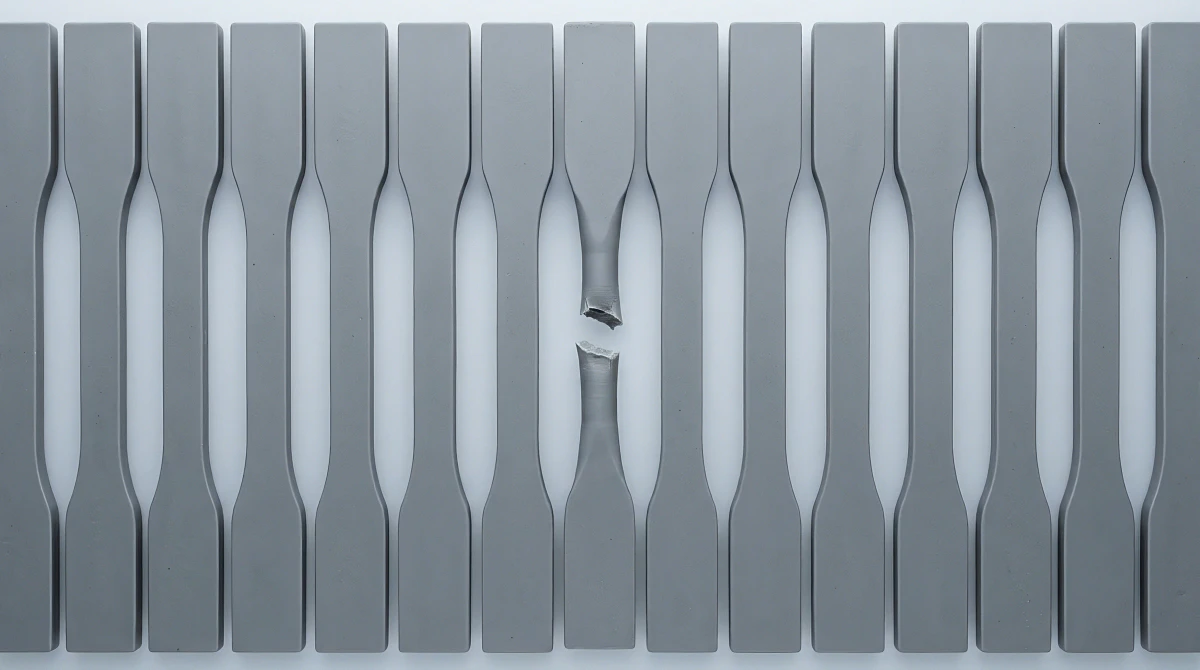
A tensile value on a casting resin sheet belongs to standard bars after one stated cure, so a requirement on parts is set on bars cast and cured with the batch.

What ISO 527 Covers on a Casting Resin Data SheetISO 527 is the international method for tensile properties of plastics, and casting resins fall inside it. The scope of ISO 527-1, as published by the Estonian standards body, sets out the general principles for determining tensile strength, tensile modulus and other aspects of the stress and strain relationship under defined conditions.

Rubber-Like Polyurethane Resins From Shore 30 A to 90 A

A rubber-like urethane is specified by grade, hardness method and a tested service temperature, because hardness alone leaves strength and heat behavior open.

Rubber-Like Vacuum Casting Grades and the Hardness Each CoversRubber-like vacuum casting resins are two- or three-component polyurethanes that cure in a silicone mold to an elastomer, with a Shore A hardness chosen for the part. The variable-hardness systems reach the range by adding a third component to a fixed A:B pair.

PP-Like and PE-Like Polyurethane Casting Resins for Vacuum Casting

PP-like and PE-like urethanes trade stiffness for elongation by grade, and their heat figures depend on cure, so the first cast part is tested in its real duty.

What PP-Like and PE-Like Mean on a Casting Resin Data SheetA PP-like or PE-like grade is a two- or three-component polyurethane formulated so that a part cast in a silicone mold behaves, in hand and in a snap fit, more like polypropylene or polyethylene than like a stiff ABS replica. The makers say so in their own words.

When a Vacuum Cast Run Should Move to an Injection Mold

Silicone molds carry a pilot, and a hard tool follows once the quantity, colors and repeat orders outgrow a handful of tools.

Where Silicone Tools Stop and the First Injection Mold StartsInjection molds are rated in classes by the construction they are built to and the cycles they are expected to give. The classification belongs to the plastics industry's trade body, PLASTICS, formerly the Society of the Plastics Industry, and its own text was not opened for this piece.

Demolding and Post-Curing Vacuum Cast Parts

Each grade prints its own demold time and its own post-cure, and thin or long parts are supported in the oven while it runs.

Demolding Vacuum Cast Parts at 70 °CDemolding means opening the silicone tool and taking the copy out once the resin has gelled and hardened far enough to hold its form. In every sheet on file the tool stays at 70 °C (158 °F) in the oven for that time.

Heat Deflection Temperature of Cast Polyurethane Under ISO 75 and ASTM D648

Heat deflection temperature ranks materials under one loaded test and does not set a service ceiling, so it is read together with post-cure and part geometry.

Heat Deflection as One Loaded Bar TestThe test bends a bar under a fixed load while the temperature climbs, and it records the temperature at which the bar has deflected by a set amount. ISO 75-1 describes the general method for determining the temperature of deflection under load, with flexural stress applied in three-point loading.

Clear Polyurethane Casting Resin for Vacuum Casting

A clear polyurethane grade is chosen by section thickness first, and its post-cure has a printed ceiling that protects the color of the part.

How Clear a Casting Resin Is in Datasheet NumbersOn a datasheet, clear is a claim with two numbers behind it at most. PX522 is described as water clear, with a coefficient of light transmission of 89 percent measured by the laboratory LNE, and PX523 prints a refractive index of 1.511.

ABS-Like Polyurethane Casting Resins for Vacuum Casting

An ABS-like polyurethane resin is a stiff thermoset named for its use, and its datasheet numbers depend on post-cure, thickness and test method.

Why a Polyurethane Resin Is Called ABS-LikeThe phrase is a maker's shorthand, not a standard. Sika describes its SikaBiresin PX331 as having mechanical properties similar to thermoplastics like filled ABS, and Renishaw lists its 6230 as having properties similar to ABS.

Send the Drawing of Your Cast Part

Send the 2D drawing and the 3D file, with the quantity and the stage of the project. An engineer replies within 1 working day.

The quote form, the mutual NDA and the private folder for your files are on Protolis Atelier, with Vacuum Casting chosen.

Request a Quote