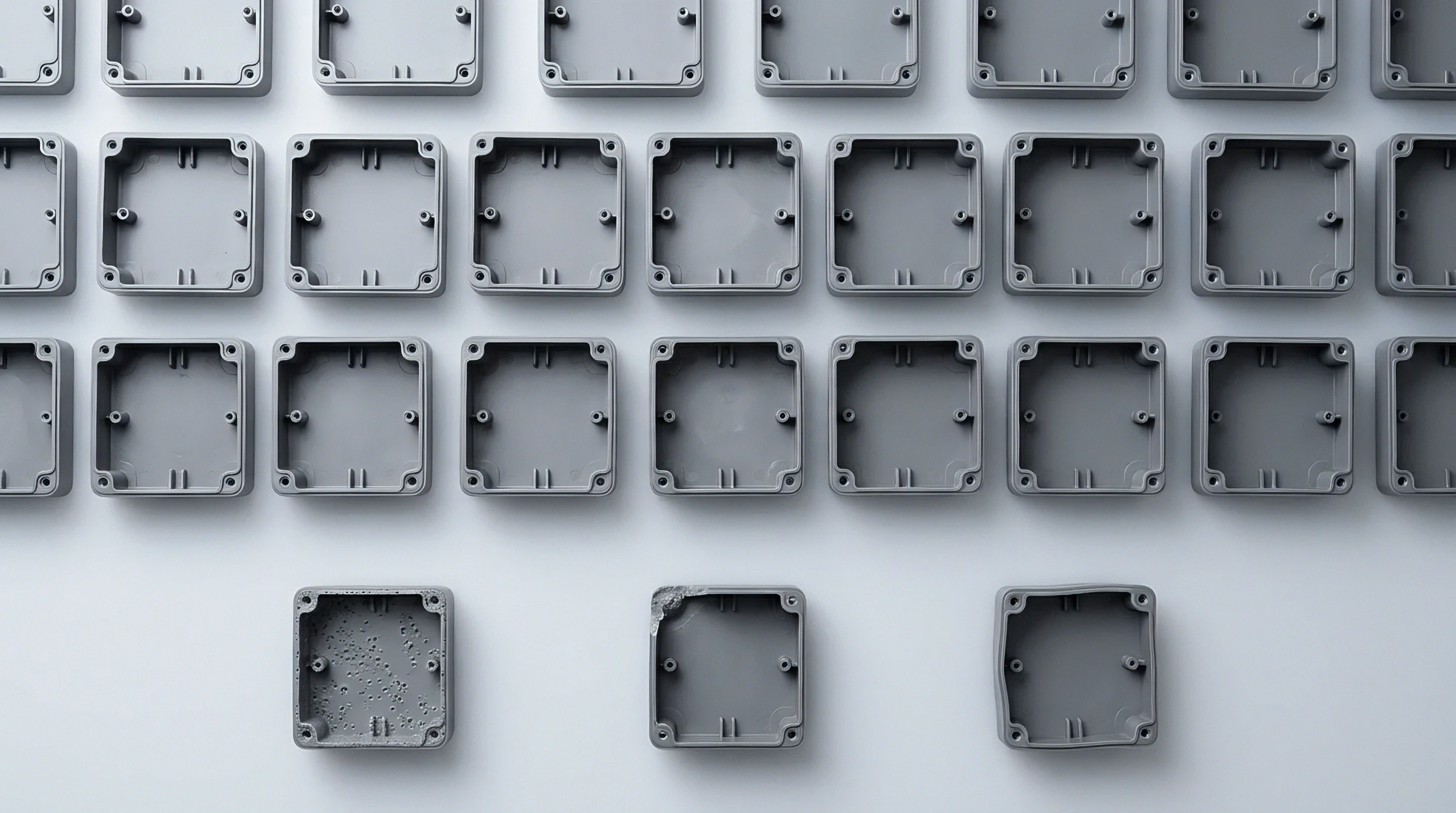
At 20 mbar (0.29 psi), a bubble already in the resin grows to about 50 times its size. A 2025 thesis from Aalto University on bubble formation in cast polyurethanes cites that figure from earlier work, and it explains a defect every casting room has seen: a batch that degassed well yesterday comes out pitted today, because air was folded into the mix before the vacuum reached it. The vacuum did not create the bubbles. It made them large enough to see.
A list of casting defects is only useful when each one points back to a cause, and in a batch the cause often depends on where in the run the defect appears. Some faults show on the first casting and repeat on every one.
Others appear on one pour and vanish on the next. A third group creeps in as the silicone mold ages. This piece sorts the defects of vacuum casting that the makers’ sheets and the published studies describe, by what causes them and by when they show up in a run.
The List of Casting Defects and the Cause Behind Each
Vacuum casting defects trace to six causes: moisture in the components, air folded in during mixing and pouring, a mixing ratio upset by weighing or crystallization, a mold or master fault copied into every part, a cure or demold cut short, and a silicone mold wearing out over the run. The table pairs the defects named in the opened documents with those causes and with what a buyer or inspector sees.
| Defect seen on the part | Cause | Sign that points to it | Documents |
|---|---|---|---|
| Fine bubbles through the section, or foam | moisture in polyol or isocyanate reacting to carbon dioxide | worse on humid days; isocyanate cloudy or with solids in the can | ResinLab; Aalto thesis; Loughborough guide; Polytek |
| Bubbles at the surface or near the top of the part | air folded in during mixing or pouring, expanded by the vacuum | varies from pour to pour; worse with fast or splashing mixing | Aalto thesis; Renishaw sheets; Loughborough guide |
| Unfilled corner or short shot | too little resin head, missing riser, pot life exceeded, resin too viscous for a thin wall | same place on several parts, or a whole late pour | Loughborough guide; Aggenbacht dissertation |
| Soft, tacky or uncured areas | mixing ratio off (cup loss, small batch), crystallized component, unmixed streaks | whole pour affected; can shows crystals | Renishaw sheets; Sika sheets; Aggenbacht dissertation |
| Hazy clear part or poor cure at the surface | condensation-cure silicone leaving residual alcohol | clear grades only, every part from that mold | Polytek Poly-Optic bulletin |
| Distortion or warp | demolded too soon, part unsupported in post-cure, exotherm in a thick section | thin or heavy parts; worse after post-cure | Polytek bulletins; Sika PX 223 HT; Loughborough guide |
| Step or flash at the split line | parting tape thickness, soft silicone, mold halves not held firmly | at the parting line of every part | Aggenbacht dissertation |
| Pitted or rough surface on every part | master surface defects, too much release agent | identical on each casting from one mold | Aggenbacht dissertation |
| Defects that grow late in the run | silicone hardened and degraded by the resin | parts worsen with copy number; mold stiff or cracking | Loughborough guide; Renishaw sheets and brochure; Smooth-On |
Read across, the table has a useful property for a buyer looking at a reject pile: the position of the defect on the part and its pattern across the batch separate the causes. A defect in the same place on every part is in the mold or master. One that appears on a single pour is in that pour’s resin. A defect that grows with the copy number is the mold wearing.
Where a defect sits on the part, and on which castings of the batch it appears, separates the causes: the same place every time points to the mold or master, one pour points to that pour’s resin, a steady rise points to a tired mold.
Moisture Bubbles and How They Are Recognized
Moisture is the chemical cause of bubbles, and ResinLab’s technical bulletin on moisture contamination of polyurethanes describes the reaction plainly. Polyols and isocyanates both absorb moisture from the air; when the isocyanate meets water, it forms carbon dioxide and amines, and the gas leaves bubbles in the cured material, or foam if the water content is high enough.
The same bulletin tells an inspector what to look for before the pour. Moisture-contaminated isocyanate may look cloudy, may hold solid material at the bottom of the can, or may grow a solid layer on top. A contaminated polyol, by contrast, usually looks no different from a dry one, so its moisture is found by its effect on the casting.
The Aalto thesis by Fredrik Parvinen, reviewing the literature, gives the thresholds that published work sets: a polyol moisture above 1,000 ppm has a drastic effect on bubble formation, and lower levels around 300 ppm are recommended to prevent bubbles. Loughborough University’s vacuum casting guide gives the casting-room version, noting moisture problems with one ABS-like resin in high humidity, leading to excessive foaming, and recommending dry nitrogen sprayed into containers before the lids are closed.
The makers write the same precaution into their sheets. Renishaw states that its resin components are sensitive to humidity and asks for opened cans to be kept in an oven at 40 °C (104 °F) with their caps on. Polytek warns that atmospheric moisture after opening may cause foaming, and suggests a dry gas to displace moist air before resealing; its bulletins also ask for metal or plastic mixing tools, because paper or wood can bring moisture in. ResinLab adds that fillers are oven-dried and batches mixed under vacuum or nitrogen in its own production.
Humidity also slows the cure. The 2004 vacuum casting dissertation from the Central University of Technology, Free State, records that during periods of high relative humidity the curing time is prolonged.
Air Bubbles From Mixing in Vacuum and Pouring
Air is the physical cause, and it enters at every handling step. The Aalto thesis lists the stages where air is trapped: preparation and mixing, pouring, vacuum treatment and curing. Fast stirring or a badly fitted mixer creates vortices and cavities that hold bubbles; a poorly placed inlet traps air in the mold; and as the resin thickens during cure, bubbles still rising are locked in.
The vacuum works against air only when the order is right. Through Henry’s law, the thesis explains that dissolved gas falls with pressure, and that bubbles already present grow as the pressure drops. Hence the figure in the opening: 50 times larger at 20 mbar (0.29 psi). It reviews work at 5, 15 and 50 mbar (0.07, 0.22 and 0.73 psi), with the strongest bubble removal below 5 mbar, a level the thesis calls very hard to reach industrially.
| Item | Figure | Source |
|---|---|---|
| Component degassing before mixing | 10 minutes after reaching full vacuum (8040, 8045); 10 to 15 minutes, with 30 minutes primary degassing listed (8060-2) | Renishaw sheets |
| Mixing | pour cup A into cup B, mix as fast as possible without splashing; 30 to 60 s (8040), 30 to 40 s (8060-2), about 45 s (PX 223 HT) | Renishaw; Sika |
| Calming a mix that still gives off air | a pressure shot of 50 mbar (0.73 psi) into the chamber | Aggenbacht dissertation |
| During the pour | a fast leak of about 25 % as the resin leaves the cup, then full release once resin rises in the vents | Loughborough guide |
| Resin head | part mass plus sprues plus at least 30 % | Loughborough guide |
| Pressure range in the literature | 5 to 50 mbar (0.07 to 0.73 psi); best removal below 5 mbar | Aalto thesis |
| Pouring technique | thin stream, resin flowing along the mold wall | Aalto thesis |
| Vibration during casting, as a remedy in the literature | 5 to 50 Hz | Aalto thesis |
Polytek’s help page on vacuuming describes what happens at full vacuum, about 29 to 30 inches of mercury on its gauge: the mixed material rises and foams, then the bubbles break and the mass falls, and it is held under vacuum for another 2 to 3 minutes. Its container rule, about four times the volume being degassed, matches the dissertation’s five times for silicone. A mix degassed in too small a cup boils over and is pulled from the chamber early, with its air still in it.
Air enters the mix at stirring, pouring and curing. Degassing the components before they meet, mixing fast without splashing, and pouring in a thin stream keep bubbles small enough that the vacuum removes them rather than enlarges them.
Short Fills, Soft Spots and Distortion
Three further defects are process faults with clear signatures.
A short fill, a cavity corner that resin never reached, usually traces to the resin head or the venting. Loughborough’s guide advises at least 30 % extra material to keep a head of resin in the feed pipe and hopper, a feed at the lowest point of the mold, and a tape fence on top of the mold to catch resin overflowing from the vents. The dissertation adds risers of 2 to 3 mm (0.08 to 0.12 in) at the highest points, drilled at 3 mm afterward where air gathers, and warns that thin walls may not fill if the resin is too viscous for them. A fill that fails on a late pour of the day may simply be a pot life exceeded.
Soft or uncured areas trace to the mix ratio. The dissertation explains that some resin always stays behind in the smaller cup when it is tipped, so about 5 g (0.18 oz) extra is weighed in to compensate, and that below about 50 g (1.8 oz) of resin the loss upsets the ratio enough to change the material’s properties. Renishaw asks for the same allowance for cup loss. Crystallization is the other ratio thief: Renishaw tells users to heat a crystallized B component at 70 °C (158 °F) for 2 to 4 hours and stir it, and Sika’s elastomer sheets ask for crystals to be melted out by heating before use, then the component cooled to processing temperature.
Distortion traces to the cure. Polytek’s bulletins warn that parts demolded too soon may be subject to deformation, and that thin sections cure more slowly than thick ones. Its clear-resin bulletin adds that exothermic heating can cause distortion, waviness and shrinkage, especially in castings thicker than 12.7 mm (0.5 in). Sika’s PX 223 HT sheet asks for the part to be supported in the oven during post-cure to keep its shape, and Loughborough lists warping when parts are not cured properly among the disadvantages of the process.
Mold and Master Defects That Repeat on Every Part
Some defects are not in the pour at all. They are in the mold, and the mold copies them faithfully onto every casting.
The dissertation names several. Deficiencies in the master’s surface are reproduced in the part. Parting tape of about 150 µm (0.006 in) leaves an error of its own thickness.
Too much release agent in the mold affects both the surface finish and the strength of the casting. The relatively soft silicone available for its experiments left clear parting lines on the parts, which in turn affected the measured dimensions. And a silicone mold left in the vacuum chamber after its pot life ends forms bubbles under its top surface that stay there.
Clear parts add one more. Polytek warns that condensation-cure silicones are not recommended for its clear Poly-Optic resins, because residual alcohol can inhibit cure or produce hazy castings. A hazy clear part, every time from one mold, points to the silicone, not the resin.
These defects are cheap to find and expensive to ignore. They show on the first casting, they repeat on every copy, and the only correction is a new mold, or a reworked master and a new mold.
Defects That Grow Over the Run as the Mold Ages
A silicone mold is a consumable, and its wear shows in the parts. Loughborough’s guide explains the mechanism: the polyurethane resins chemically affect the silicone, making it increasingly hard and stiff until it breaks, cracks or crumbles. It expects typically no more than 20 moldings from one mold. The Free State dissertation cites the same order, about 20 components per RTV mold depending on complexity, while Renishaw’s brochure states that its molds can produce up to 50 parts before retooling and that typically 30 to 50 color-matched parts come from a single mold.
The makers name what extends the life and what shortens it.
- Release agent and timely demold. Renishaw’s resin sheets say mold life increases with the correct release agent and with demolding the casting immediately after curing.
- No release agent. Smooth-On states that casting urethane resin in a silicone mold without release agent cuts the mold’s production life by half.
- Resin choice. Sika describes PX 223 HT as having low aggressiveness against silicone molds, and PX840 likewise.
- Silicone choice. Sika offers a catalyst for its SI291 silicone that makes it self-bleeding, advised to increase the number of parts from one mold.
- Oven time. The dissertation warns that a mold left too long in the oven with resin may be damaged.
For a batch, this sets the inspection rhythm. A defect that appears at copy 18 and grows at copy 22 is the mold telling the room it is near its end, and the number of copies a silicone mold gives is planned with that end in view.
Mold wear is a defect with a schedule. Guides on file expect about 20 copies and makers up to 50, and release agent, prompt demolding and a gentle resin move a mold toward the higher figure.
Inspecting a Vacuum Cast Batch for These Defects
The time structure of the run makes inspection straightforward. Loughborough estimates about 2 hours per molding including an oven cure of around 45 minutes, and the 2020 Malaysian study by Mustafa and co-authors totals about 2.22 hours of preheating, vacuum and curing per casting. Each casting is a separate pour, so each can be checked before the next.
- First casting from each new mold. Checked whole: surface against the master, parting line, fill at every corner and riser, dimensions. Mold and master defects show here or not at all.
- Every pour. A quick look for bubbles and soft spots, since moisture and mixing faults belong to one pour. A fault here sends the room back to the cans and the vacuum log, not to the mold.
- Every resin lot and every humid day. A check of the isocyanate’s clarity in the can, the signs ResinLab describes.
- Late in each mold’s life. A closer look at copy numbers approaching the mold’s expected life, for tears, stiffening and growing flash.
- After post-cure. A flatness or shape check on thin or heavy parts, since distortion can appear in the oven rather than in the mold.
Recording which mold and which pour each part came from turns a reject into a diagnosis. For runs of tens to a few hundred parts, where each pour is its own small batch, that record is part of low-volume vacuum casting, and it carries straight into bridge production, where the defect history of each mold helps decide when the hard tool takes over.
Sources and Further Reading
- F. Parvinen, Mekaniska och kemiska processparametrarnas inverkan på bubbelformning vid formgjutning av polyuretaner (effects of mechanical and chemical process parameters on bubble forming in mold casting of polyurethane), bachelor’s thesis, 2025, Aalto University
- Moisture contamination of polyurethanes, technical bulletin, 2021, ResinLab
- What is vacuuming and why should I do it?, Polytek Development Corp.
- Poly-Optic 14-Series casting resins, technical bulletin, Polytek Development Corp.
- Kast-Series urethane resins, technical bulletin, Polytek Development Corp.
- Poly 15-Series liquid plastics, technical bulletin, Polytek Development Corp.
- Development and evaluation of a vacuum casting process, F. C. Aggenbacht, M.Tech. dissertation, 2004, Central University of Technology, Free State
- Vacuum casting in the Loughborough Design School, a guide for final year students, R. Bibb, Loughborough University
- Data sheet: vacuum casting resin 8040, H-5800-0060-03-A, Renishaw
- Data sheet: vacuum casting resin 8060-2, H-5800-0597-03-A, Renishaw
- Data sheet: polyurethane resin 8045, H-5800-0802-04-A, Renishaw
- Brochure: Vacuum casting systems, H-5800-0110-03-A, issued 10.2017, Renishaw
- PX 223 HT, technical data sheet, version 01, February 2021, Sika
- SikaBiresin UR350 UR360, product data sheet, version 01.01, 12-2025, Sika
- Move your business forward with SikaBiresin and SikaBlock solutions, tooling and composites, Sika
- What paint should I use and how can I make paint stick to my resin castings? FAQ 141, Smooth-On
- N. N. Mohd Mustafa et al., Comparison of different additive manufacturing patterns on the performance of … vacuum casting for mating parts via the Taguchi method, Journal of Mechanical Engineering and Sciences 14(1), 2020, Universiti Malaysia Pahang