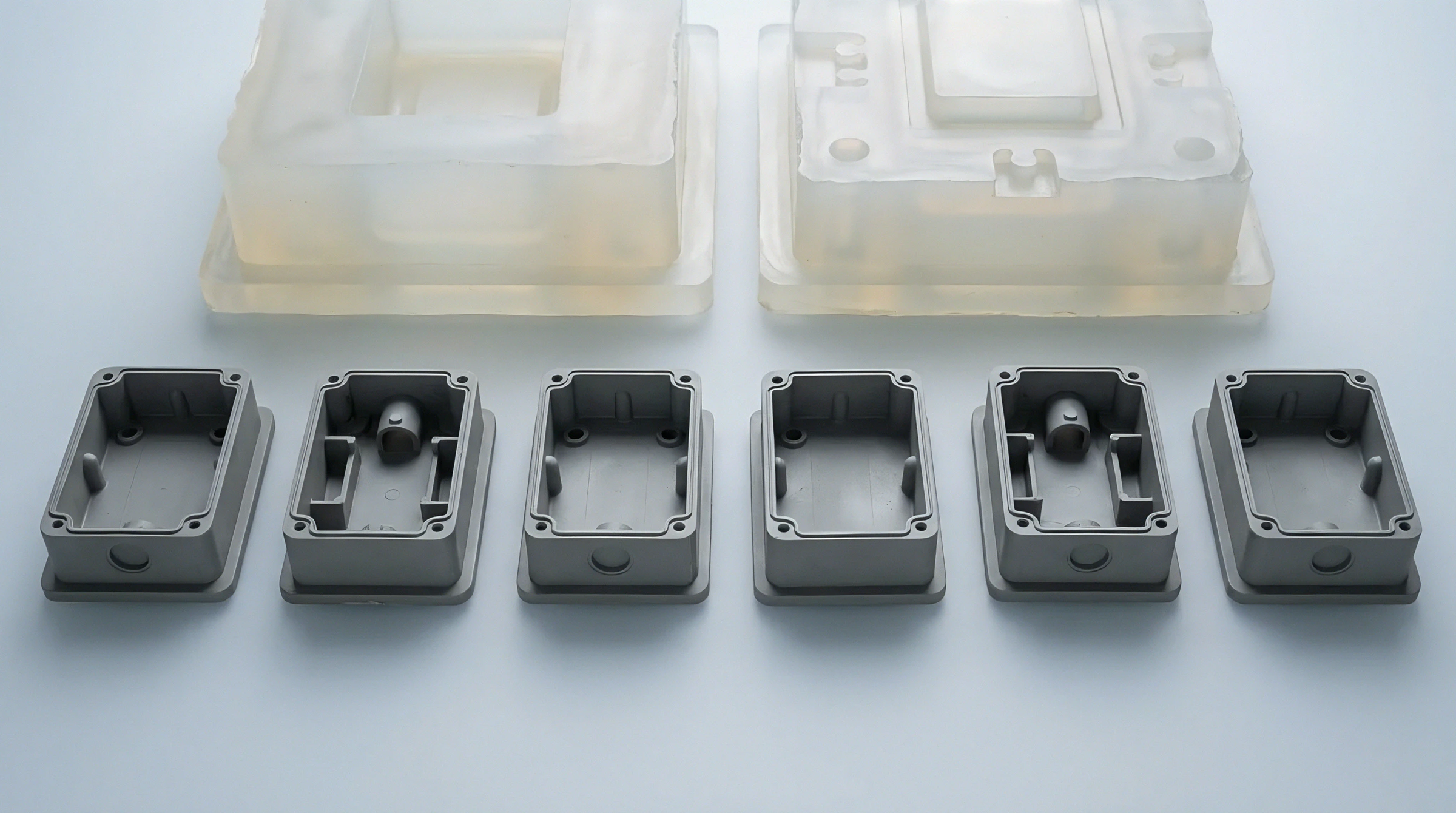
Renishaw’s brochure for its vacuum casting systems gives the answer in two sentences that do not quite agree. One says molds are capable of producing up to 50 parts before retooling is required. The other says that typically between 30 and 50 colour matched parts can be produced from a single mold. Read together, one is a ceiling and the other a working range, and the gap between them (and the lower figures that appear when the resin or the geometry is unkind) is the whole subject of this piece.
A silicone tool is not a hard tool with a fixed life. It is a rubber cavity that is heated to 70 °C (158 °F), filled with a reactive liquid, opened by stretching, and closed again, and every one of those steps takes something from it. How much is taken depends on the resin, the shape of the part, the care with which the tool is opened and the standard the copy is held to.
The Published Figures and What They Count
The first thing to read is who counted. Makers who publish a figure sell vacuum casting systems, resins or silicone, and each states its number as a typical value or a maximum, never as a guarantee. A buyer who reads three of them gets three words for the same thing: up to, typically, about.
| Statement | Figure | Condition stated | Source |
|---|---|---|---|
| mold capable of producing | up to 50 parts before retooling | none given | Renishaw, vacuum casting systems brochure, 10.2017 |
| typical output from one mold | 30 to 50 colour matched parts | colour matched; first parts within 24 h | Renishaw, same brochure |
| one silicone mold | about 50 casts | general guide | Formlabs, Guide to Vacuum Casting |
| mold in high-temperature-vulcanizing silicone | 300 to 500 casts | the same guide’s claim for HTV silicone | Formlabs, same guide |
| silicone mold resistance | outstanding resistance to casting resins, particularly polyurethanes and epoxies; no count given | ELASTOSIL M 4645 A/B product page | Wacker Chemie |
Two points stand out. The Renishaw wording includes the words “colour matched”, which makes the 30 to 50 a count of copies that look alike, and not only a count of copies that came out of the tool. And the Wacker page, written by a silicone maker, links the resistance of its silicone to a long mold life without printing a number, which is what a maker does when the figure depends on a resin it does not control.
A published copy count is a ceiling set by the best case, and the case a buyer has in hand is set by the resin, the geometry and how often the tool is opened.
Why the Count Is Per Tool and Not Per Master
Each tool is cast fresh from the master, and each is a separate cavity. A copy from the third tool is a first part in the metrological sense: its dimensions are not guaranteed to match a copy from the first tool, because the silicone, its cure and the position of the master in the frame all differ slightly. The count on a datasheet is therefore a count for one tool, and a batch of 150 parts spread over four tools is four sets of first parts, not one long run.
What Happens to the Tool at Each Pour
A pour costs the silicone three things: heat, chemical contact and mechanical stretch. Each can be put on a figure from a maker’s sheet, and none of them is the whole story.
Heat at 70 °C Every Time
Every resin sheet on file asks for a mold temperature of 70 °C, and the tool stays at that temperature through the demold time. The time added to the tool per copy is therefore the demold time of the grade.
| Grade and demold time | Copies | Oven hours at 70 °C |
|---|---|---|
| Renishaw 6230, 25 to 60 min | 30 | 12.5 to 30 h |
| Renishaw 8263, 60 min in the mold | 50 | 50 h |
| Renishaw 8020-2, 90 min in the mold | 30 | 45 h |
| Sika PX331, 45 min (above 3 mm) | 50 | 37.5 h |
| Sika PX331, 75 min (below 3 mm) | 50 | 62.5 h |
| Sika PX523, 3 h (below 5 mm) | 50 | 150 h |
The arithmetic is only the demold time times the copy count, and it leaves out the preheat before each pour. Results run from about 12 hours up to 150 hours at 70 °C, depending on the grade. A resin that demolds quickly leaves the silicone in the oven for a fraction of the time that a slow-demolding one does, at the same number of copies. Renishaw’s sheets tie demolding the casting immediately after curing to a longer mold life, which agrees with that arithmetic.
Chemical Contact
The resin is a reactive liquid in contact with the silicone for the pot life and the cure. Sika describes PX 223 HT as having low aggressiveness against silicone molds, and Wacker advertises resistance to casting resins as the feature that extends mold life, which tells a buyer that grades differ in how hard they are on the tool. The PX522 sheet goes further and says to cast it in a new mold without casting resin previously inside, so a clear grade asks for a tool that has never held another resin.
Sika’s sheets add a general caution that tests under actual processing conditions with release agents have to be performed to prove material compatibility. The maker is saying that the combination of resin, silicone and release agent is the thing being tested, not any one of them.
Mechanical Stretch at Every Opening
Opening the tool stretches the silicone around the part and, at every undercut, through it. Vacusil 2000, the mold silicone in Renishaw’s range, prints a hardness of 37 Shore A, a tensile strength of 4.5 MPa, an elongation at break of 380 % and a crescent tear strength of 32 N/mm. Those are the limits of a single pull.
A rough case shows how far a pull sits from the limit. Take a lip of silicone that has to pass through a 2 mm undercut on a 10 mm bridge is strained by about 20 % across that bridge if all the stretch is taken there, far below 380 %. The sheet prints no fatigue figure, so how the tool behaves after the thirtieth such pull is not on it. That illustration is simple geometry and a published limit, and it makes one point only: the tear limit is not the one reached first, and wear from repeated stretching is the thing the count describes.
Each copy exposes the tool to 70 °C for the demold time, to the resin for the cure, and to one full opening, and the published count is the number of times the tool has been seen to survive all three.
The Factors That Move the Count
A short list of what shifts the number up or down is easier to use than any single figure, provided it states how much each factor is backed by a published source and how much is reasoning from the three exposures above.
| Factor | Direction | Backing |
|---|---|---|
| release agent as the maker names it | longer life | stated on Renishaw 6230, 8263 and 8020-2 sheets |
| demolding immediately after curing | longer life | stated on the same Renishaw sheets |
| resin aggressive against silicone | shorter life | implied by Sika’s note on PX 223 HT and Wacker’s resistance claim |
| long demold time at 70 °C | shorter life | follows from the oven hours in Table 2 |
| undercuts and deep ribs in the part | shorter life | reasoning from the stretch at each opening |
| clear grade needing an unused tool | fewer copies from a tool | stated on the PX522 sheet |
| HTV silicone in place of the usual silicone | longer life | Formlabs guide, 300 to 500 casts |
| colour match required | fewer acceptable copies | Renishaw wording “colour matched” |
None of the entries is a measured exchange rate. The honest reading is that a buyer can rank the factors but cannot price them from public documents, and a supplier that quotes a count is quoting its own experience with its own resins and silicone.
Tool Count at the Low End and the High End
The same batch draws a different tool plan from each figure on the table. A batch of 120 copies needs 3 tools at the Renishaw ceiling of 50 and 4 tools at the 30 that opens its working range. Asking a supplier for the count it plans with, and for the resin and the color that the count was taken on, is asking for the one number that sets how many first parts to expect.
Where the Tail of the Run Goes
The last copies from a tool are the ones that go wrong first. Fine detail can be expected to soften, the parting line to show more flash, and a tear to start at the thinnest silicone wall. That is reasoning from the three exposures above, not a published sequence, and the way to see it is to compare the first and last copy of each tool rather than to take the average. A supplier that retires a tool when the last copies differ from the first by more than the drawing allows is working to the right rule.
What the Silicone Itself Brings to the Count
Wear is measured from the starting point the rubber sets. The Vacusil 2000 sheet prints the following for the cured silicone, and every figure is a property of the new tool and not of the tool after its fortieth pour:
- hardness 37 Shore A, tensile strength 4.5 MPa (about 650 psi), elongation at break 380 %,
- crescent tear strength 32 N/mm (about 183 lbf/in), specific gravity 1.08 g/cm³ (about 67 lb/ft³),
- mixed viscosity 45,000 mPa·s at 23 °C, pot life 90 minutes, cure 24 hours at 23 °C.
Other sources sit near that hardness. Wacker lists a medium Shore A hardness of approximately 40 for ELASTOSIL M 4645 A/B and describes a fast, non-shrink cure at room temperature that heat can speed up, and the Formlabs guide recommends 40 to 50 Shore A for mold silicone. In general a harder silicone supports a thin feature better and a softer one gives way more easily around an undercut. Where the sources agree is on the range, 37 to 50 Shore A, and not on a single best value.
The silicone’s mix and cure are themselves a daily source of variation. Vacusil 2000 is an addition-cure silicone, and its sheet lists water, sulphur, amine, organometallic and phosphorus compounds among the materials that can inhibit cure, with condensation-cure silicones, clays, adhesive tapes, waxes and paints named. A tool whose cure was slightly inhibited starts its life weaker than the sheet, and a patch test before the pour is the maker’s own guard against that.
Evidence a Buyer Can Ask For From the First and Last Copy
Comparing the first and the last copy of each tool turns the count from a promise into a measurement. A first article from each tool is kept, the last copy before the tool is retired is kept, and a named feature is measured on both. If the feature has moved by less than the drawing allows, the tool was retired with room to spare, and if it has moved by more, the count that tool earned is the number that went before. The records are cheap to keep and they are the only way to turn a supplier’s count into one for the parts on the order.
The Tool Count a Batch Inherits
A list of what a buyer can write into a request turns the count into a plan:
- the number of copies per tool the supplier plans with, and the resin and color that number was taken on,
- the rule for retiring a tool, such as a visible defect or a measured drift on a named feature,
- whether the first and last copy of each tool are inspected and kept,
- whether a different grade or color in the batch gets its own tool, as PX522 asks,
- who keeps the master between deliveries, since a repeat order starts from the master and not from the old tool.
Master Reuse and a Repeat Order
A silicone tool does not wait on a shelf for the next order. Its copies are normally spent on the first order, so a repeat order starts from the master and makes new tools. The master is therefore the asset that carries between deliveries, which is the reason to settle who holds it. Silicone tools themselves are consumables.
Copies per Tool When the Color Changes
Renishaw’s resin sheets limit pigment to no more than 2 % of the total weight for 6230 and 8263 and 1 % for 8020-2, and the 8020-2 sheet carries a minimum shot weight of 150 g. A color change within a batch is a separate pour with its own pigment, and Renishaw counts its 30 to 50 as colour matched parts, so a batch split into three colors reads, in tool terms, as three batches. When the quantity needs more tools than the schedule can absorb, the count is also the point where a program looks at an injection mold instead, whose steel is built once for many thousands of shots.
Reading the Number for a Real Quantity
Take a batch of 100 parts in one resin and one color. At the Renishaw working range of 30 to 50 copies, that is 2 to 4 tools. If the part has deep undercuts, or the resin is one that the maker rates as aggressive against silicone, a plan built on the lower end and a spare tool is the cautious reading, and a plan built on the ceiling leaves no room for the last tool failing early. With a clear grade, the new-mold condition on the PX522 sheet adds a tool for each lot of resin.
At some quantity the count of tools stops being a detail. A request in the hundreds already needs ten or more tools, each with its own silicone cure and its own first parts, and that is the point at which a buyer weighs low-volume vacuum casting against bridge production toward a hard tool.
Sources and Further Reading
- Renishaw, Brochure: Vacuum casting systems, issued 10.2017
- Renishaw, Data sheet: Vacusil 2000 silicone rubber, issued 10.2017
- Renishaw, Data sheet: vacuum casting resin 6230, issued 09.2015
- Renishaw, Data sheet: vacuum casting resin 8263, issued 05.2015
- Renishaw, Data sheet: vacuum casting resin 8020-2, issued 04.2018
- Sika, PX 223 HT, technical data sheet, version 01, 2021
- Sika, SikaBiresin PX523, product data sheet, version 01.01
- Sika, SikaBiresin PX331 and PX522 product data sheets, version 01.01 (08-2026), industry.sika.com
- Wacker Chemie, ELASTOSIL M 4645 A/B, room temperature curing silicone rubber (RTV-2)
- Formlabs, Guide to Vacuum Casting (Urethane Casting)