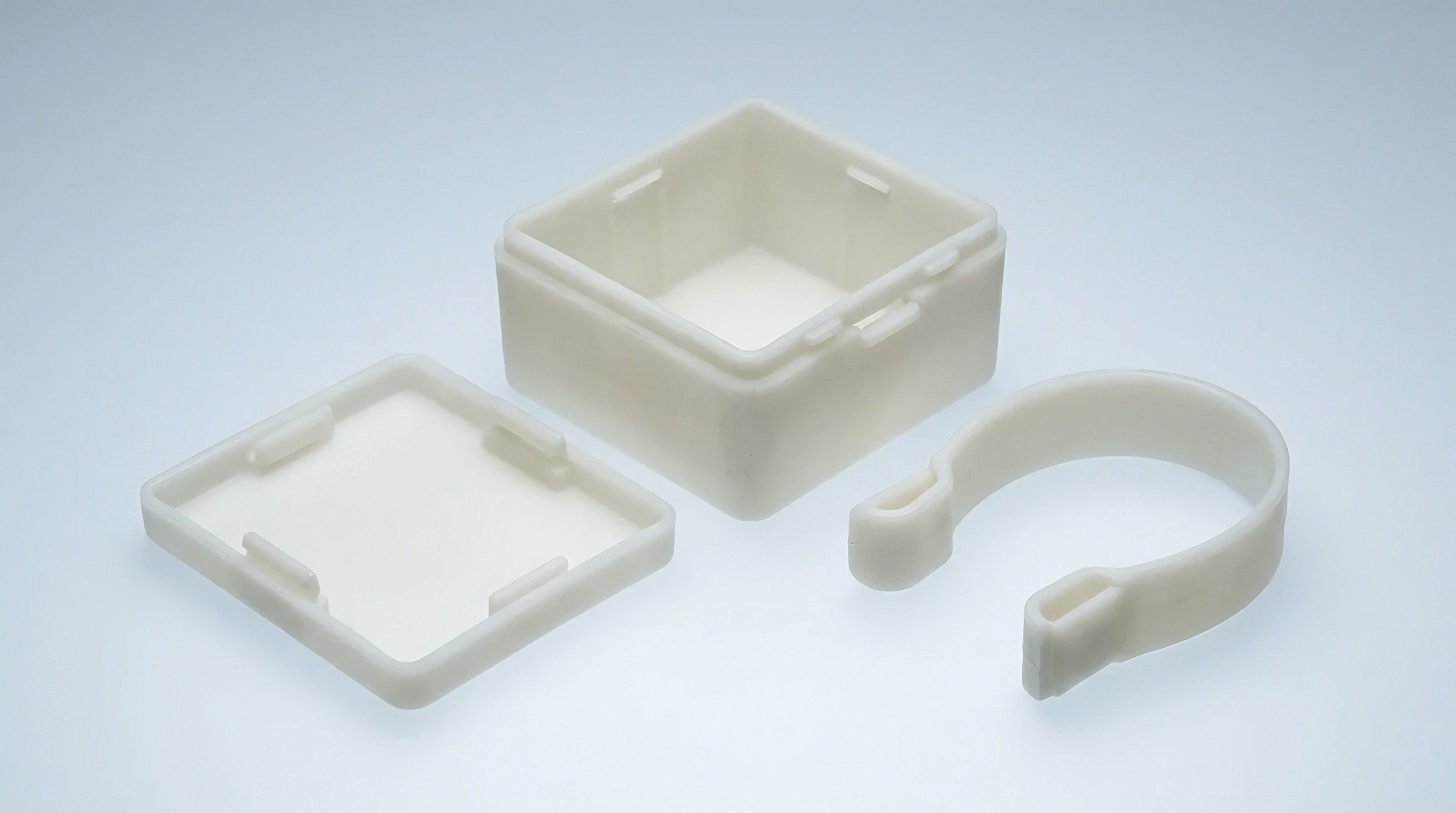
Four parts by weight of one extra liquid separate a Shore D 74 casting from a Shore D 48 casting. Renishaw’s 8045 sheet mixes its A and B components at 100:140 and then adds a C component at 0, 25, 50 or 75 parts. Across those four steps the tensile modulus falls from 970 MPa (141,000 psi) to 150 MPa (21,800 psi), and the label on the column moves from PP to PP/PE and finally to PE.
That single sheet explains most of what a buyer meets when a quote names a “PP-like” or “PE-like” urethane. The cast part is still a crosslinked polyurethane. Its names describe a target stiffness, hardness and toughness that the formulator has tuned toward the feel of a polyolefin, and each maker prints its own evidence for the claim under its own test conditions.
What PP-Like and PE-Like Mean on a Casting Resin Data Sheet
A PP-like or PE-like grade is a two- or three-component polyurethane formulated so that a part cast in a silicone mold behaves, in hand and in a snap fit, more like polypropylene or polyethylene than like a stiff ABS replica. The makers say so in their own words. Renishaw describes 8045 as a “translucent PP/PE type” suited to high impact and snap fit applications, 8060-2 as a grade that simulates PP/PE, and 8040 as a low viscosity material similar to polypropylene. Sika lists SikaBiresin PX212 L5 for thermoplastic-like parts with a flexural modulus close to filled PP.
None of those sheets claims the cast part is a polyolefin. Each prints hardness, tensile, flexural and impact values measured on cured specimens, and those values are the only basis for comparison. A dissertation from the Central University of Technology, Free State, summarizing Huntsman’s vacuum grades in 2004, shows the same habit of naming: Ureol 5232 simulates PE/PP, Ureol 5233 simulates PP, and Ureol 5234 and 5235 simulate a blend of PP and ABS.
What the labels share is a position on the stiffness scale. Rigid ABS-like vacuum grades in Sika’s own range print tensile moduli of 2,400 to 4,500 MPa (348,000 to 653,000 psi) on PX522 and PX331. The PP-like and PE-like grades sit well below that, between about 150 and 1,225 MPa (21,800 and 178,000 psi), and they trade stiffness for elongation. These grades exist because the production part is usually injection molded in polypropylene or polyethylene, and the cast copies let a team test the feel and the fit before that tool is cut.
PP-like and PE-like are formulators’ targets, not polymer families. The cast part stays a polyurethane, and the sheet’s measured values, under their stated test methods, carry the comparison.
The Renishaw 8045 Family and the C Component That Sets Hardness
The 8045 system is the clearest case in the open literature of one resin covering both labels. Its A and B components stay fixed at 100:140 by weight. A C component is weighed into the same cup as the A component, at 25, 50 or 75 parts, and the cured part softens step by step.
| Property (standard) | 8045 (PP) | 8045-1 (PP/PE) | 8045-2 (PP/PE) | 8045-3 (PE) |
|---|---|---|---|---|
| Mixing ratio A:B:C by weight | 100:140:0 | 100:140:25 | 100:140:50 | 100:140:75 |
| Hardness at 25 °C (77 °F), Shore D (ISO 868) | 74 | 70 | 61 | 48 |
| Tensile strength (ISO 527) | 32 MPa (4,640 psi) | 24 MPa (3,480 psi) | 12 MPa (1,740 psi) | 10 MPa (1,450 psi) |
| Tensile modulus (ISO 527) | 970 MPa (141,000 psi) | 700 MPa (102,000 psi) | 400 MPa (58,000 psi) | 150 MPa (21,800 psi) |
| Elongation (ISO 527) | 55 % | 60 % | 65 % | 75 % |
| Bending strength (ISO 178) | 43 MPa (6,240 psi) | 22 MPa (3,190 psi) | 11 MPa (1,600 psi) | 5 MPa (725 psi) |
| Bending modulus (ISO 178) | 1,000 MPa (145,000 psi) | 580 MPa (84,100 psi) | 300 MPa (43,500 psi) | 110 MPa (16,000 psi) |
| Impact strength (ISO 180) | 16 kJ/m² (7.6 ft·lb/in²) | 16 kJ/m² (7.6 ft·lb/in²) | 19 kJ/m² (9.0 ft·lb/in²) | 21 kJ/m² (10.0 ft·lb/in²) |
| Deflection temperature at 0.45 MPa (ISO 75-1) | 79 °C (174 °F) | 53 °C (127 °F) | 42 °C (108 °F) | 35 °C (95 °F) |
| Pot life, 100 g at 25 °C (3.5 oz at 77 °F) | 345 s | 320 s | 300 s | 270 s |
| Specific gravity at 25 °C | 1.07 | 1.07 | 1.16 | 0.99 |
Three trends run through the table, and a buyer choosing a grade trades along all of them at once.
- Stiffness drops faster than toughness rises. From 8045 to 8045-3 the tensile modulus falls to less than a sixth, while elongation rises only from 55 % to 75 % and Izod impact from 16 to 21 kJ/m² (7.6 to 10.0 ft·lb/in²).
- Heat resistance goes with stiffness. The deflection temperature at 0.45 MPa (65 psi) falls from 79 °C (174 °F) to 35 °C (95 °F). A PE-like 8045-3 part reaches its test deflection at a temperature only 12 °C (22 °F) above a 23 °C (73 °F) room.
- Working time shortens as the C component rises. The pot life of a 100 g (3.5 oz) mass at 25 °C (77 °F) runs from 345 s down to 270 s, which leaves less time to fill a large mold.
Renishaw’s combined resin chart adds one figure the single sheets leave out: a typical shrinkage of 0.4 % for all four 8045 grades, against 0.5 % for the 8060 grades. The chart labels the row “according to wall thickness”, so the figure belongs to the test geometry, not to every part.
On 8045, one fixed A:B pair and a variable C component span Shore D 74 to 48. Modulus, flexural strength and heat deflection fall together, so the softest PE-like grade is also the one with the lowest service temperature.
Stiffer PP-Like Grades for Heat and for Filled Polypropylene
Where the part replaces a heat-loaded or filled polypropylene, the makers offer stiffer grades that keep the polyolefin label but print very different heat figures. Renishaw’s 8060-2 is listed for automotive under-hood use. Its sheet prints Shore D 80 at 23 °C (73 °F), a flexural strength of 48 MPa (6,960 psi) and an Izod impact of 15 kJ/m² (7.1 ft·lb/in²). It also leaves tensile strength, modulus and elongation as “not measured”, a gap worth noticing before a snap fit is designed around it.
Renishaw’s 8040 sits between the two. Its sheet calls it a good all-round material similar to polypropylene, with excellent flow for thin-wall sections, and prints a full tensile set. Sika’s PX212 L5 comes from the other direction, a translucent grade described as close to filled PP and suited to automotive parts, with impact above 50 kJ/m² (23.8 ft·lb/in²).
| Property | Renishaw 8040 | Renishaw 8060-2 | Sika PX212 L5 |
|---|---|---|---|
| Maker’s description | similar to PP, thin walls | simulates PP/PE, high temperature | filled PP similarity |
| Hardness, Shore D | 70 at 23 °C (73 °F) | 80 at 23 °C (73 °F) | 76 |
| Tensile strength | 27 MPa (3,920 psi), ISO 527 | not measured | 40 MPa (5,800 psi) |
| Tensile modulus | 942 MPa (136,600 psi), ISO 527 | not measured | not printed |
| Elongation at break | 50 % | not measured | 25 % |
| Flexural strength | 42 MPa (6,090 psi), ISO 178 | 48 MPa (6,960 psi), ISO 178 | 80 MPa (11,600 psi) |
| Flexural modulus | 1,050 MPa (152,300 psi) | 1,010 MPa (146,500 psi) | 1,200 MPa (174,000 psi), printed as E-modulus |
| Impact | Izod 15 kJ/m² (7.1 ft·lb/in²), ISO 180 | Izod 15 kJ/m² (7.1 ft·lb/in²), ISO 180 | above 50 kJ/m² (23.8 ft·lb/in²) |
| Heat deflection | 65 °C (149 °F) | 90 to 110 °C (194 to 230 °F) | 78 °C (172 °F) |
| Glass transition | 78 °C (172 °F) | 105 to 132 °C (221 to 270 °F) | 90 °C (194 °F) |
| Mixing ratio by weight | A:B 110:90 | A:B 100:250 | A:B 100:100 |
| Pot life | 300 s, 100 g at 25 °C | 270 s, 100 g at 25 °C | 4 to 6 min |
| Typical shrinkage | 0.5 % | 0.5 % | not printed |
The 8040 sheet also prints Shore D hardness at three temperatures, which is rare and useful. Measured that way, the part reads D 70 at 23 °C (73 °F), D 64 at 60 °C (140 °F) and D 37 at 80 °C (176 °F). A grade with a heat deflection of 65 °C (149 °F) has lost almost half its surface hardness by 80 °C, which is the practical meaning of that heat figure for a housing or clip.
Sika’s brochure does not name the impact method for PX212 L5, and its tensile and flexural figures are given as approximate values. The Renishaw columns name ISO 527, ISO 178 and ISO 180. A buyer comparing the two columns is comparing two makers’ test programs, not one.
How Post-Cure Moves the Heat Figure on 8060-2
The 8060-2 range of 90 to 110 °C (194 to 230 °F) is not a tolerance band. Renishaw ties heat deflection to a post-cure of 60 minutes at a chosen temperature, and prints the pairs.
| Post-cure, 60 min at | Heat deflection temperature |
|---|---|
| 100 °C (212 °F) | 120 °C (248 °F) |
| 110 °C (230 °F) | 125 °C (257 °F) |
| 120 °C (248 °F) | 135 °C (275 °F) |
| 130 °C (266 °F) | 140 °C (284 °F) |
| 140 °C (284 °F) | 155 °C (311 °F) |
| 150 °C (302 °F) | 160 °C (320 °F) |
| 160 °C (320 °F) | 165 °C (329 °F) |
| 170 °C (338 °F) | 170 °C (338 °F) |
| 180 °C (356 °F) | 175 °C (347 °F) |
The heat deflection test piece on the sheet measures 110 mm × 12.7 mm × 6.4 mm (4.33 in × 0.50 in × 0.25 in). Two consequences follow for a purchase order.
First, a PP-like part that is to meet a heat figure carries its post-cure temperature on the drawing or the order, because the same resin spans more than 50 °C (90 °F) of heat deflection depending on it. Second, the printed figure is a material comparison. The ISO 75-1 scope, as published by the Estonian standards body, states that heat deflection results do not necessarily represent maximum applicable temperatures, because time, load and surface stress in service differ from the test. By contrast, the 8040 sheet states “None” for post-curing, so its 65 °C (149 °F) is what the cast part has.
Renishaw’s combined chart carries two sister grades as well. Where it prints 90 to 110 °C (194 to 230 °F) for 8060-2, it prints 105 to 175 °C (221 to 347 °F) for 8060-1 and 115 to 180 °C (239 to 356 °F) for 8060-3, all three at Shore D 80. Each of the three, read that way, spans a band of heat deflection rather than one value.
Heat deflection on a PP-like grade belongs to its cure. On 8060-2 the oven temperature of one hour’s post-cure moves the figure from 120 °C to 175 °C (248 °F to 347 °F), and ISO 75-1 keeps even that figure apart from a service limit.
Casting a PP-Like Grade in the Vacuum Chamber
The Renishaw sheets for 8045, 8040 and 8060-2 print almost the same handling procedure, and the differences are worth reading line by line. Their common steps run as follows.
- Shake the unopened A and B cans for 10 to 15 s, then warm them in an oven at 70 °C (158 °F) for 2 hours and move them to 40 °C (104 °F) to stabilize.
- Preheat the silicone mold to 70 °C (158 °F). The sheets note that exact mold and resin temperatures are important.
- Weigh A and B into separate cups, allowing for the resin left behind in cup A after tipping. On 8045 the C component goes into cup A with the A component.
- Add pigment to cup A, no more than 2 % of the total weight.
- Start the vacuum pump and the mixer motor, and wait 10 minutes after reaching full vacuum. The 8060-2 sheet asks for 10 to 15 minutes, and lists a primary degassing of 30 minutes.
- Pour cup A into cup B and mix as fast as possible without splashing: 30 to 40 s for 8060-2, 30 to 60 s for 8040.
- Fill the mold and let air back into the chamber before the pot life ends.
- Cure in the oven: 60 minutes at 60 °C (140 °F) for 8045, 90 to 120 minutes at 70 °C (158 °F) for 8040, and 60 minutes at 65 to 70 °C (149 to 158 °F) for 8060-2.
The pot lives in step 7 are short. At 270 to 345 s for a 100 g (3.5 oz) mass at 25 °C (77 °F), the whole sequence from tipping cup A to letting air in has to fit inside five or six minutes. The 2004 Huntsman summary shows the same order of working time for older PP-like grades: 4 to 5 minutes for 500 g of Ureol 5232 and 6 minutes for 500 g of Ureol 5233, both at 25 °C (77 °F).
Two handling notes on the Renishaw sheets matter for a batch. All components are sensitive to humidity, so opened cans are stored at 40 °C (104 °F) with their caps on. If the B component crystallizes, the can goes into the oven at 70 °C (158 °F) for 2 to 4 hours and is stirred afterward. The 8060-2 sheet adds that the product generates a high exotherm, which bears on thick sections.
Wall Thickness, Color and Shrinkage for PP-Like Parts
PP-like grades are often chosen for thin, flexing features, and the sheets give some limits. Renishaw recommends 8040 for thin-wall section molding because of its flow. The Huntsman summary lists a maximum wall thickness of 10 mm (0.39 in) for Ureol 5232 and 5 mm (0.20 in) for Ureol 5233, 5234 and 5235, which shows how differently two PP-like grades of one maker can be limited.
Color is usually cast in. The 8045 and 8060-2 sheets call the grades pigmentable and cap pigment at 2 % of total weight; the cured 8045 is white and the softer variants translucent, and 8060-2 cures slightly yellow and translucent. Renishaw’s 8040 cures white and opaque, which changes how a pigment reads in the finished part.
Shrinkage figures from Renishaw sit at 0.4 % for 8045 and 0.5 % for 8040 and 8060-2. Those values set the scale of the master, and the first-article check confirms it. For a PP-like housing with a snap fit, the useful habit is to ask which wall thickness the shrinkage figure was measured on, since the chart ties it to wall thickness.
A PP-like grade is cast inside a pot life of about five minutes, at a mold temperature the sheet fixes, with pigment capped at 2 %. Thin-wall flow and printed wall limits differ between grades as much as hardness does.
What the Data Sheet Leaves Open for a Snap Fit or Living Feature
The values in Tables 1 and 2 come from standardized specimens, and the standards themselves limit how far they carry. As published, the scope of ISO 527-2 covers rigid and semi-rigid thermosetting cast materials and prefers the multipurpose test specimen. In the same way, the ISO 180 scope states that the Izod method is not intended as a source of data for design calculations, and that specimens of different dimensions or notches can give results that are not comparable. ISO 178 says the same of flexural values, which serve material testing and quality control.
For a buyer, that leaves a short list of questions the sheet cannot answer.
- Cyclic flexing. No sheet on file prints fatigue or repeated snap fit data for a PP-like urethane. Renishaw’s brochure points to its nylon casting module for living hinges, which signals that the urethane grades are not offered for that duty.
- Behavior at temperature. Only 8040 prints hardness at 60 °C and 80 °C (140 °F and 176 °F). For the others, a part that will see heat is tested at that heat.
- Values the sheet leaves blank. 8060-2 prints no tensile figures. A design that depends on tensile modulus either uses a grade that prints it or measures it on cast bars.
- Comparability across makers. Sika’s brochure figures are approximate and do not name every method. A side-by-side table, like Table 2, compares two test programs.
The practical path is to choose the label from the stiffness and heat table, then cast a first article in the chosen grade and cure, and try the snap fit or flexing feature on it. Parts needed in dozens to a few hundred copies in these grades fit low-volume vacuum casting, and the same PP-like resins can carry a program through bridge production while a production tool for the polyolefin part is cut.
Sources and Further Reading
- Data sheet: polyurethane resin 8045, H-5800-0802-03-A, issued 04.2017, Renishaw
- Data sheet: polyurethane resin 8045, H-5800-0802-04-A, issued 04.2018, Renishaw
- Data sheet: vacuum casting resin 8060-2, H-5800-0597-03-A, issued 09.2015, Renishaw
- Data sheet: vacuum casting resin 8040, H-5800-0060-03-A, issued 04.2018, Renishaw
- Renishaw vacuum casting resins and silicone rubbers, H-5800-0030-07-A, Renishaw
- Brochure: Vacuum casting systems, H-5800-0110-03-A, issued 10.2017, Renishaw
- Move your business forward with SikaBiresin and SikaBlock solutions, tooling and composites, Sika
- SikaBiresin PX522 with PX521, product data sheet, Sika
- SikaBiresin PX331, product data sheet, Sika
- Development and evaluation of a vacuum casting process, F. C. Aggenbacht, M.Tech. dissertation, 2004, Central University of Technology, Free State
- EVS-EN ISO 178:2019, plastics, determination of flexural properties, scope, Estonian Centre for Standardisation and Accreditation
- EVS-EN ISO 75-2:2013, plastics, determination of temperature of deflection under load, part 2, scope, Estonian Centre for Standardisation and Accreditation
- EVS-EN ISO 75-1:2020, plastics, determination of temperature of deflection under load, part 1, scope, Estonian Centre for Standardisation and Accreditation
- EVS-EN ISO 527-2:2012, plastics, determination of tensile properties, part 2, scope, Estonian Centre for Standardisation and Accreditation
- EVS-EN ISO 180:2019, plastics, determination of Izod impact strength, scope, Estonian Centre for Standardisation and Accreditation