Riser

A riser is a vent channel from the highest points of a silicone mold cavity to the vacuum chamber, formed by a rod on the master, that lets trapped air escape and shows when the cavity has filled.

Every Riser article of the Vacuum Casting Resources, newest first, each written from published standards, research and makers’ data.

Meaning

A riser is a vent channel from the highest points of a silicone mold cavity to the vacuum chamber, formed by a rod on the master, that lets trapped air escape and shows when the cavity has filled. The Free State dissertation forms risers with brass rods of 2 to 3 mm (0.08 to 0.12 in) glued to the master, and drills more at 3 mm (0.12 in) through the cured mold where air gathers.

Vacuum Venting

The chamber never reaches a perfect vacuum, so some air remains. Risers give that air a path from every high point.
Read More

Pour Completion

Resin rising out of the risers signals that the mold is full. The dissertation pressurizes the chamber once resin flows from them, and Loughborough’s guide releases the remaining vacuum after resin rises through the vents, with a tape fence around the top of the mold to catch the overflow.

Resin Head

Loughborough’s guide advises weighing at least 30 % more resin than the part and its sprues need, so that a head of resin stands in the feed while the risers fill, and the master is sometimes tilted so the gate meets the lowest point of the cavity and the risers leave from the highest.

Riser Faults

A missing riser at a high pocket leaves a short fill or an air void in the same place on every casting. An insert placed in the mold creates new high points behind and under it, which may need risers of their own.

Witness Marks

Each riser leaves a small witness where it meets the part, trimmed after demold, so its position is chosen on the master with the part’s cosmetic faces in mind.
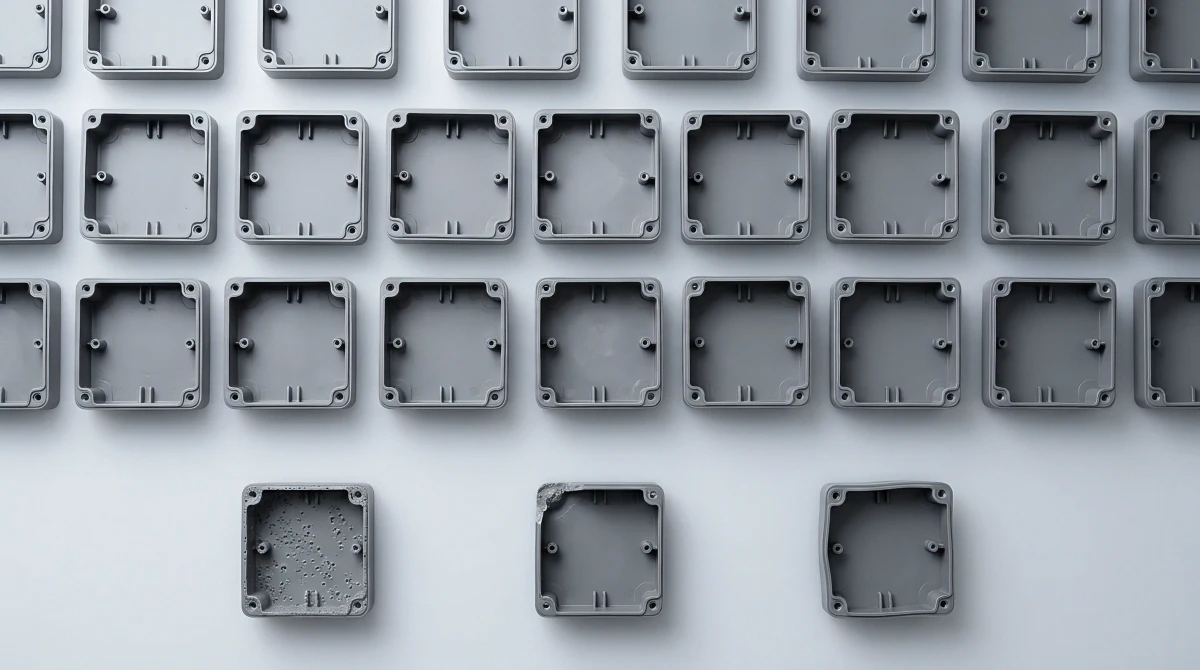
Vacuum Casting Defects in a Batch Traced to Their Cause

A vacuum casting defect points to its cause by where it sits on the part and which castings of the batch show it, from one wet pour to a mold near its end.

The List of Casting Defects and the Cause Behind EachVacuum casting defects trace to six causes: moisture in the components, air folded in during mixing and pouring, a mixing ratio upset by weighing or crystallization, a mold or master fault copied into every part, a cure or demold cut short, and a silicone mold wearing out over the run. The table pairs the defects named in the opened documents with those causes and with what a buyer or inspector sees.

Overmolding and Inserts in Vacuum Casting Step by Step

Inserts in a cast part are held by knurls and undercuts, located on pins in the silicone, and surrounded by resin mixed and poured under vacuum.

The Vacuum Casting Steps for a Part With InsertsA vacuum cast part with molded-in inserts is made in eight steps: the insert is chosen and shaped for mechanical retention, the master is prepared so the mold can locate it, the insert's surface is prepared, it is placed in the opened silicone mold, the mold is closed and preheated, the resin is degassed and mixed under vacuum, the mold is filled and vented, and the part is cured and demolded around the insert. An overmolded part adds a second mold and a second pour.

Making the Master Pattern for Vacuum Casting From SLA or CNC

The master is finished, sealed and fitted with its parting line, gate and risers before the silicone is poured, because the mold copies every mark into the batch.

What the Master Pattern Has to Deliver Before the Silicone Is PouredA master pattern for vacuum casting is the physical original from which the silicone mold is cast, and the mold reproduces it so faithfully that every cast part inherits its shape, its surface and its faults. Loughborough University's vacuum casting guide puts it plainly: the mold replicates the master extremely faithfully, so the master's surface finish and accuracy are what the moldings will have.

Surface Finish of Vacuum Cast Parts and How the Master Sets It

A vacuum cast part copies its master's roughness and comes out slightly smoother, so the finish is specified and measured on the master before the mold is poured.

How Closely a Vacuum Cast Surface Follows Its MasterA vacuum cast part's surface roughness is set by its master within about a tenth of the master's value, in the two studies on file. In the 2020 study by Mustafa and co-authors, parts cast from FDM, SLA and multi jet fusion (MJF) masters all came out smoother than the master, by 1.84 %, 9.62 % and 6.09 % respectively.

Send the Drawing of Your Cast Part

Send the 2D drawing and the 3D file, with the quantity and the stage of the project. An engineer replies within 1 working day.

The quote form, the mutual NDA and the private folder for your files are on Protolis Atelier, with Vacuum Casting chosen.

Request a Quote