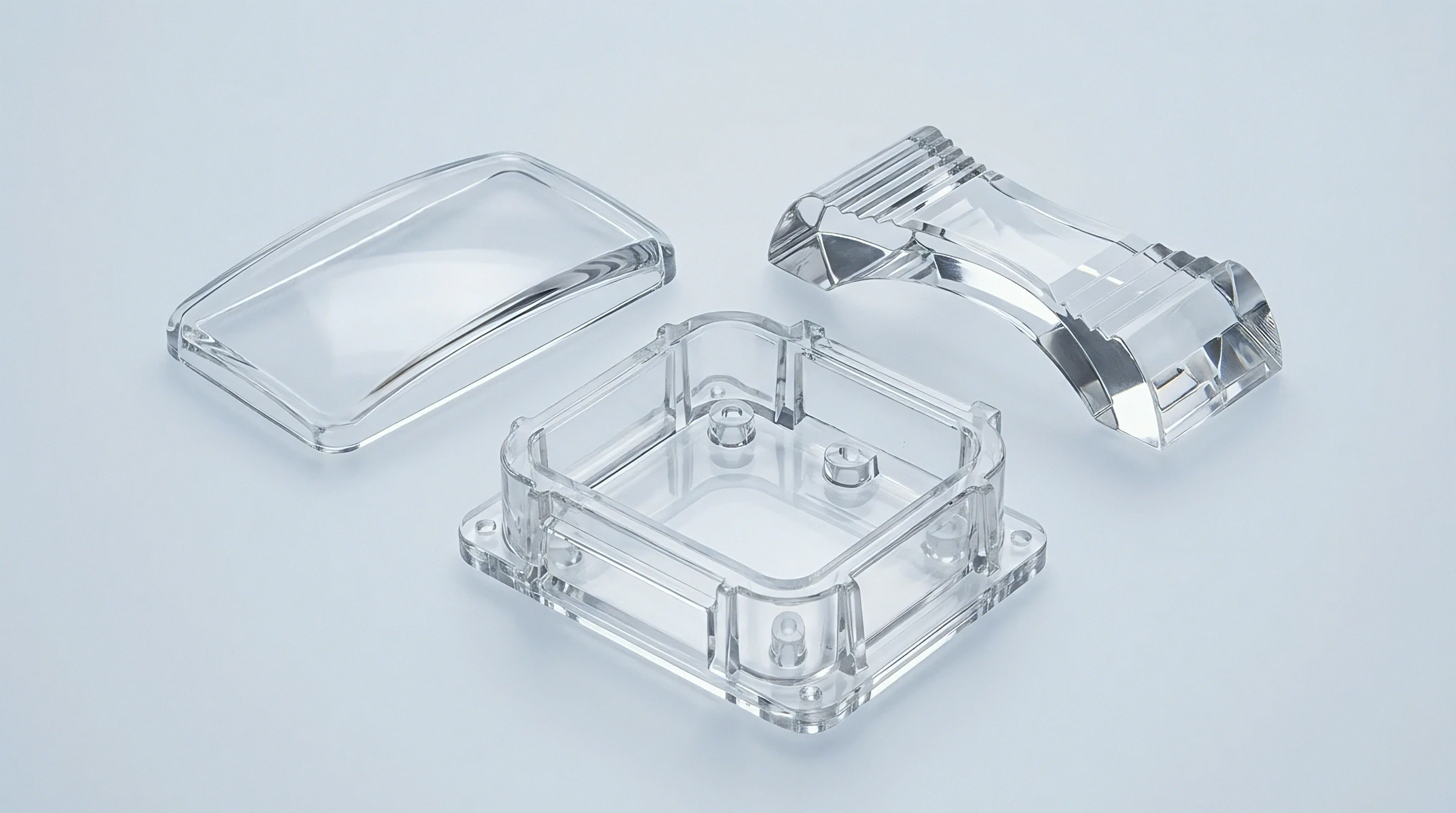
Sika’s data sheet for PX523 sets three ceilings on the post-cure of a clear part: 7 days at 70 °C (158 °F), 48 hours at 80 °C (176 °F), or 16 hours at 100 °C (212 °F), and no longer, to prevent yellowing. The same sheet’s own post-cure schedule, 16 hours at 100 °C, sits exactly on the third ceiling. A clear resin therefore lives close to a limit that a colored resin never meets, and the datasheet shows the margin in a line most buyers skip.
Clear polyurethane is the grade a buyer asks for when a part has to pass light, whether a lens cover, a light pipe or a display window. The sections below read the two clear systems Sika prints for vacuum casting, explain what the optical numbers do and do not say, and list the conditions that decide whether a cast part keeps its clarity.
How Clear a Casting Resin Is in Datasheet Numbers
On a datasheet, clear is a claim with two numbers behind it at most. PX522 is described as water clear, with a coefficient of light transmission of 89 percent measured by the laboratory LNE, and PX523 prints a refractive index of 1.511. Neither sheet states the thickness at which the 89 percent was read, the wavelength or the surface finish of the sample, and a transmission figure moves with every one of those.
So the number serves as a ranking inside one maker’s range, not as an optical specification. A buyer who needs a defined transmission or haze at a stated thickness asks for it as a measurement on a cast sample, taken on the actual grade after the actual post-cure.
A clear casting resin promises a water-clear look and prints one or two optical numbers. A drawing that needs more states the thickness and the measurement it expects.
The resin is a polyurethane, so the chemistry matches the ABS-like grades: an isocyanate component, called PX521 for both systems, and a polyol that differs by grade. What changes is the polyol and the mix ratio, which Sika sets at 100 to 50 by weight for PX522 and 100 to 62 for PX523. Renishaw lists a transparent ABS-type resin, SG95, among the common polyurethane grades in its brochure, so the clear family is not limited to one maker.
Two Clear Grades and Their Thickness Windows
The two Sika systems share a component and a look but not a use. PX522 is built for transparent parts up to 10 mm (0.39 in) thick, and PX523 for parts up to 100 mm (3.94 in) thick, which Sika calls large volume.
| Property | PX522 with PX521 | PX523 with PX521 |
|---|---|---|
| Mix ratio by weight | 100 : 50 | 100 : 62 |
| Pot life | 8 min (150 g, 23 °C) | 20 min (162 g, 23 °C) |
| Mixed viscosity | 500 mPa·s | 500 mPa·s |
| Maximum casting thickness | 10 mm (0.39 in) | 100 mm (3.94 in) |
| Demold time at 70 °C | 60 min | 45 min at 100 mm; 3 h below 5 mm |
| Shore D, ISO 868 | 85 | 86 |
| Flexural modulus, ISO 178 | 2,400 MPa (348 ksi) | 2,100 MPa (305 ksi) |
| Tensile strength, ISO 527 | 66 MPa (9.6 ksi) | 68 MPa (9.9 ksi) |
| Elongation at break | 7.5 % | 6 % |
| Impact resistance, ISO 179 | 48 kJ/m² | 42 kJ/m² |
| Heat deflection, ISO 75A | 85 °C (185 °F) | 85 °C (185 °F) |
| Glass transition, ISO 11359 | 95 °C (203 °F) | 100 °C (212 °F) |
| Post-cure behind the figures | 4 h at 80 °C plus 16 h at 100 °C | 16 h at 100 °C |
The mechanical figures sit close together. PX523 trades a little stiffness and impact resistance for the ability to fill a block. The difference a buyer feels is in the cure: PX522 has one demold time, an hour at 70 °C, while PX523 needs 45 minutes for a 100 mm section and 3 hours when the wall is under 5 mm.
Why a Thick Block Demolds Sooner Than a Thin Wall
The demold figures of PX523 run against intuition, and the reason is heat. A polyurethane reaction releases heat of its own, and a block 100 mm thick holds much of it, so the center of the cast can run warmer than the oven. In contrast, a wall under 5 mm gives the heat away through the silicone at once and cures at roughly the temperature of the mold. Sika prints the two numbers but not the explanation, so this reading comes from the sheet’s figures and is not a statement in it.
The same mechanism limits the other end. PX522 stops at 10 mm, and a buyer who needs a 25 mm clear section chooses PX523 even if the rest of the part is thin, then accepts the longer cure for the thin ribs around it.
Post-Cure Ceilings That Protect Clarity
Post-cure raises a clear resin’s properties and, past a limit, spoils its color. Sika’s PX523 sheet gives the limit as three time and temperature pairs, and every recommended schedule needs to be read against them.
| Temperature | Ceiling stated for PX523 | Recommended schedule |
|---|---|---|
| 70 °C (158 °F) | 7 days | none stated |
| 80 °C (176 °F) | 48 hours | 16 h, for the electrical figures, followed by 24 h at 23 °C |
| 100 °C (212 °F) | 16 hours | 16 h for the mechanical figures (PX523); 16 h after 4 h at 80 °C (PX522) |
PX522’s sheet states no ceiling of its own. It lists a schedule of 4 hours at 80 °C plus 16 hours at 100 °C, which uses the same 16 hours at 100 °C as the PX523 limit, and a buyer who trusts the pattern may read it across. The sheet does not say it applies, so a ceiling for PX522 is a question for the maker.
Three practical points follow from the table:
- A casting house that adds a second 16 hours at 100 °C to a batch of PX523 passes the printed limit, if the limit counts total time, which the sheet does not say.
- A part held in the oven by accident, for a long weekend at 80 °C, exceeds the 48-hour limit on the sheet.
- A clear part cast beside a colored one in the same oven load inherits the longer of the two schedules unless the loads are separated.
Demolding Hot and Holding the Shape
A clear part leaves the 70 °C mold at 70 °C, and both Sika systems print a heat deflection temperature of 85 °C (185 °F). That leaves a 15 °C margin at demold, measured on a test bar after post-cure, so a freshly demolded wall is softer than the figure suggests, because the part has not yet had the post-cure the figure assumes. Sika’s answer is the conformer, a fixture shaped like the part that holds it through post-cure, and the sheets recommend one depending on the geometry and weight of the part.
For a clear part the stakes are optical. A lens cover that bows by a fraction of a millimeter during a 16-hour soak at 100 °C gives a distorted view of whatever sits behind it, and no polishing removes a bow. The conformer therefore belongs on the tooling list of a clear part, in a material that survives 100 °C without marking the surface it touches.
Mold and Mixing Conditions for a Clear Part
Clear resins show every flaw, and the sheets say so in the way they handle the mold and the mix. Sika asks that PX522 be cast in a new mold that has not held casting resin before. The sheet gives no reason, and the conservative reading is that traces of an earlier resin, release agent or colorant would show in a transparent part.
The mix itself follows the same order as for the ABS-like grades, with adjustments:
- Both components are evacuated separately for 10 minutes.
- PX522 is mixed under vacuum for at least 4 minutes, while PX523 on a machine is mixed for 2 to 3 minutes.
- Material and processing temperature stay between 18 °C and 25 °C, and the silicone mold sits at 70 °C.
- Containers are closed tightly right after use so moisture cannot enter, and an opened pack is used as soon as possible.
PX523 also allows a manual process, which the PX522 sheet does not describe. The two components are mixed with a spatula or a stirrer turning at 300 rpm or less, the mixture is poured into a second container and mixed again, and the result is evacuated until the bubbles are gone, all inside the 20-minute pot life. On a machine, the cup order reverses relative to PX522: PX523 puts the polyol in the upper cup and the isocyanate in the lower, where PX522 does the opposite. A casting room that switches between the two grades on one machine needs that difference written on the bench.
Getting the Bubbles Out Before the Mold Fills
An air bubble that would vanish in a dark part shows as a bright spot in a clear one, so the degassing steps carry more weight here. Sika prints the 10-minute evacuation of each component and a minimum mixing time under vacuum, and Renishaw’s casting procedure for its own resins adds a wait of 10 minutes after the chamber reaches full vacuum before the two cups are combined. A 2004 dissertation describes the same logic from the bench: a first degassing of each component, a second once the mold is on the lifting table, and a short pressure shot of 50 mbar into the chamber when air still rises from the mixed resin, to calm it. Whatever the machine, the clock is the pot life, 8 minutes on PX522 against 20 on PX523, which is the argument for PX523 on parts with long flow paths.
Clear parts forgive nothing in the degassing. The pot life sets how much time the room has, and the grade with the longer clock gives the longer margin.
Pigment and the Clear Grades
Both sheets keep a pigment line, 1 percent added to the polyol, and both name Sika’s own paste as the tested option. That line serves a tinted clear part, such as an amber lens. A water-clear part carries no pigment at all, which keeps the batch simple and removes one source of moisture.
Electrical Numbers Printed for PX523
PX523 is the only clear grade here with a block of electrical data, and the block shows how a datasheet admits its own age.
| Property | Value | Method | Note on the sheet |
|---|---|---|---|
| Dielectric strength, 1 mm, 50 Hz | 37 kV/mm (940 V/mil) | IEC 60243-1 E2 | cured 16 h at 80 °C, then 24 h at 23 °C |
| Volume resistivity | 2.97 × 10¹⁵ Ω·cm | IEC 60093 E2 | same cure |
| Tracking resistance | 600 V | IEC 60112 E3 | same cure |
| Dielectric constant, 100 Hz | 3.18 | IEC 60250 | marked OUTDATED |
| Dissipation factor, 100 Hz | 0.015 | IEC 60250 | marked OUTDATED |
Two of the five lines carry the word OUTDATED on Sika’s own sheet, which is an honest flag and a useful one. A buyer who wants those two numbers asks the maker for a current value instead of reading them from the sheet. The cure under the electrical figures, 16 hours at 80 °C, is also different from the 16 hours at 100 °C under the mechanical figures, so a part post-cured for strength is not the sample whose resistivity is printed.
Shrinkage and the Clear Part That Has to Fit
PX522 is the only clear grade here with a shrinkage figure: 7 mm per meter on a bar of 500 × 50 × 5 mm (19.7 × 1.97 × 0.20 in) cast in a silicone mold, which is 0.7 percent. On a lens cover 60 mm across, that is about 0.42 mm (0.017 in) smaller than the master unless the master was scaled up. PX523 prints no figure at all, and a 100 mm block of it is the kind of cast where the shrinkage question is at its sharpest.
Sika’s sheet does not say whether the PX522 bar was post-cured before it was measured, and the post-cure for the other properties runs 4 hours at 80 °C and 16 hours at 100 °C. A clear part that has to seat in a frame needs that answer from the maker, or a measured first article, before the master is cut. The shrinkage piece in these resources’ tolerance category reads these figures across all grades. A clear part that only needs a few copies and has flat faces can also be cut as machined plastic from cast acrylic and polished, which is the usual alternative when a silicone mold is not worth making.
Storing and Opening the Components
Clear grades share the storage rules of the rest of the family, and an old pack hurts them most. Sika asks for storage between 15 °C and 25 °C in unopened containers, prints a shelf life of 12 months for both systems, and describes crystallization after cold storage that is reversed by warming the component to 70 °C at most and letting it cool before use. The dissertation reports a South African workshop storing resin at 30 °C to prevent crystals, and finding that an opened pair of containers lost its shelf life to roughly two weeks. It also notes that curing took longer on days of high relative humidity.
Those local figures belong to a different supplier’s grades, so they set a habit, not a rule for PX522 or PX523. The habit is to date every opened can, to keep both components sealed between pours, and to record the room’s humidity on the day a clear batch is cast.
Open Questions on Clarity, Thickness and Yellowing
The two sheets give a buyer a workable start and leave several answers unstated.
- Neither states how the clarity changes with thickness, so a 3 mm lens and a 60 mm block of the same grade are not described by one number.
- Neither quantifies yellowing, and the PX523 ceilings say when it starts but not how it looks.
- PX522 claims good UV resistance and easy polishing in words, and the sheet gives no test or rating for either.
- The sheets say nothing on a clear part’s behavior in a damp environment or in contact with cleaning fluids.
A 2004 dissertation from the Central University of Technology in South Africa describes two transparent polyurethane systems from a different supplier, with a 10 mm maximum wall and temperature resistance to 90 °C, one of them noted as UV stable. That description matches the pattern on the Sika sheets, which suggests the limits belong to the material class, not to one maker.
For a clear part, the practical sequence is to settle thickness first, since it picks PX522 or PX523. The post-cure follows within the ceiling, and a cast sample goes to whatever measurement the part needs. Where a clear part is needed in dozens of copies, low-volume vacuum casting covers that range with clear grades, and the same resin supports a program through bridge production while a hard tool is built.
Sources and Further Reading
- Sika, SikaBiresin PX522 with PX521, product data sheet, version 01.01, 08-2026
- Sika, SikaBiresin PX523, product data sheet, version 02.01, 11-2026
- Renishaw, Data sheet: vacuum casting resin 6230, issued 09.2015
- Renishaw, Brochure: vacuum casting systems, issued 10.2017
- F. C. Aggenbacht, Development and evaluation of a vacuum casting process, M.Tech. dissertation, Central University of Technology, Free State, 2004