A freshly mixed batch of Renishaw’s Vacusil 2000 starts at 45,000 mPa·s at 23 °C (73 °F), and its data sheet gives it 90 minutes to be degassed and poured. Wacker, which makes a competing mold silicone, defines the end of the pot life as the moment its mixture reaches 60,000 mPa·s. The two makers measure the same thing with different ends, and the pair of numbers shows how much a mold silicone is a controlled clock before it is a rubber.
The silicone is the one material in vacuum casting that the finished part never contains, and it still sets the surface, the size and the number of copies. Below, the sections read what the makers print about the silicone grades used for polyurethane casting, what separates the cure chemistries, and which conditions decide whether a mold gives its copies or loses them.
Silicone Rubber as the Mold Material in Vacuum Casting
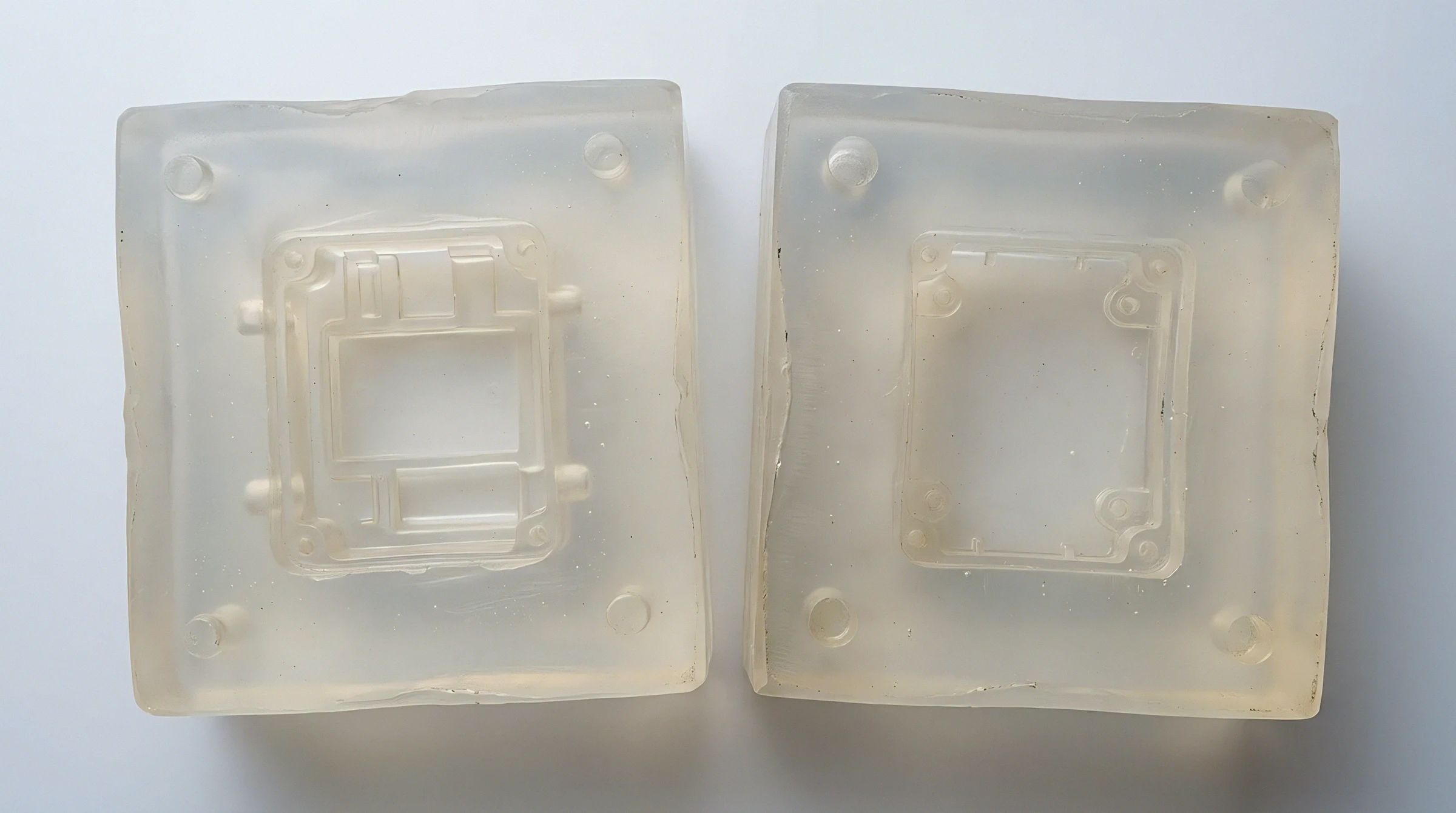
A mold silicone is a two-component liquid rubber that is poured round a master, cured at room temperature or a little above, and cut open to release the master. Renishaw describes Vacusil 2000 as a two-component addition-cure liquid silicone rubber designed for mold making, curing at room temperature to a translucent, high-strength elastic rubber, and names vacuum casting of polyurethane resins among its uses. Wacker describes ELASTOSIL M 4601 in the same terms: a pourable two-component addition-cure silicone that resists common casting resins, polyurethane in particular.
Four jobs fall to the rubber. First, it reproduces the master’s surface without sticking to it. Second, flexing enough to release a cured copy with undercuts is part of the brief. The 70 °C of the casting oven then has to be survived for as many pours as the part allows, and the rubber degasses cleanly so that no bubbles ride on the cavity wall.
A mold silicone is chosen for flow, cure chemistry, hardness and resistance to the casting resin, and the sheet values of those four decide how many good copies the tool gives.
The silicone does not compete on the same terms as the resin. Resin choice follows the part’s job, and silicone choice follows the master, the undercuts and the resin that will sit in the mold. A single silicone typically serves several resins, which is why the silicone sheets list a single hardness and cure time while the resin sheets list many.
Vacusil 2000 gives some of the physical data a buyer wants before choosing a pour: an unmixed viscosity of 65,000 mPa·s, a mixed viscosity of 45,000 mPa·s, a specific gravity of 1.08 g/cm³ (67 lb/ft³) and a tear strength of 32 on the crescent test, printed as N/mm². Such a thick liquid does not flow into fine detail on its own, which is the reason the sheet stresses a slow, steady stream and a second degassing after the pour. The work runs on gravity and vacuum together.
Renishaw’s brochure puts the whole method in a few lines: the mold is made by encapsulating a master in two-part liquid silicone rubber, a vacuum removes the trapped air, and the block is cured in an oven, after which it is cut open to form a split line and the master comes out. The brochure adds that masters come from several 3D printing technologies, stereolithography being the most common, and the same silicone serves each of them.
Mold Silicones Read Side by Side
Two grades from the makers’ own sheets, and two from a 2004 dissertation that tested silicones under local conditions, give a fair view of what the data looks like.
| Property | Vacusil 2000 (Renishaw) | ELASTOSIL M 4601 A/B (Wacker) | Silicone 4640 (dissertation) | Silicone 4642 (dissertation) |
|---|---|---|---|---|
| Cure chemistry | addition | addition | RTV, catalyst | RTV, catalyst |
| Shore hardness | 37 A | about 28 Shore A | not stated | not stated |
| Tensile strength | 4.5 MPa (653 psi) | not stated | not stated | not stated |
| Elongation at break | 380 % | not stated | not stated | high extensibility |
| Mix ratio | 100 : 10 | not stated on page | 1 : 10 | 1 : 10 |
| Pot life | 90 min at 23 °C | to 60,000 mPa·s | 90 min (23 °C, 50 % RH) | 90 min (23 °C, 50 % RH) |
| Cure or demold time | 24 h at 23 °C | quick, faster with heat | 15 h at 23 °C | 12 h at 23 °C |
| Linear shrinkage | not stated | described as non-shrinking | under 0.1 % after 7 days | under 0.1 % after 7 days |
Several rows are blank for a reason. Wacker’s page publishes a handful of figures and points to a technical data sheet for the rest, so a buyer reading it finds hardness and a statement about shrinkage, not a full table. Both dissertation grades are older, local products, and the dissertation reproduces only the key properties of each.
Hardness and What a Softer Rubber Buys
Hardness is the one value that all of the current sheets give or imply.
Vacusil 2000 sits at 37 Shore A, and ELASTOSIL M 4601 at about 28. A lower number means a softer rubber, and Wacker names models with deep undercuts as an application of its grade. The dissertation reports the trade on the other side: its silicone had a relatively low Shore hardness, and the author links it to visible parting lines on the cast parts, which influenced the average dimension he could determine. He notes that silicones with higher Shore hardness reached the market later and would have changed his results.
So softness helps release, and stiffness helps the rubber hold size and a crisp parting line. Neither sheet prints a number that ties hardness to dimensional change, which leaves the choice to the casting house’s experience with a given geometry.
Addition Cure Against Condensation Cure
Most vacuum casting molds are made from addition-cure silicone, and the reason shows up in two published sentences. A 2020 study of mating parts used an addition-cure rubber with a 1 to 1 mix ratio and states that it exhibits virtually no shrinkage compared with condensation-cure rubber. The Vacusil 2000 sheet turns the same fact around by listing condensation-cure silicone rubbers among the materials that can inhibit its own cure.
That second point is the practical one. The two chemistries do not coexist in a casting room without care:
- A condensation-cure silicone, whether in a tool, a clay bed or a leftover film, sits on the inhibitor list.
- Tapes, waxes and paints on the master or the frame are named on the same list.
- A mixing container that is not clean and dry brings in contaminants, which the Vacusil sheet asks the user to avoid.
Each of these is the cure inhibition problem under another name, and each is avoided by the same habits: dedicated clean tools, a dry cup and paddle for every batch, and a test before the real pour.
The Patch Test and the Inhibitor List
Renishaw lists the materials that can inhibit the cure: water, sulfur, amine, organometallic and phosphorus compounds, as found in condensation-cure rubbers, clays, wood resins, synthetic rubbers, adhesive tapes, waxes and paints. The sheet recommends a preliminary test of compatibility and calls patch testing advisable before use. In practice that means coating a small area of the master or a scrap piece with each material that will touch the silicone, pouring a small amount of mixed rubber over it, and waiting for the full cure time to see whether the rubber sets completely.
The dissertation describes the same check for two situations. Where modeling clay forms the first half of a two-part mold, a piece of silicone is cast onto the clay to see whether it releases cleanly after vulcanizing. With the casting resin, a small amount of plastic is cast over a piece of cured silicone, again to see whether it lets go. The checks cost an afternoon and spare the room a day of silicone cure that would have been wasted.
Making the Mold Around the Master
How the rubber goes round the master matters as much as which rubber it is. The dissertation walks through a two-part mold made with a clay bed: half of the master is embedded in clay, the clay is degassed, the first half of the mold is cast over it, and the clay is then removed and cleaned off completely so that the parting line stays clear. A wavelike edge on the clay bed makes the finished halves fit together in one way only, and a release agent goes onto the first half before the second is poured over it. Silicone quantity follows from the volume of the molding frame minus the volume of the master, with an allowance for what stays in the mixing bowl.
Complex shapes use more segments. Renishaw’s brochure states that highly complex shapes are handled through multi-segment molds, so the same silicone gives a three- or four-piece tool where two halves cannot release the part. Each extra parting line is another seam on the copy, and each costs the casting room a little time to align.
The rubber is only as good as the parting plan. Where the master is cut, how the halves register and how clean the first half is before the second pour all show up on every copy.
Preheated Molds and Size Change
The oven also affects the silicone, and the sources disagree on how much.
A 2020 study preheated its molds to 65 °C and gives the reason as compensation for mold shrinkage. Sika’s resin sheets ask for a mold at 70 °C. The dissertation ran casts with the mold at 30, 50 and 70 °C and reports that shrinkage of its cast parts stayed constant as the mold went from 30 to 50 °C and started to vary above 50 °C, with no clear trend in some series. It also warns that a mold left in a 40 °C oven with the resin for much longer than the cure needs may be damaged.
Read together, those lines say the mold temperature is a quiet variable with a threshold near 50 °C in one test, and that holding it steady matters more than a particular value. The resin sheets already print their number, 70 °C, and a casting house that keeps the oven there from the first part to the last removes one source of drift between copies.
Degassing the Silicone Before the Pour
Both sources agree that the rubber is freed of air twice. Degassing happens in the mixing cup first, and a second time after the silicone has been poured round the master, so that air trapped under the master or at its undercuts has a chance to rise. Renishaw’s sheet gives 2 to 3 minutes of vacuum for the first stage and warns that the silicone can expand up to 7 times its original volume while air leaves, which is why it asks for a cup four to five times larger than the batch.
The dissertation adds a bench method for a cup that is too small. Vacuum is pulled until the silicone reaches the rim, the pressure is raised by 50 hPa to let it drop, and the cycle repeats until the silicone stops rising, at a chamber pressure below 15 hPa. That text also gives a minimum cup volume of 5 times the silicone inside, which agrees with the Renishaw range.
Whatever the method, the working time is the limit. Vacusil 2000 gives 90 minutes at 23 °C, and every minute spent on mixing, the first degassing and pouring comes out of the time left for the second degassing. A batch that thickens before the second degassing is the usual cause of voids on a mold surface that looks clean on the outside.
Wear and the Copy Count of One Mold
Renishaw’s brochure states that its molds are capable of producing up to 50 parts before retooling, and that typically between 30 and 50 color-matched parts come from a single mold. The 6230, 8263 and 8020-2 resin sheets from the same maker add a practical rule: mold life is extended by using the right release agent and by demolding the casting immediately after the cure. A thin cloud of release agent, dried before the mold is closed, is the dissertation’s advice, because too much release agent affects the finish and the strength of the cast part.
Those statements name the levers in plain terms: the release agent, the demold timing and the support of the tool. The dissertation notes that large molds may need supports against distortion, and that the halves are closed with tape or staples that hold them firmly together.
The brochure also lists the silicone families Renishaw sells for mold making, which shows how the choice splits by job. Rensil is described as transparent, low in viscosity and long in mold life. VTV750 is translucent and colorless, VTX950 is transparent and colorless, and VTN6000 is a transparent grade meant for nylon casting. The sheet figures for those grades are not printed in the brochure, so the list serves as a map of the choices, with the numbers behind each name available from the maker.
A transparent rubber has a practical advantage that has nothing to do with the cast resin: the operator can see the master, the vent rods and any trapped air through the mold wall when the block is cut or inspected. Vacusil 2000 is translucent, and the dissertation’s silicone 4640 is a pourable transparent product, which fits the practice of reading the block through its own wall.
| Statement | Condition on the sheet | Source type |
|---|---|---|
| Up to 50 parts before retooling | maker’s general claim, resin not named | Renishaw brochure |
| 30 to 50 color-matched parts per mold | typical, first parts within 24 h | Renishaw brochure |
| Life increased by release agent and immediate demolding | stated on the 6230, 8263 and 8020-2 sheets | Renishaw resin sheets |
| Too much release agent harms finish and strength | thin cloud, dried before closing the mold | dissertation, 2004 |
The numbers match what the casting trade says in general, and none of them is a guarantee. A deep undercut, a thin rib in the master or a resin that attacks silicone shortens the count, and the sheets give no formula for it.
Numbers a Silicone Sheet Does Not Print
The sheets are written for people who already know the process, so several answers sit outside them:
- Hardness is given for the cured rubber alone, with no link to how many copies a given geometry survives.
- Shrinkage appears as a general statement, such as no dimensional change, and is not tied to a master size.
- The inhibitor list names families of materials, not the paint or tape brand on the bench, so every shop builds its own record of what passed the patch test.
- None of the sheets states how the mold ages in the 70 °C oven, so the 50-part statement stays a typical figure.
In short, the mold silicone needs to be an addition-cure grade, checked against every material it touches, degassed twice inside its pot life and looked after as a consumable. When a program grows from a handful of copies to hundreds, the question of how many molds the quantity needs belongs to the production plan, and low-volume vacuum casting and bridge production are the two stages that work from the figures above.
Sources and Further Reading
- Renishaw, Data sheet: Vacusil 2000 silicone rubber, issued 10.2017
- Wacker Chemie, ELASTOSIL M 4601 US A/B, room temperature curing silicone rubber, product page
- Renishaw, Brochure: vacuum casting systems, issued 10.2017
- Renishaw, Data sheet: vacuum casting resin 6230, issued 09.2015
- Renishaw, Data sheet: vacuum casting resin 8263, issued 05.2015
- Sika, SikaBiresin PX331, product data sheet, version 01.01, 08-2026
- Renishaw, Data sheet: vacuum casting resin 8020-2, issued 04.2018
- N. N. Mohd Mustafa, A. Z. Abdul Kadir, N. H. Akhmal Ngadiman, A. Ma’aram, K. Zakaria, Comparison of different additive manufacturing patterns on the performance of … vacuum casting for mating parts via the Taguchi method, Journal of Mechanical Engineering and Sciences 14(1), 2020
- F. C. Aggenbacht, Development and evaluation of a vacuum casting process, M.Tech. dissertation, Central University of Technology, Free State, 2004