Mixed Viscosity

Mixed viscosity is the thickness of a two-component resin or silicone just after its components are combined, given in mPa·s.

Every Mixed Viscosity article of the Vacuum Casting Resources, newest first, each written from published standards, research and makers’ data.

Meaning

Mixed viscosity is the thickness of a two-component resin or silicone just after its components are combined, given in mPa·s. It decides how well the mix flows into fine detail and how readily air leaves it. Silicones mix thick and resins mix thin. Both thicken as the pot life runs out.

Silicone Viscosity

Vacusil 2000 starts at 65,000 mPa·s (65,000 cP) unmixed and 45,000 mPa·s (45,000 cP) mixed, at 23 °C (73 °F). At that thickness, fine detail does not fill on its own. Renishaw therefore asks for a slow, even pour followed by a second degassing. Wacker ends the pot life of its own silicone when the mix reaches 60,000 mPa·s (60,000 cP).
Read More

Resin Viscosity

The resins mix far thinner. PX522 and PX523 both mix to 500 mPa·s (500 cP). PX331 mixes to 700 mPa·s (700 cP) and PX205 to 1,600 mPa·s (1,600 cP). Renishaw calls 8020-2 very low in viscosity, at 550 and 500 mPa·s (550 and 500 cP) for its 2 components.

Air Release

In a thick liquid, drag holds back a small bubble that buoyancy alone cannot lift. Polytek advises degassing silicones above about 20,000 mPa·s (20,000 cP). Vacusil 2000, at more than twice that, gets a vacuum step as a matter of course.

Flow Behavior

Heat thins the resin but shortens its working time. Renishaw 6230 shows the trade. Its pot life is 6 minutes at 25 °C (77 °F) and 3 minutes 40 seconds at 35 °C (95 °F). Viscosity is printed, yet no sheet states how far the resin runs in a thin channel. A casting room finds the flow length by trial on the actual mold.
Rubber-Like Polyurethane Resins From Shore 30 A to 90 A

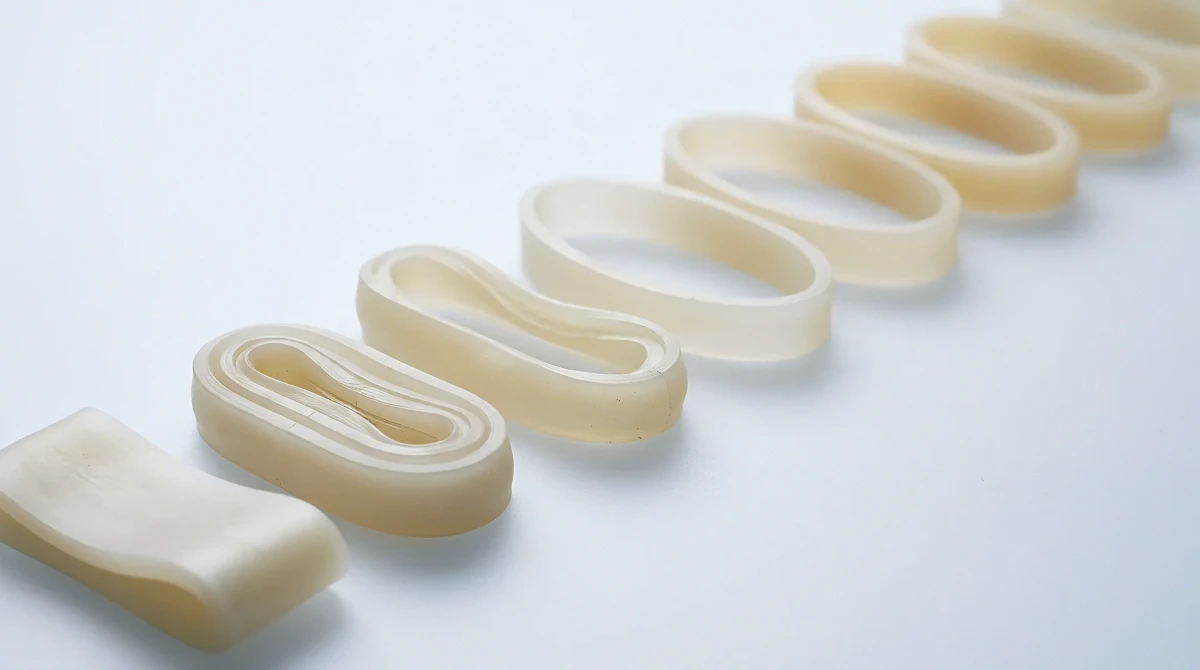
A rubber-like urethane is specified by grade, hardness method and a tested service temperature, because hardness alone leaves strength and heat behavior open.

Rubber-Like Vacuum Casting Grades and the Hardness Each CoversRubber-like vacuum casting resins are two- or three-component polyurethanes that cure in a silicone mold to an elastomer, with a Shore A hardness chosen for the part. The variable-hardness systems reach the range by adding a third component to a fixed A:B pair.

Silicone Rubber for Vacuum Casting Molds

Mold silicone is an addition-cure rubber chosen for hardness and resin resistance, checked against every material it touches, and treated as a consumable.

Silicone Rubber as the Mold Material in Vacuum CastingA mold silicone is a two-component liquid rubber that is poured round a master, cured at room temperature or a little above, and cut open to release the master. Renishaw describes Vacusil 2000 as a two-component addition-cure liquid silicone rubber designed for mold making, curing at room temperature to a translucent, high-strength elastic rubber, and names vacuum casting of polyurethane resins among its uses.

Clear Polyurethane Casting Resin for Vacuum Casting

A clear polyurethane grade is chosen by section thickness first, and its post-cure has a printed ceiling that protects the color of the part.

How Clear a Casting Resin Is in Datasheet NumbersOn a datasheet, clear is a claim with two numbers behind it at most. PX522 is described as water clear, with a coefficient of light transmission of 89 percent measured by the laboratory LNE, and PX523 prints a refractive index of 1.511.

Send the Drawing of Your Cast Part

Send the 2D drawing and the 3D file, with the quantity and the stage of the project. An engineer replies within 1 working day.

The quote form, the mutual NDA and the private folder for your files are on Protolis Atelier, with Vacuum Casting chosen.

Request a Quote