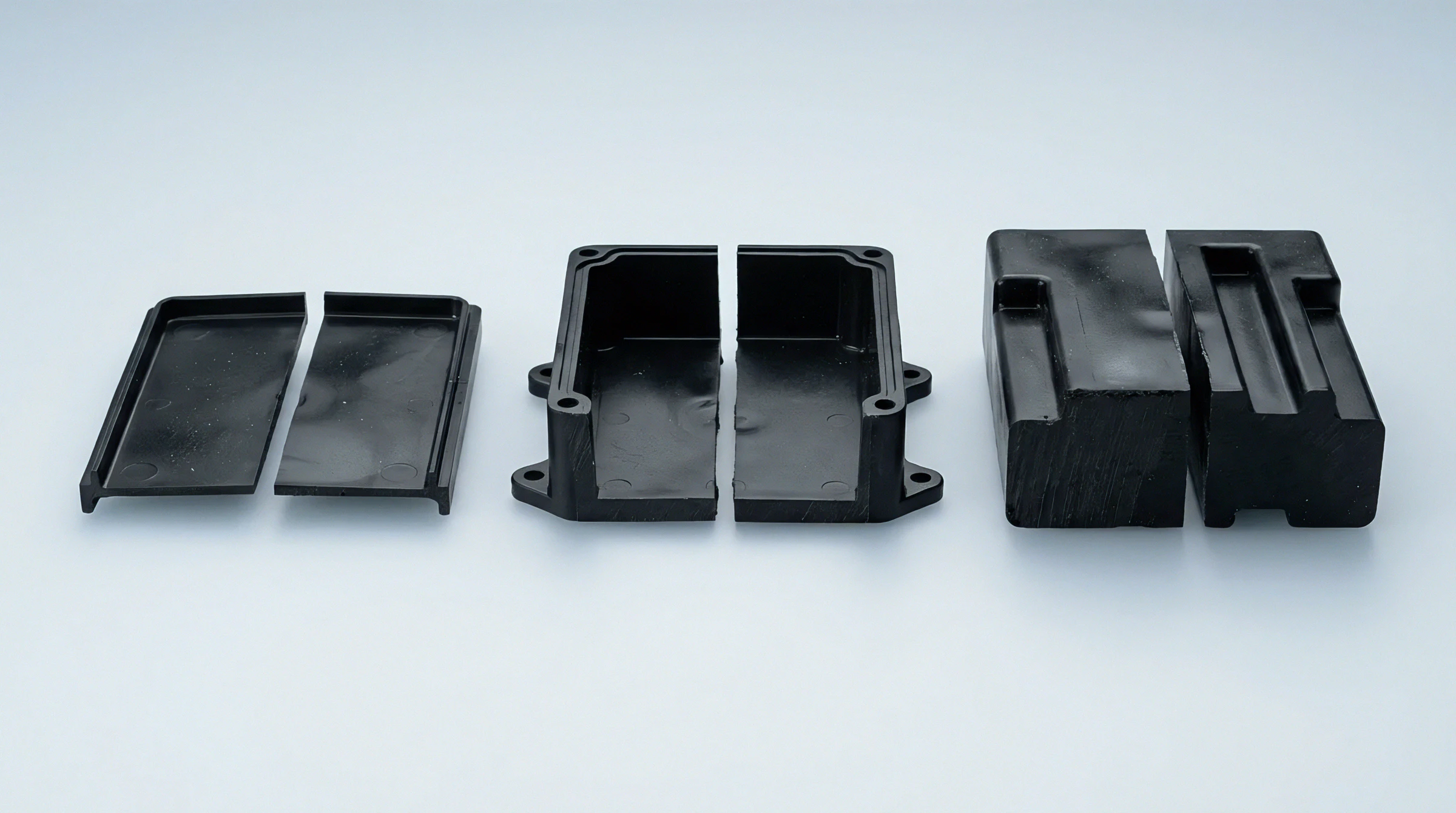
SikaBiresin PX523 is cast up to 100 mm thick, and SikaBiresin PX331 stops at 5 mm. Twenty times separates the two polyurethane systems, and both pour into the same kind of silicone mold at 70 °C (158 °F). The gap is printed on the data sheets under a line called maximum casting thickness, and it governs more of a casting job than any strength value does.
A thickness limit is the first tolerance a casting buyer meets, because it decides whether a part can be cast in a grade at all, and which grade is left when it can. This piece collects the limits that casting makers print, shows the thickness each property is measured at, and sets out what the sheets leave unsaid about thin walls and thick sections.
Maximum Casting Thickness as the Maker Prints It
Several Sika sheets print a line titled maximum casting thickness, and Sika’s text for PX522 and PX523 words the same idea as parts until 10 mm or until 100 mm thickness by vacuum casting in silicone molds. Renishaw’s resin sheets for 6230 and 8263 print no such line. The line is a statement about the resin, not about the process: it names the thickest section the maker’s formulation is meant to cure properly.
Neither Sika nor Renishaw says what happens beyond the limit. The sheets give no failure description, no test and no definition of whether the limit refers to a nominal wall, a local boss or the largest mass anywhere in the cavity. A reader can reasonably expect a chemical reason, since the polyurethane reaction releases heat, but the sheets keep to a single number.
A maximum casting thickness is a limit set by the maker’s chemistry and printed without a definition. A part with one thick boss in a thin wall asks the maker which section the number applies to.
Sika’s sheets also give a second, less visible thickness: the demold time changes with wall thickness. PX331 needs 45 minutes in a 70 °C oven for walls above 3 mm and 75 minutes below 3 mm, and PX523 needs 45 minutes at 100 mm and 3 hours below 5 mm. The curing time, in short, is a function of thickness in both directions.
Thickness Limits and Demold Times Printed for Casting Resins
The table collects what the sheets opened for these resources print. A blank means the sheet gives no value, and the lower rows come from a 2004 dissertation that summarized a supplier’s nine grades.
| Resin | Maximum casting thickness | Demold time | Source |
|---|---|---|---|
| SikaBiresin PX205 | 5 mm (0.20 in) | 60 min at 70 °C | Sika sheet |
| SikaBiresin PX331 | 5 mm (0.20 in) | 45 min above 3 mm; 75 min below 3 mm | Sika sheet |
| SikaBiresin PX522 | 10 mm (0.39 in) | 60 min at 70 °C | Sika sheet |
| SikaBiresin PX523 | 100 mm (3.94 in) | 45 min at 100 mm; 3 h below 5 mm | Sika sheet |
| Sika PX 223 HT | 5 to 10 mm (0.2 to 0.4 in) | 45 to 70 min at 70 °C | Sika sheet |
| Renishaw 6230 | not stated | 25 to 60 min at 70 °C | Renishaw sheet |
| Renishaw 8263 | not stated | 60 min in the mold at 70 °C | Renishaw sheet |
| Renishaw 8020-2 | not stated, thin walls named as the use | 90 min in the mold at 70 °C | Renishaw sheet |
| Nine Huntsman grades | 5 mm to 20 mm across the nine | 30 min to 2 h, mold at 40 to 70 °C | dissertation, 2004 |
Sika’s four thin-section grades sit at 5 to 10 mm, and PX523 is the exception built for blocks. The dissertation’s nine grades fall in the same band, with the thickest limit, 20 mm, given for a black rubber-like grade of Shore A65 and several others at 5 mm.
Two readings of the table follow. First, a general-purpose grade is a thin-wall grade: a 12 mm cast section already needs PX523 or one of the thicker grades. Second, a quick demold does not mean a thin part. PX523 demolds a 100 mm block in 45 minutes, the same time that PX331 takes on a wall above 3 mm.
Why the Same Resin Cures Faster in a Thick Block
PX523’s demold figures are the clearest example. On that sheet a 100 mm block demolds in 45 minutes, and a part under 5 mm needs 3 hours, four times as long. A reaction that gives off heat warms a large mass from the inside, and a thin wall loses its heat to the mold and the oven, and cures at about the temperature of the oven. Sika prints the numbers without the explanation, so the mechanism is the writer’s reading of the sheet.
The consequence for a part of mixed thickness is that the sheets do not say which wall controls the demold time. A part with a 2 mm skin and a 20 mm boss is outside the table’s cases, and the maker or a trial casting answers it.
Thin Walls and What the Sheets Say About Them
Thin walls are where most real parts live, and the sheets say little. The one thin-wall statement is Renishaw’s, which describes its 8020-2 as ideal for thin wall sections on gaskets, seals and valves, and which sets a minimum shot weight of 150 g. A shot of that mass in a thin gasket mold is far more resin than the part needs, and a casting room casts a tool of several parts to use it, or gives up the grade for a small part.
The dissertation adds a practical limit from the other end, the resin weighing. Its author notes that resin left in the pouring cup after tipping is about 5 g, and that processing less than about 50 g makes the ratio between the two components drift enough to change the resin’s characteristics. A tiny part is therefore cast with a larger batch, and the extra is discarded or used in a second cavity.
A third source puts a number on a real thin wall: a 2020 study cast a battery cover with a wall of 1.5 mm (0.059 in) in an ABS-like polyurethane, and reports deviations from the master of under 0.05 mm for its FDM and SLA masters on dimensions of 27 mm and 50 mm. That study does not claim 1.5 mm as a minimum, only that the casting worked and measured.
What Cures More Slowly Below 3 mm
The Sika sheets tie two of their longer demold times to thin walls: 75 minutes for PX331 below 3 mm, and 3 hours for PX523 below 5 mm. Both sheets also recommend a conformer, depending on the geometry and weight of the part, to support the part during post-cure. A thin part is the likelier one to bow in a long soak, which makes the demold time and the conformer two answers to one condition.
Thick Sections and Large Mold Volumes
PX523 shows what the other end looks like. Its sheet allows manual mixing with a spatula or a stirrer at 300 rpm or less, as well as machine mixing, a pot life of 20 minutes for 162 g at 23 °C, and a post-cure ceiling printed against yellowing. That pot life is the longest on any Sika or Renishaw sheet opened for these resources, and it suits a part that needs a large pour.
The printed post-cure ceilings for PX523, 7 days at 70 °C, 48 hours at 80 °C or 16 hours at 100 °C against yellowing, apply to every thickness, so a thick part that needs a long soak runs into them at the same hour as a thin one. Thick sections add questions that the sheet leaves open. It prints no shrinkage value for PX523, and the sheets of the thin grades show shrinkage on bars 3 to 5 mm thick, so a figure from one does not carry to a block. A 100 mm section also holds more resin and calls for a bigger tool, and the dissertation notes that large molds may need supports to prevent distortion under their own weight.
Flow Into Thin Cavities Before the Pot Life Ends
A thin cavity fills only while the mixed resin still flows, and the sheets print the two numbers that decide it. Mixed viscosities run from 500 mPa·s on PX522 and PX523 to 700 mPa·s on PX331 and 1,600 mPa·s on PX205. Renishaw calls 8020-2 very low in viscosity, with 550 mPa·s on one component and 500 mPa·s on the other. Pot lives run from 5 minutes on 8020-2 for 100 g at 25 °C to 20 minutes on PX523 for 162 g at 23 °C.
Temperature trades one against the other. Renishaw gives 6230 a pot life of 6 minutes for 100 g at 25 °C and 3 minutes 40 seconds for the same mass at 35 °C. A warmer resin flows more freely and has less time in which to do it, so a long thin cavity does not simply improve by heating. The sheets give no flow length, and a casting room finds it by trial on the actual mold.
Sizing a Pour for the Section
Resin mass links thickness to the clock. A block 100 mm by 50 mm by 50 mm has a volume of 250 cm³ (15.3 in³), and at the 1.06 g/cm³ printed on the PX523 sheet that is about 265 g of cured polyurethane. The 2020 study sized its pour at roughly 1.3 times the weight of the master, which would take this block to a little under 350 g of mixed resin once the cup residue and the sprue are counted. That is twice the 162 g for which Sika prints the PX523 pot life of 20 minutes.
The sheet states no pot life for larger masses, so a casting room that pours 350 g has to find out how much of the 20 minutes is left, and the sheet’s own manual process, with two mixings and a vacuum until the bubbles stop, uses part of it. Small parts run the arithmetic the other way, and there Renishaw states a minimum shot weight of 150 g for 8020-2 and the dissertation puts the practical floor at about 50 g.
| Figure | Value | Source |
|---|---|---|
| Pot life reference mass, PX331 | 200 g at 23 °C | Sika sheet |
| Pot life reference mass, PX523 | 162 g at 23 °C | Sika sheet |
| Pot life reference mass, 6230 and 8263 | 100 g at 25 °C | Renishaw sheets |
| Minimum shot weight, 8020-2 | 150 g | Renishaw sheet |
| Practical minimum batch | about 50 g | dissertation, 2004 |
| Resin mass for a pour | about 1.3 times the master’s weight | study, 2020 |
The Thickness Each Property Was Measured At
A buyer reads a property value and assumes it describes the part. The thickness of the test specimen is the first condition to check, and the sheets and standards differ widely.
| Value | Specimen thickness | Source |
|---|---|---|
| UL 94 V-0 rating, PX331 | 3 mm (0.118 in) | Sika sheet |
| FAR 25 §853 (b) compliance, PX331 | 1.5 mm (0.059 in) | Sika sheet |
| Linear shrinkage, PX205 | 3 mm bar | Sika sheet |
| Linear shrinkage, PX522 | 5 mm bar | Sika sheet |
| Linear shrinkage, PX 223 HT | 3 mm bar | Sika sheet |
| Dielectric strength, PX523 | 1 mm (0.039 in) | Sika sheet |
| Heat deflection, 6230 and 8263 | 6.4 mm bar (0.25 in) | Renishaw sheets |
| Heat deflection method, ASTM D648 | 3 mm or thicker | ASTM scope |
| Horizontal burning, ASTM D635 | compare similar thickness only | ASTM significance text |
Renishaw’s heat deflection bar is 6.4 mm thick, and the Sika sheets name no bar size for their own figures, so the two makers’ numbers rest on different specimens. A property value is a statement about a specimen of a given thickness, and a part with a thinner wall than the specimen is not covered by it.
The electrical line deserves the same reading. PX523’s dielectric strength of 37 kV/mm (940 V/mil) is stated for a 1 mm specimen, so a 10 mm wall does not offer ten times the breakdown voltage on the strength of the number alone. Where an insulating wall matters, the buyer asks which thickness the figure covers and whether the cast wall matches it.
ASTM D635 puts the principle in its own words: the rate of burning varies with thickness, and test data are to be compared only for specimens of similar thickness. The same sentence works for hardness, shrinkage and heat deflection in practice, though the standards state it for burning only.
Matching Wall Range to a Grade Family
Reading Table 1 from the part’s side gives a short rule for a first selection. Three bands cover the Sika grades opened here:
- Walls under 5 mm sit inside the limit of every grade, and the choice among PX205, PX331 and PX 223 HT then follows stiffness and heat.
- A section of 6 to 10 mm leaves PX522 or the upper end of PX 223 HT.
- Anything thicker than 10 mm leaves PX523 as the only Sika grade with a stated limit that covers it.
A part that runs from thin to thick across one cavity is the case that decides. The grade has to cover the thickest section, the cure has to be right for the thinnest, and the sheets do not say how to combine the two. Mixed-thickness parts are common, and the maker’s technical department is the right place for the question, in writing, with a drawing of the section.
Walls the Sheets Do Not Define
Several answers a designer needs sit outside the printed lines:
- No sheet states a minimum wall thickness, and the thinnest cast wall reported in these resources’ sources is the 1.5 mm of the 2020 study, and the thinnest specimen on a sheet is the 1.5 mm of Sika’s aviation compliance line.
- No sheet defines whether maximum casting thickness refers to a nominal wall, a local boss or the largest mass.
- No sheet gives a flow length, the distance resin travels in a thin cavity before its viscosity rises, though pot life and viscosity are printed.
- No sheet states how a thin rib attached to a thick wall cures, or which section sets the demold time.
The practical response is to ask the casting house early and to cast a trial of the thinnest and thickest section before the master is finalized. Each answer lands as a drawing note: the wall range, the grade chosen for it and the cure schedule that goes with that grade.
The thickness range of a part picks the grade before any strength figure does. A part that spans 2 mm to 20 mm is a question for the maker, not a line in a table.
For parts with a single wall range, low-volume vacuum casting matches the grade to the thickness and records the cure on each batch, and a program that grows past the silicone tool moves into bridge production with the same wall-thickness notes carried over.
Sources and Further Reading
- Sika, SikaBiresin PX205, product data sheet, version 01.01, 08-2026
- Sika, SikaBiresin PX331, product data sheet, version 01.01, 08-2026
- Sika, SikaBiresin PX522 with PX521, product data sheet, version 01.01, 08-2026
- Sika, SikaBiresin PX523, product data sheet, version 02.01, 11-2026
- Sika, PX 223 HT, technical data sheet, version 01, February 2021
- Renishaw, Data sheet: vacuum casting resin 6230, issued 09.2015
- Renishaw, Data sheet: vacuum casting resin 8263, issued 05.2015
- Renishaw, Data sheet: vacuum casting resin 8020-2, issued 04.2018
- F. C. Aggenbacht, Development and evaluation of a vacuum casting process, M.Tech. dissertation, Central University of Technology, Free State, 2004
- N. N. Mohd Mustafa, A. Z. Abdul Kadir, N. H. Akhmal Ngadiman, A. Ma’aram, K. Zakaria, Comparison of different additive manufacturing patterns on the performance of … vacuum casting for mating parts via the Taguchi method, Journal of Mechanical Engineering and Sciences 14(1), 2020
- ASTM International, D648, standard test method for deflection temperature of plastics under flexural load in the edgewise position, scope
- ASTM International, D635, standard test method for rate of burning and extent and time of burning of plastics in a horizontal position, scope