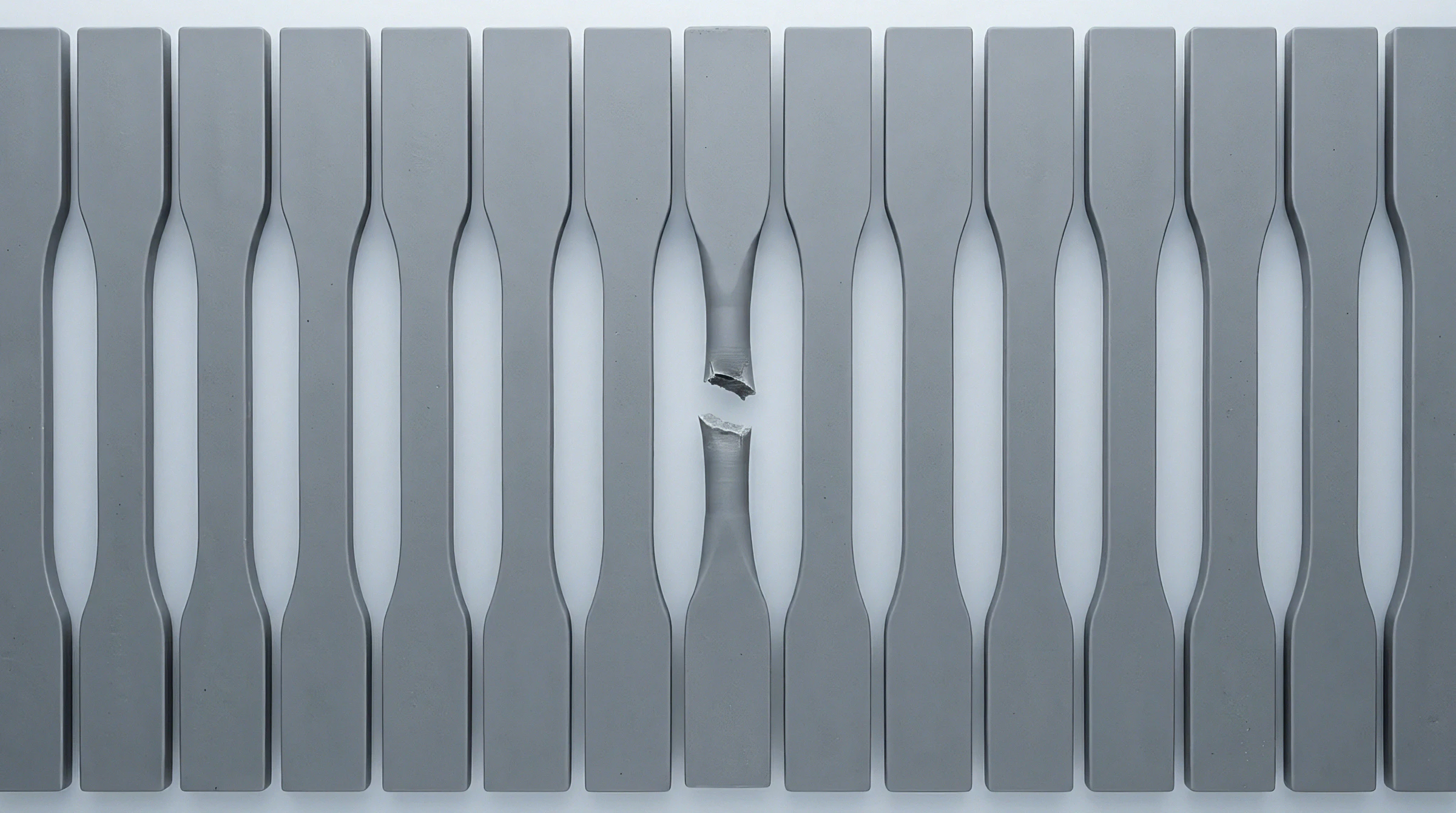
A tensile bar cast in a silicone mold at 30 °C (86 °F) and cured at 50 °C (122 °F) broke at 54 MPa (7,830 psi). The same resin, poured into the same kind of mold preheated to 70 °C (158 °F) and cured at the same 50 °C, broke at 60 MPa (8,700 psi). Both figures come from a 2004 vacuum casting study at the Central University of Technology, Free State, and they sit 11 % apart on one material.
A data sheet prints one tensile strength for a casting resin. The study shows why that number needs its conditions beside it before it can stand on a drawing. Most European casting resin sheets name ISO 527 as the method, and the standard, read for what it covers and what it leaves to the lab, tells a buyer how much the number can carry.
What ISO 527 Covers on a Casting Resin Data Sheet
ISO 527 is the international method for tensile properties of plastics, and casting resins fall inside it. The scope of ISO 527-1, as published by the Estonian standards body, sets out the general principles for determining tensile strength, tensile modulus and other aspects of the stress and strain relationship under defined conditions. It names rigid and semi-rigid thermosetting molding materials among those it suits.
ISO 527-2 then gives the test conditions for molding and extrusion plastics. Its scope names rigid and semi-rigid thermosetting molding and cast materials, which is where a vacuum casting polyurethane belongs, and it states that the multipurpose test specimen of ISO 20753 is preferred. Specimens may be molded to the chosen dimensions or machined from molded plates.
So when a Sika sheet prints “Tensile strength (CQP036-2 / ISO 527) 66 MPa”, the figure is a measurement on a standard specimen, pulled under the conditions the standard defines, after a cure the sheet states in a footnote. It is not a guaranteed property of every part cast from the can.
ISO 527 covers rigid and semi-rigid cast thermosets, measured on standard specimens. A casting resin’s tensile figure is a property of that specimen after that cure, which is why the footnote matters as much as the number.
The Parts of ISO 527 and Which One Applies to Cast Polyurethane
The standard is a family of parts, and the scopes say which material goes where. A buyer reading a sheet can place each figure by its part.
| Document | What its scope covers | Applies to a vacuum cast polyurethane |
|---|---|---|
| ISO 527-1 | general principles for tensile properties of plastics and plastic composites; defines specimen types for the later parts | yes, the principles behind every value |
| ISO 527-2 | test conditions for molding and extrusion plastics, including rigid and semi-rigid thermosetting molding and cast materials | yes, the part for rigid and semi-rigid cast grades |
| ISO 527-3 | flexible films and sheets thinner than 1 mm (0.04 in) | no, except for a film specimen |
| ISO 527-4 and ISO 527-5 | fiber-reinforced composites, textile fibers excluded from part 2 | no, for unreinforced casting resins |
| ISO 1926 | rigid cellular materials, named by ISO 527 as the method for them | only for a foamed grade |
| ISO 20753 | the multipurpose test specimen, preferred by ISO 527-2 | the preferred specimen shape |
Rubbers fall outside ISO 527 on the sheets themselves. Sika prints tensile strength for its UR350 elastomer to ISO 37, the rubber method, while its harder elastomeric resin UR390 is printed to ISO 527. The method on a sheet therefore signals how the maker classes the material, rigid or semi-rigid against rubber.
US sheets add a third method. Sika’s North American sheet for PX 1000 prints tensile strength to ASTM D638: 6,000 psi (41 MPa), with a tensile modulus of 100,000 psi (690 MPa) and 8 % elongation. A value to ASTM D638 and a value to ISO 527 are not interchangeable without a comparison on the same material, since the specimens and conditions are written separately.
How Casting Resin Makers Print ISO 527 Values
The sheets on file show three habits. Sika’s German sheets pair ISO 527 with an internal procedure number (CQP036-2 or CQP036-6) and attach a curing condition to every value marked “A”. Renishaw’s sheets write “527” or “R 527” in a standard column and print the cure in a processing block. One Renishaw sheet, for 8060-2, prints “Not measured” against all three tensile rows.
| Grade | Tensile strength | Tensile modulus | Elongation at break | Cure or post-cure stated for the value |
|---|---|---|---|---|
| Sika PX205 | 25 MPa (3,630 psi) | 530 MPa (76,900 psi) | 100 % | post-cure 80 °C (176 °F), 16 h |
| Sika PX331 | 55 MPa (7,980 psi) | 4,500 MPa (653,000 psi) | 4 % | post-cure 70 °C (158 °F) 1 h, then 80 °C (176 °F) 16 h |
| Sika PX522 with PX521 | 66 MPa (9,570 psi) | 2,400 MPa (348,000 psi) | 7.5 % | post-cure 80 °C (176 °F) 4 h, then 100 °C (212 °F) 16 h |
| Sika PX523 | 68 MPa (9,860 psi) | 2,600 MPa (377,000 psi) | 6 % | post-cure 100 °C (212 °F), 16 h |
| Sika PX 223 HT | 60 MPa (8,700 psi), ISO 527-2:1993 | not printed | 11 % | 70 °C 1 h, 100 °C 1 h, 110 °C 12 h (158, 212, 230 °F) |
| Sika UR390 (elastomeric) | 27 MPa (3,920 psi) | 530 MPa (76,900 psi) | 120 % | cure 70 °C (158 °F), 16 h |
| Sika UR132 (elastomeric) | 50 MPa (7,250 psi) | not printed | 330 % | cure 23 °C (73 °F), 7 days |
| Renishaw 8045 | 32 MPa (4,640 psi) | 970 MPa (141,000 psi) | 55 % | cure 60 min at 60 °C (140 °F); no post-cure printed |
| Renishaw 8040 | 27 MPa (3,920 psi) | 942 MPa (136,600 psi) | 50 % | 90 to 120 min at 70 °C (158 °F); post-cure “None” |
| Renishaw 8060-2 | not measured | not measured | not measured | not applicable |
| Sika PX 1000 (ASTM D638) | 41 MPa (6,000 psi) | 690 MPa (100,000 psi) | 8 % | post-cure 12 h at 70 °C (158 °F) |
Four things in the table bear on a purchase.
- The cure differs on every line. PX331’s value follows 17 hours of post-cure, PX523’s 16 hours at 100 °C (212 °F), 8040’s none at all. A part delivered without the stated post-cure is a different specimen from the one tested.
- The year of the method is sometimes printed. PX 223 HT names ISO 527-2:1993; the Sika German sheets name only “ISO 527”. Current EVS editions on file are ISO 527-1:2019 and ISO 527-2:2012.
- Elongation separates families sharply. Rigid ABS-like grades print 4 to 11 %, the PP-like 8045 and 8040 around 50 to 55 %, and the elastomeric UR grades 120 to 330 %.
- A blank is information. 8060-2 is sold for under-hood use with no tensile figure. Any design that needs one either takes another grade or tests bars of that grade.
Every tensile value on a casting resin sheet comes with a cure, and the cures differ from grade to grade. Comparing two sheets compares two cures as much as two resins.
How Much a Cast Tensile Value Moves in Practice
The 2004 dissertation by F. C.
Aggenbacht tested exactly that. Three silicone molds were made from one machined steel tensile specimen, three polyurethane specimens were cast per experiment, and mold and cure temperatures were varied between 30, 50 and 70 °C (86, 122 and 158 °F). The resin temperature was held at 30 °C (86 °F).
| Experiment | Held constant | Varied | Tensile strength reported |
|---|---|---|---|
| 1.3 | mold at 70 °C (158 °F) | cure from 30 to 70 °C (86 to 158 °F) | fell from 66 to 62 MPa (9,570 to 8,990 psi) |
| 2.2 | cure at 50 °C (122 °F) | mold from 30 to 70 °C (86 to 158 °F) | rose from 54 to 60 MPa (7,830 to 8,700 psi) |
| 2.3 | cure at 70 °C (158 °F) | mold from 30 to 70 °C (86 to 158 °F) | fell from 64 to 61 MPa (9,280 to 8,850 psi) |
The author’s overall reading is that material strength and surface hardness stayed fairly constant as operating conditions changed, and the table bears that out in one sense: no setting moved the strength by more than about 6 MPa (870 psi). In another sense it shows a spread of 54 to 66 MPa (7,830 to 9,570 psi) on one resin and one specimen geometry, depending only on two oven settings. A sheet value is one point inside that kind of spread.
The study also measured each cast dimension ten times around the specimen, and found the scatter in the cast bars much larger than in the machined steel original. A cross-section that varies changes the stress calculated from the same breaking load, which is one more reason a tensile figure belongs to a specimen measured in a lab.
What a Supplier Signs When It Prints an ISO 527 Value
The sheets are explicit about the status of their numbers, and a buyer reading them for a contract should be too.
- Typical, from laboratory tests. Sika’s “basis of product data” states that all technical data are based on laboratory tests and that actual measured data may vary due to circumstances beyond its control.
- Average values on standard specimens. The PX 223 HT and PX 1000 sheets footnote their tables as average values obtained on standardized specimens after the stated post-cure.
- Guidance, with testing left to the user. Renishaw’s sheets state that the information is for general guidance only, not a definitive statement of the product’s properties, and that the user is to conduct its own testing to decide whether the product suits its needs.
None of these is a promise about a cast part. A buyer who needs a tensile figure on the part, rather than on the material, therefore asks for one of two things: test bars cast with the batch, in the same resin lot, mold temperature and post-cure as the parts, pulled to ISO 527-2; or specimens machined from a plate cast with the batch, since the ISO 527-2 scope allows machined specimens as well as molded ones. Either way the order names the standard, the specimen type, the cure and the number of specimens.
A sheet’s ISO 527 value is a typical result on standard bars, offered as guidance. Any tensile requirement on a part is met by bars cast with the batch, or by specimens machined from a plate cast with them, tested to the same standard and cure.
Reading the Modulus and Elongation Columns Together
Tensile strength draws the eye, but for most cast parts the modulus and elongation decide the design. A housing that has to snap, a clip that has to flex or a bracket that has to stay stiff under a screw load all depend on stiffness and on how far the material stretches before it breaks.
The sheets show how widely those two columns move. Sika’s rigid PX331 prints a modulus of 4,500 MPa (653,000 psi) with 4 % elongation; its semi-rigid PX205 prints 530 MPa (76,900 psi) with 100 %. Renishaw’s 8045 prints 970 MPa (141,000 psi) with 55 %. A buyer replacing a thermoplastic part reads those pairs against the part’s job, not the strength alone.
There is one caution on comparing columns across makers. The ISO 527-1 scope describes the methods as giving tensile strength, modulus and other aspects of the stress and strain relationship “under the conditions defined”. Test speed, specimen type and conditioning sit inside those conditions, and the sheets on file do not print them. Two sheets that both say “ISO 527” may have used different specimens or speeds, so a close comparison between grades from different makers is settled on bars tested side by side.
Tensile Values Next to the Heat and Thickness Lines
A tensile figure is printed at room temperature, and the lines printed beside it on the same sheet tell a buyer how far it travels. Sika’s sheets place a heat deflection temperature to ISO 75 method A and a glass transition temperature to ISO 11359 a few rows below the tensile values, under the same curing footnote.
PX205 prints a heat deflection of 55 °C (131 °F), a glass transition of 90 °C (194 °F) and a maximum casting thickness of 5 mm (0.20 in). For PX331 the three are 90 °C (194 °F), 100 °C (212 °F) and 5 mm. PX522 prints 85 °C (185 °F), 95 °C (203 °F) and 10 mm (0.39 in), and PX523 prints 85 °C, 100 °C and 100 mm (3.9 in).
Two readings follow. A part that works warm cannot borrow the room-temperature tensile value. Renishaw’s 8040 sheet, the one on file that prints hardness at three temperatures, shows the scale of the change: Shore D 70 at 23 °C (73 °F), 64 at 60 °C (140 °F) and 37 at 80 °C (176 °F), on a grade whose heat deflection is 65 °C (149 °F). Stiffness and strength fall in the same direction as surface hardness, and a requirement for a warm part is tested warm.
The thickness line matters for the specimen as much as for the part. Test bars named on these sheets are thin: the shrinkage bars on PX205 and PX522 measure 3 mm and 5 mm (0.12 in and 0.20 in) through, inside the 5 mm limit of PX205 and PX331. A part section thicker than the printed maximum cures under different heat from its own reaction, which is why the maker limits it, and the bar no longer represents that section. PX523, sold for clear parts up to 100 mm (3.9 in), is the exception that proves the point, since its sheet ties both demold time and curing to thickness.
The tensile value, the heat deflection and the maximum casting thickness on a sheet describe one cured bar. A part that runs warm, or has sections thicker than the sheet allows, needs its own test.
Writing an ISO 527 Requirement for Cast Parts
A drawing or order that cites ISO 527 for a vacuum cast part is clearer when it states:
- the part of the standard, normally ISO 527-2, and its edition;
- the specimen, normally the multipurpose specimen preferred by ISO 527-2, cast or machined;
- the resin grade and the full cure and post-cure, copied from the maker’s footnote;
- the properties required, strength, modulus and elongation at break, with the minimum for each;
- how many specimens, and whether they are cast with the first article, with each batch or with each resin lot.
That list turns a typical value into an acceptance test. For parts in the tens to a few hundred, cast to a stated grade and cure, the work fits low-volume vacuum casting, and test bars poured with each batch keep the same requirement honest through bridge production until the molded part takes over.
Sources and Further Reading
- EVS-EN ISO 527-1:2019, plastics, determination of tensile properties, part 1, general principles, scope, Estonian Centre for Standardisation and Accreditation
- EVS-EN ISO 527-2:2012, plastics, determination of tensile properties, part 2, test conditions for moulding and extrusion plastics, scope, Estonian Centre for Standardisation and Accreditation
- SikaBiresin PX205, product data sheet, version 01.01, 08-2026, Sika
- SikaBiresin PX331, product data sheet, version 01.01, 08-2026, Sika
- SikaBiresin PX522 with PX521, product data sheet, version 01.01, 08-2026, Sika
- SikaBiresin PX523, product data sheet, version 02.01, 11-2026, Sika
- PX 223 HT, technical data sheet, version 01, February 2021, Sika
- PX 1000 NA, technical data sheet, version 01, February 2021, Sika
- SikaBiresin UR390, product data sheet, version 02.01, 08-2026, Sika
- SikaBiresin UR132, product data sheet, version 03.01, 07-2026, Sika
- SikaBiresin UR350 UR360, product data sheet, version 01.01, 12-2025, Sika
- Data sheet: polyurethane resin 8045, H-5800-0802-04-A, issued 04.2018, Renishaw
- Data sheet: vacuum casting resin 8040, H-5800-0060-03-A, issued 04.2018, Renishaw
- Data sheet: vacuum casting resin 8060-2, H-5800-0597-03-A, Renishaw
- Development and evaluation of a vacuum casting process, F. C. Aggenbacht, M.Tech. dissertation, 2004, Central University of Technology, Free State