Maximum Applicable Temperature

A maximum applicable temperature is the highest temperature at which a part can serve under its real load and time.

Every Maximum Applicable Temperature article of the Vacuum Casting Resources, newest first, each written from published standards, research and makers’ data.

Meaning

A maximum applicable temperature is the highest temperature at which a part can serve under its real load and time. No casting resin sheet on file prints one. ISO 75-1 states that its heat deflection results do not necessarily represent it. The 2 figures are often merged, and the standard keeps them apart. A part’s service limit has to be shown on the part.

Test Limits

ISO 75-1 gives 3 reasons. Real use differs from the test in duration, load and surface stress. The standard rules out using its data for design or for forecasting service behavior. A heat deflection of 85 °C (185 °F) for PX523 or PX522, or 90 °C (194 °F) for PX331, compares materials. None of them is a safe operating limit.
Read More

Part Check Method

A working order starts from the highest temperature the part sees and the load it carries there. That temperature is kept well below the grade’s printed heat deflection. The post-cure behind the printed figure is planned for the delivered part. The wall is checked against the range the test covers. A first article then spends time at that temperature under load, and its shape is checked afterward.

Soak Record

The soak record is short. Grade, cure, soak conditions, support and the change in shape go on it. Subsequent batches of that grade and cure are checked against it.

Margin Shortfall

For a part that sees 85 °C (185 °F), most grades on file print a heat deflection at or below that figure. Only PX331 and Renishaw 6230 sit above it, by 5 °C and 13 °C (9 °F and 23 °F). The choice then moves to another resin family or to a redesign that spreads the load.
Flatness and Warp of Large Vacuum Cast Parts

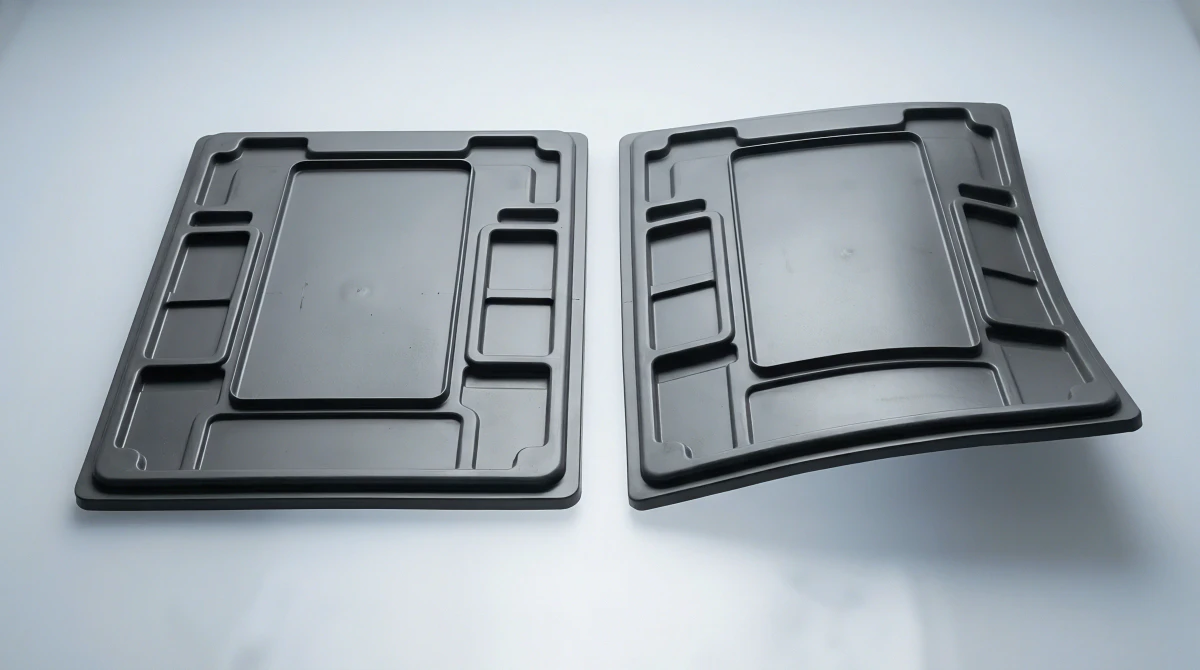
Large vacuum cast panels stay flat through a uniform thin wall, a slow cure, a conformer in post-cure and a temperature kept well below heat deflection.

What Sets Flatness and Warp on a Large Vacuum Cast PartFlatness on a large vacuum cast part is set by five conditions: the heat the resin releases as it cures, the wall thickness against the grade's maximum, how evenly and how long the part cures before demold, whether it is supported during post-cure, and the temperature it later works at. No resin maker, guide or study opened for this piece prints a flatness or warp tolerance for vacuum cast parts.

Rubber-Like Polyurethane Resins From Shore 30 A to 90 A

A rubber-like urethane is specified by grade, hardness method and a tested service temperature, because hardness alone leaves strength and heat behavior open.

Rubber-Like Vacuum Casting Grades and the Hardness Each CoversRubber-like vacuum casting resins are two- or three-component polyurethanes that cure in a silicone mold to an elastomer, with a Shore A hardness chosen for the part. The variable-hardness systems reach the range by adding a third component to a fixed A:B pair.

PP-Like and PE-Like Polyurethane Casting Resins for Vacuum Casting

PP-like and PE-like urethanes trade stiffness for elongation by grade, and their heat figures depend on cure, so the first cast part is tested in its real duty.

What PP-Like and PE-Like Mean on a Casting Resin Data SheetA PP-like or PE-like grade is a two- or three-component polyurethane formulated so that a part cast in a silicone mold behaves, in hand and in a snap fit, more like polypropylene or polyethylene than like a stiff ABS replica. The makers say so in their own words.

Demolding and Post-Curing Vacuum Cast Parts

Each grade prints its own demold time and its own post-cure, and thin or long parts are supported in the oven while it runs.

Demolding Vacuum Cast Parts at 70 °CDemolding means opening the silicone tool and taking the copy out once the resin has gelled and hardened far enough to hold its form. In every sheet on file the tool stays at 70 °C (158 °F) in the oven for that time.

Heat Deflection Temperature of Cast Polyurethane Under ISO 75 and ASTM D648

Heat deflection temperature ranks materials under one loaded test and does not set a service ceiling, so it is read together with post-cure and part geometry.

Heat Deflection as One Loaded Bar TestThe test bends a bar under a fixed load while the temperature climbs, and it records the temperature at which the bar has deflected by a set amount. ISO 75-1 describes the general method for determining the temperature of deflection under load, with flexural stress applied in three-point loading.

Send the Drawing of Your Cast Part

Send the 2D drawing and the 3D file, with the quantity and the stage of the project. An engineer replies within 1 working day.

The quote form, the mutual NDA and the private folder for your files are on Protolis Atelier, with Vacuum Casting chosen.

Request a Quote