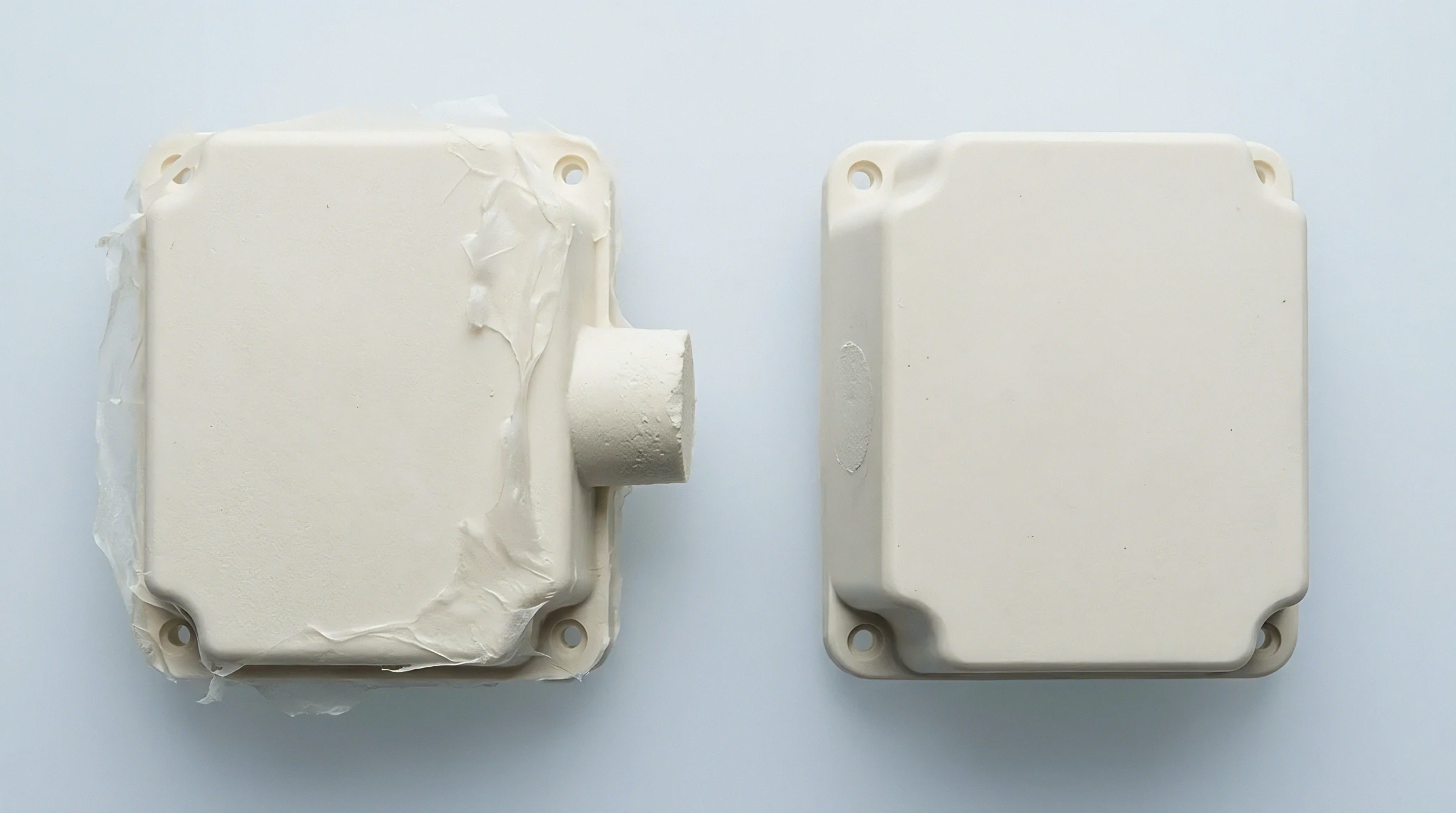
Sika’s technical data sheet for PX 223 HT gives a demold time of 45 to 70 minutes at 70 °C (158 °F) and then asks for a post-cure of 1 hour at 70 °C, 1 hour at 100 °C (212 °F) and 12 hours at 110 °C (230 °F). The part therefore spends about 14 hours in the oven after the tool opens, which is 12 to 19 times longer than it spent inside the tool. One more line on the sheet explains why the order matters: after demolding, support the part in the oven so it keeps its shape.
Demolding and post-curing are the two steps where a cast part is most easily spoiled after the pour has gone well. The tool is opened while the part is still warm and not yet at its full stiffness, and the part then goes back into heat with nothing but its own geometry to hold it. Each maker prints times for both steps, and the numbers differ between grades by an order of magnitude.
Demolding Vacuum Cast Parts at 70 °C
Demolding means opening the silicone tool and taking the copy out once the resin has gelled and hardened far enough to hold its form. In every sheet on file the tool stays at 70 °C (158 °F) in the oven for that time. Renishaw states the sequence in its brochure for vacuum casting systems: the casting is cured at 70 °C, the mold segments are then separated and the part removed, and what remains is to trim and finish it.
The time on the sheet is the earliest point at which the part can come out, set by the thinnest section. Sika gives the PX331 two figures, 45 minutes for a thickness above 3 mm and 75 minutes below 3 mm, and the PX523 a range from 45 minutes at 100 mm down to 3 hours below 5 mm. The thin section is the slow one because it has only the oven for heat, while a thick section warms itself from the reaction inside it.
| Grade | Demold at 70 °C (158 °F) | Post-cure on the sheet | Glass transition on the sheet |
|---|---|---|---|
| Sika PX205 | 60 min | 80 °C (176 °F), 16 h | 90 °C (194 °F) |
| Sika PX331 | 45 min above 3 mm; 75 min below 3 mm | 70 °C for 1 h, then 80 °C (176 °F) for 16 h | 100 °C (212 °F) |
| Sika PX522 | 60 min | 80 °C for 4 h, then 100 °C (212 °F) for 16 h | 95 °C (203 °F) |
| Sika PX523 | 45 min at 100 mm; 3 h below 5 mm | 100 °C (212 °F), 16 h | 100 °C (212 °F) |
| Sika PX 223 HT | 45 to 70 min | 70 °C for 1 h, 100 °C for 1 h, 110 °C (230 °F) for 12 h | 120 °C (248 °F) by TMA |
| Renishaw 6230 | 25 to 60 min | none | 115 °C (239 °F) by TMA |
| Renishaw 8263 | 60 min in the mold | none | not measured |
| Renishaw 8020-2 | 90 min in the mold | none | not measured |
Most Sika values in the property tables carry a footnote that names the post-cure schedule they were measured after. A part opened at the demold time and shipped without the post-cure is therefore a different material state from the one in the table, and a buyer who reads a flexural or tensile figure off a Sika sheet is reading the figure for the post-cured part.
The properties printed for most Sika grades belong to the post-cured part, not to the part that left the tool.
Why the Part Is Not Left Longer in the Tool
Time in the tool is also time on the silicone. Renishaw’s sheets for 6230, 8263 and 8020-2 state that mold life can be increased by using the correct Renishaw release agent and by demolding the casting immediately after curing. The silicone sits at 70 °C throughout, in contact with the copy. Releasing the tool for the next pour is the first purpose of a demold time on a sheet, and holding the part’s shape until the post-cure is the second.
What Comes Out Warm
A part taken out of a 70 °C tool is warm and still has the stiffness of a warm polymer, which is lower than the stiffness it reaches at room temperature. Long, thin or unsymmetrical shapes can bend under its own weight on a bench, and a part carried by the corner can take a set. The answer on the sheets is a support form that holds the part in the posture it had in the tool, and it has a name.
The Conformer and Supported Post-Cure
Three Sika sheets, for PX205, PX331 and PX523, state that further post-curing of the demolded part can improve the final mechanical properties and that, depending on the geometry and weight of the part, a conformer is recommended during post-curing. The PX 223 HT sheet says that after demolding it is necessary to support the part in the oven to maintain its shape, and to ensure the geometry or mass of the part does not present any deformation risk.
A conformer is Sika’s word for a support form that holds the part in its intended shape through the oven. Whether a part needs one follows from its shape and weight, which the sheets say in two words, geometry and weight. A compact part may need none, and a thin-walled, long, flat or heavy part is the case the sheets have in mind.
Post-Cure Temperature Against the Glass Transition Value
On several sheets the highest post-cure temperature sits at or above the glass transition value printed on the same sheet. PX522 is post-cured at 100 °C and lists 95 °C. PX523 is post-cured at 100 °C and lists 100 °C. PX205 at 80 °C and PX331 at 80 °C, with transition values of 90 °C and 100 °C, stay below. A part that has not yet been post-cured has a lower transition temperature than the finished one, and the glass transition value is measured on the post-cured material, so a reading cannot say at which temperature the green part softens. What the pairing shows is that a post-cure is a hot treatment close to the polymer’s softening range, and a supported part is the prudent arrangement.
The Glass Transition and the Deflection Temperature Are Different Measurements
The sheets print two temperatures that buyers often merge. ISO 11359-2 specifies a thermomechanical analysis method for the coefficient of linear thermal expansion and for the glass transition temperature of solid plastics. Heat deflection is covered by ISO 75-1, which gives a general method for the temperature of deflection under load of plastics, in which a flexural stress is applied in three-point loading as the temperature rises. Part 2 of that standard defines method A at 1.80 MPa, method B at 0.45 MPa and method C at 8.00 MPa.
ISO 75-1 also states that its results do not necessarily represent maximum applicable temperatures, because time, loading conditions and surface stress in practice differ from the test, and that the data are not intended for design analysis. A heat deflection figure of 85 °C (185 °F) for PX523 or PX522, or 90 °C (194 °F) for PX331, is a way to compare materials and does not set a safe service temperature for a part.
When More Post-Cure Hurts
Time at temperature has an upper limit on at least one grade. The PX523 sheet says that, to prevent any yellowing of the cast part, the curing time should not exceed 7 days at 70 °C, 48 hours at 80 °C or 16 hours at 100 °C. For this grade the printed post-cure is 16 hours at 100 °C, exactly the third limit, so no margin is left for a second cycle at that temperature.
For a clear lens this is a visible constraint: a part that is rejected and re-treated, or put back in an oven over a long weekend, can use up the whole allowance. The sheets for the other grades on file print no such limit, which means only that no figure was available in those sheets, not that none exists.
| Grade | Condition limit on the sheet | Linear shrinkage printed | Bar and condition |
|---|---|---|---|
| Sika PX205 | none printed | 7 mm/m (0.007 in/in) | 3 x 50 x 250 mm bar, after 80 °C for 16 h |
| Sika PX522 | cast in a mold without resin previously inside | 7 mm/m (0.007 in/in) | 500 x 50 x 5 mm bar |
| Sika PX523 | no yellowing: 7 d at 70 °C, 48 h at 80 °C or 16 h at 100 °C at most | not printed | not applicable |
| Sika PX 223 HT | support the part in the oven | 0 % | 250 x 50 x 3 mm bar in silicone mold, after post-cure |
| Renishaw 6230 | none printed | 0.3 % typical | not stated on the sheet |
| Renishaw 8263 | none printed | 0.3 % typical | not stated on the sheet |
| Renishaw 8020-2 | minimum shot 150 g | 0.2 % typical | not stated on the sheet |
The two makers also differ in what they print for post-cure. Renishaw’s three sheets on file give “none” for the post-curing process, and report heat deflection temperatures of 98 °C (208 °F) for 6230 under ISO 75 at 1.80 MPa and 80 °C (176 °F) for 8263 on a 110 mm by 12.7 mm by 6.4 mm test piece. Sika’s sheets print schedules that run from 14 to 20 hours and give figures measured afterward. Neither approach is wrong, but a buyer comparing an ABS-like grade from one maker with one from the other is comparing a part used as demolded with a part that has been through a long oven treatment.
The shrinkage column shows why post-cure and dimensions are a single topic. A shrink figure comes with a bar size and a schedule, and the part’s own thickness, support and time in the oven all sit between the bar and the real part. The PX 223 HT sheet is the one that states the post-cure within the shrinkage line itself, and it prints zero.
Reading a Demold Time Against the Part’s Thickness
A demold time belongs with a thickness limit, because the same sheet that prints the time also prints the thickest section the grade is meant to fill. Placed side by side, the maximum casting thickness on the sheets on file reads:
- PX205 and PX331, 5 mm (0.20 in),
- PX 223 HT, 5 to 10 mm (0.2 to 0.4 in),
- PX522, 10 mm (0.39 in),
- PX523, 100 mm (3.9 in).
A part with a 12 mm boss in PX331 is therefore outside the sheet’s thickness range before the demold time is even read, and the 45 minutes printed for a thickness above 3 mm does not cover it. Designers who read demold time first and thickness second are likely to pick a grade that the part’s thickest section has already ruled out.
Read the maximum casting thickness before the demold time, since a grade that cannot fill the boss has no demold time that applies to it.
Faults Seen at the Opening and in the Oven
The faults of this stage are few and each leaves a mark that points to its cause. A person opening the tool or unloading the oven can usually tell which one it is without a measurement.
| Fault | How it is seen | Check |
|---|---|---|
| Opened too early | part soft to the nail, parting line distorted, thin rib bent or torn | demold time against the thinnest wall; tool at 70 °C |
| Part sticking in the tool | torn feature on the part or a torn edge in the silicone | release agent applied as the maker directs; demold immediately after curing |
| Bow or twist after post-cure | part no longer lies flat or the ring is out of round | support or conformer used; heat-up in a supported posture |
| Tacky surface | skin that stays soft or marks easily | resin ratio and mix, cure time at 70 °C, wet components |
| Yellowing of a clear part | yellow cast against a clear reference | total hours at temperature against the sheet limit |
| Dimensions off after post-cure | features move between the as-cast and the post-cured measurement | measure at the same stage each time, after cooling |
Measuring After Post-Cure
Dimensions and hardness are read after the part has cooled and settled. ISO 291 sets out standard atmospheres for conditioning and testing of all plastics and all types of test specimen at constant atmospheric conditions, and a part that goes from a 100 °C oven to a gauge on the bench is read in a different state from the one it will have a day later. A buyer who writes a measuring condition into a drawing or a specification, such as parts conditioned to a stated atmosphere before inspection, removes a source of argument at the cost of one line.
Three decisions go into that line, and each one is the buyer’s to set:
- the stage at which the part is measured, as cast or after post-cure,
- the time and atmosphere for cooling and conditioning before the reading,
- the support state, which means whether the part is measured free or clamped to a fixture.
After the tool opens and the part comes out, what matters is time, temperature and support.
A part that is measured warm, unsupported and as cast will not match the same part measured cold, supported and post-cured, and both numbers are correct.
What the Step Does to the Calendar
Demolding fixes the tool’s turnaround, since one tool cannot be poured again until its copy is out. Post-cure fixes the batch’s end date, since the schedules on the sheets run from 14 hours on PX 223 HT to 20 hours in two stages on PX522, and every copy has to complete it before it ships. The first of these scales with the number of copies per tool and the second with the number of batches of parts through the oven.
For a short run in a grade with no post-cure, such as Renishaw 8263 at 60 minutes in the mold, the oven timeline ends with the last demold. With a clear or technical grade on a 14 to 16 hour post-cure, the timeline ends the next morning at the earliest. A buyer who needs both a high property level and a short delivery is therefore choosing between a grade with a short demold and no post-cure and a grade whose figures need the longer schedule, and a conversation about a low-volume vacuum casting batch that grows toward bridge production is better held with the post-cure column of Table 1 open.
Sources and Further Reading
- Sika, PX 223 HT, technical data sheet, version 01, 2021
- Sika, SikaBiresin PX523, product data sheet, version 01.01
- Sika, SikaBiresin PX205, PX331 and PX522 product data sheets, version 01.01 (08-2026), industry.sika.com
- Renishaw, Data sheet: vacuum casting resin 6230, issued 09.2015
- Renishaw, Data sheet: vacuum casting resin 8263, issued 05.2015
- Renishaw, Data sheet: vacuum casting resin 8020-2, issued 04.2018
- Renishaw, Brochure: Vacuum casting systems, issued 10.2017
- ISO, ISO 75-1:2020, Plastics, determination of temperature of deflection under load, Part 1 general test method (scope as published by the Estonian Centre for Standardisation and Accreditation)
- ISO, ISO 75-2:2013, Plastics, determination of temperature of deflection under load, Part 2 plastics and ebonite (scope as published by evs.ee)
- ISO, ISO 11359-2:2021, Plastics, thermomechanical analysis, Part 2 coefficient of linear thermal expansion and glass transition temperature (scope as published by evs.ee)
- ISO, ISO 291:2008, Plastics, standard atmospheres for conditioning and testing (scope as published by evs.ee)