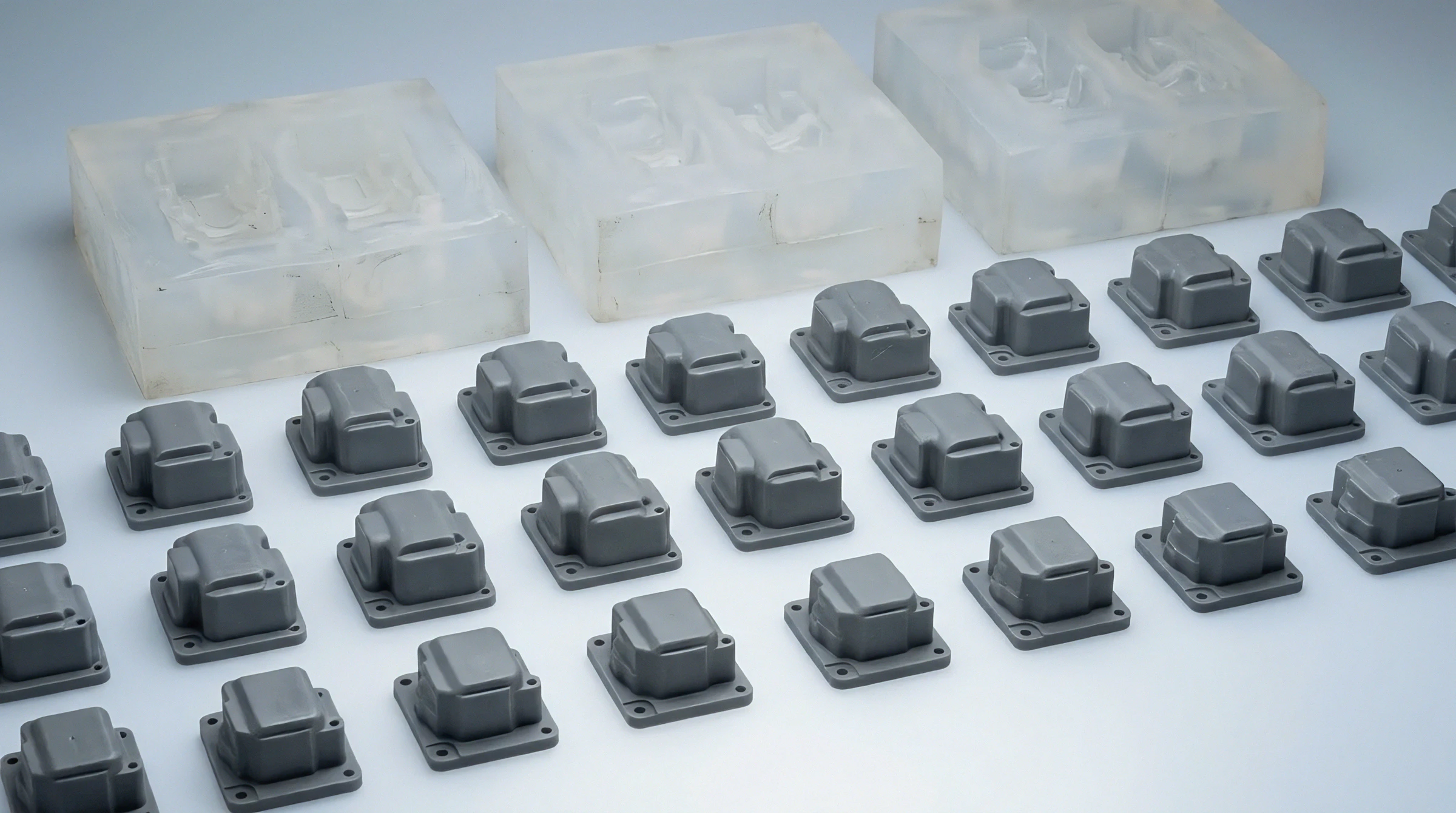
Renishaw’s brochure promises first parts within 24 hours of a master model. A guide from Formlabs, a 3D printer maker, puts a full job at about 10 days from master model to cast parts and one machine at up to 50 castings in two days. The two statements describe different things: the first is the moment the first copy exists, the second is when the batch is done, and the days between them are the production run.
This piece follows that run for a buyer who has a quantity in mind, not a part. It counts the silicone molds a quantity needs, the masters and cures they take, the days those pours take on one chamber, and the inspection that has to cover copies from several tools. The tool count follows from a copy count per mold that no one can print as a guarantee, so each table below states its assumption in its caption.
How Many Silicone Molds a Vacuum Cast Batch Needs
The tool count is the quantity divided by the copies one tool gives, rounded up. Renishaw states that a mold can produce up to 50 parts before retooling and typically between 30 and 50 colour matched parts. Table 1 uses 50 and 30 from that brochure, and adds 15 as a planning floor for a resin or a geometry that is hard on the silicone. The 15 is an assumption of this piece, since no maker sheet on file prints a lower figure.
| Parts in the batch | 15 copies per mold (planning floor) | 30 copies per mold | 50 copies per mold |
|---|---|---|---|
| 10 | 1 | 1 | 1 |
| 25 | 2 | 1 | 1 |
| 50 | 4 | 2 | 1 |
| 100 | 7 | 4 | 2 |
| 250 | 17 | 9 | 5 |
| 500 | 34 | 17 | 10 |
| 1,000 | 67 | 34 | 20 |
The rounding is part of the information. A batch of 50 needs one tool at the ceiling and two at the working figure, and a batch of 51 needs two at the ceiling, so a small increase in quantity can add a whole tool and its day of silicone cure. Whenever a quantity sits close to a multiple of the supplier’s copy count, the question to ask is what the plan is, not whether the quantity is right.
Because tools are counted in whole numbers, a batch that sits just over a multiple of the copies per mold pays for an extra tool.
Tools From One Master Come One After Another
Each mold is cast around the master and the master stays inside the frame until the silicone has cured and the block is cut open, so a second tool from the same master waits for the first. The Vacusil 2000 sheet gives a pot life of 90 minutes and a cure of 24 hours at 23 °C, and Wacker describes the cure of its ELASTOSIL silicone as fast and non-shrink at room temperature, with heat able to speed it up. Four tools from one master therefore take about four silicone cures in sequence, while four copies of the master turn the same work into one cure in parallel.
This is reasoning from how the process works, not a figure on a sheet, and it explains why a supplier asked about a larger quantity answers with a number of masters and a number of tools, two figures and not one. A master that is damaged when a tool is cut open puts the plan back to the start.
Colors and Grades Split a Batch Into Smaller Ones
A batch described as 300 parts is rarely 300 identical parts. Every resin grade and every color is a separate pour, and Renishaw counts its 30 to 50 per mold as colour matched parts. Sika’s clear grade PX522 asks for a mold without resin previously inside, which means a clear grade does not share a tool with any other resin.
| Split of the 300 parts | Tools at 30 copies per mold | Tools at 50 copies per mold |
|---|---|---|
| one color, 300 parts | 10 | 6 |
| three colors, 100 each | 12 | 6 |
| four colors, 100, 80, 70 and 50 | 12 | 7 |
| six colors, 50 each | 12 | 6 |
| seven colors, 43 or 42 each | 14 | 7 |
At 30 copies per mold, the same 300 parts need 10 tools in one color and 12 in three, and 14 when seven shades are asked for. With 50 per mold the extra tools mostly vanish, except where an uneven split leaves a color with a few parts over a multiple, as the four-color case shows. The pigment sheet limits also matter, since Renishaw states no more than 2 % of total weight in colour pigment for 6230 and 8263 and no more than 1 % for 8020-2, and Sika’s PX331 sheet asks for CP colors tested for its resins. A supplier that matches a color is working inside those limits.
A Short Batch in Several Grades
A pilot build of 25 parts in 3 different grades needs at least 3 tools whatever the copy count, because no mold serves two resins. Seen in tools, a quantity that looks small is a handful of small batches, each with its own first part.
The Calendar From Master to Last Copy
The time a batch takes is the sum of a few blocks that the sheets let a buyer read, with one assumption for the throughput of the casting chamber. Because each pour needs the two components degassed for 10 minutes, mixed for 45 seconds to 3 minutes by grade, poured, and the air let back in before the pot life ends, the chamber is the shared machine.
The blocks, each with its source:
- master to first parts: within 24 hours, as a stated capability (Renishaw brochure),
- silicone cure per tool: 24 hours at 23 °C, shorter with heat (Vacusil 2000 sheet, Wacker product page),
- resin component degassing: 10 minutes each (Sika PX523 and PX331, Renishaw resin sheets),
- mixing in vacuum: 45 seconds to 3 minutes (Renishaw 8020-2, Sika PX523),
- pot life: 3 minutes 40 seconds at 35 °C for Renishaw 6230 up to 20 minutes for Sika PX523 at 23 °C,
- demold in the oven at 70 °C: 25 minutes for Renishaw 6230 up to 3 hours for Sika PX523 in thin walls,
- post-cure: none on the Renishaw sheets, 14 to 20 hours on the Sika schedules,
- a full job from master model to cast parts: about 10 days, and one machine at up to 50 castings in two days (Formlabs guide).
Days of Pouring at Two Rates
Pouring days follow from the number of copies and the pours the chamber completes in a day. The Formlabs figure of up to 50 castings in two days gives 25 pours a day. As an alternative, this piece assumes a more cautious 12 pours a day, which corresponds to a 40-minute slot per pour over a working shift and allows for the 10-minute degassing, the mix, the pour, the reload and a pause for the next set of tools to come out of the oven. The figure of 12 is an assumption and the 25 is a published claim, and the two bracket what a buyer is likely to be quoted.
| Parts in the batch | At 12 pours a day | At 25 pours a day |
|---|---|---|
| 25 | 3 | 1 |
| 50 | 5 | 2 |
| 100 | 9 | 4 |
| 250 | 21 | 10 |
| 500 | 42 | 20 |
| 1,000 | 84 | 40 |
A batch in the hundreds is already a matter of weeks of pouring on one chamber, and a batch of 1,000 is a matter of months. More chambers shorten the calendar but also multiply the masters, the ovens and the people, and the figures say nothing about how a particular supplier is set up.
At the published pace, 1,000 parts take about 40 working days of pouring on one chamber, before silicone cure, post-cure or inspection.
What Shipping Waits On
The pour is not the end. Each Sika grade with a post-cure needs 14 to 20 hours of oven time, so the last copy of the last pour is not ready until the next day at the earliest. For a batch in a grade with a post-cure, the last copy of the batch is ready to measure on the morning after its last pour, and the inspection that follows adds its own day. On Renishaw grades with no post-cure, the final demold ends the production run.
One Batch Worked Through
Take 120 parts in two colors, 80 in one and 40 in the other, and plan at 30 copies per mold. Table 1’s logic gives 3 tools for the first color and 2 for the second, 5 tools in all. From one master, 5 silicone cures in sequence take about 5 days at 24 hours each, and from five copies of the master they take 1. Pouring 120 copies takes 10 days at 12 pours a day and 5 days at 25. A post-cure of 14 to 20 hours adds a day, and inspection adds another.
Added without overlap, that is 5 + 10 + 1 + 1 = 17 working days at the upper end. At the lower end, with five masters and the published pace, it is 1 + 5 + 1 + 1 = 8. The Formlabs figure of about 10 days for a full job sits inside that spread. Pouring can start as soon as the first tool is cut open, so real schedules fall between the two ends, and the useful result is that a buyer can place a supplier’s quote on the spread and ask what makes up the difference.
Deliveries Share the Tools Until They Wear Out
A batch delivered in two parts does not need the tools twice. The same molds pour the second delivery until they have given their copies, so splitting 120 parts into two deliveries of 60 uses the same 5 tools if the supplier keeps them in good order between deliveries. A buyer whose second delivery arrives after weeks gets the same parts from molds that have been stored in between, which is a reason to agree in writing whether the second delivery counts as a continuation or as a new batch with new first parts.
Inspecting Copies From Several Tools
Each tool is a new cavity, so each tool has its own first part. A batch of 100 made from 4 tools holds four small populations of copies, and the inspection plan that fits it measures within each tool and not across the pool.
A sensible plan has four elements, and a buyer can ask a supplier which of them it uses:
- a first article from each tool, measured on the features the drawing marks,
- a later copy from the same tool, to show whether the tool has drifted,
- a hardness reading and a color check on parts from each pour,
- a marking or lot record that ties each copy to its tool and pour.
The hardness reading in that list needs a temperature beside it. Renishaw’s sheet for resin 8263 prints a Shore hardness of 83 D at 23 °C and 80 D at 60 °C and at 80 °C, measured to ISO 868, and Sika’s sheets print Shore D values to the same standard after the post-cure named in their footnotes. A reading taken on a warm part straight from the oven is not the number on the sheet, and a color check made under a different light from the reference one is not a color check.
Within a batch the inspection unit is the tool, since each tool is a separate cavity and a separate set of first parts.
The Tolerance Reference and Its Limit
ISO 20457, which the evs.ee catalog lists as withdrawn from 6 August 2026 in favor of ISO 20457:2026, specifies manufacturing tolerances for plastic molded parts. Its scope names injection molding, injection compression molding, transfer molding, compression molding and rotational molding, and it applies to other plastic processes if the contractual parties agree. Vacuum casting is not named, so a buyer who wants the standard’s tolerance classes on cast parts writes it into the order, and it applies from then on by agreement.
Conditioning Before the Reading
ISO 291 sets standard atmospheres for conditioning and testing all plastics. A cast part that has just left a post-cure oven is measured in a different state from one that has rested in a conditioned room, so a specification names the atmosphere and the rest time before it names the tolerance. The readings can then be compared across tools and across deliveries.
Questions to Put to a Supplier About a Batch Plan
A plan worth trusting answers each of these in numbers that belong to the buyer’s parts:
- the copies per mold it plans with, and the resin, color and geometry that figure was taken on,
- the number of tools, the number of colors and grades, and how the quantity splits across them,
- the pours per day it expects from its own equipment, and the delivery dates that follow,
- the post-cure schedule, its hours at temperature, and the day the oven is free,
- the inspection plan per tool, the standard or drawing tolerance it measures against, and how the copies are marked.
The answers matter more than the numbers in the tables above, since the tables are the buyer’s way to check that the quoted calendar is plausible. A supplier that quotes 5 working days for 250 parts has either more than one chamber or a very different method, and the buyer is entitled to ask which.
When the Calendar Decides the Process
At 250 parts or more per resin and color, Table 1 shows 5 to 17 silicone tools and Table 4 shows 10 to 21 working days of pouring on one chamber. Past that point the timeline, the number of first parts to check and the spread of colors between tools carry the decision, and the question is whether the order still fits low-volume vacuum casting, or has grown into bridge production toward a hard tool.
Sources and Further Reading
- Renishaw, Brochure: Vacuum casting systems, issued 10.2017
- Renishaw, Data sheet: Vacusil 2000 silicone rubber, issued 10.2017
- Renishaw, Data sheet: vacuum casting resin 6230, issued 09.2015
- Renishaw, Data sheet: vacuum casting resin 8263, issued 05.2015
- Renishaw, Data sheet: vacuum casting resin 8020-2, issued 04.2018
- Sika, SikaBiresin PX523, product data sheet, version 01.01
- Sika, SikaBiresin PX331 and PX522 product data sheets, version 01.01 (08-2026), industry.sika.com
- Sika, PX 223 HT, technical data sheet, version 01, 2021
- Wacker Chemie, ELASTOSIL M 4645 A/B, room temperature curing silicone rubber (RTV-2)
- Formlabs, Guide to Vacuum Casting (Urethane Casting)
- ISO, ISO 20457:2018, Plastics moulded parts, tolerances and acceptance conditions (scope as published by evs.ee)
- ISO, ISO 291:2008, Plastics, standard atmospheres for conditioning and testing (scope as published by evs.ee)