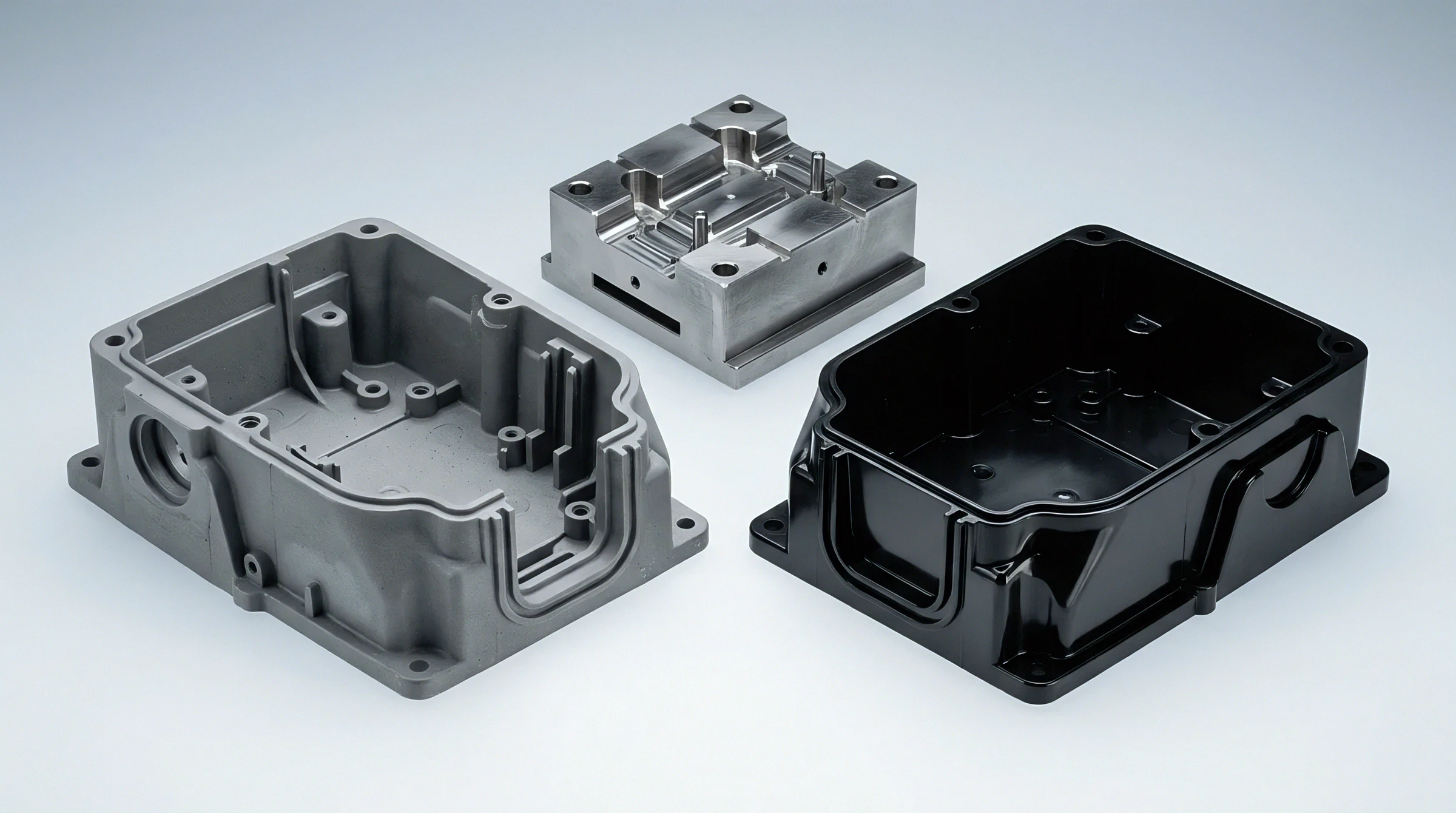
A moldmaker asked how many parts a mold will make often answers by its class: a Class 101 mold, in the industry’s classification, should produce up to a million cycles, as a Plastics Technology column on mold life puts the usual reply. A silicone tool for vacuum casting gives 30 to 50 colour matched copies by Renishaw’s account. One mold of that class therefore stands for the output of 20,000 to 33,000 silicone tools, and somewhere between one silicone tool and that number sits the point where a cast plan gives way to steel.
The distance between those two ends is where a buyer’s quantity lives, and the decision to leave silicone for steel or aluminum is made somewhere in it. What decides it is tool counts, pouring days, colors, repeat orders and the amount of re-measuring a change of process forces on a design that has been approved in cast urethane.
Where Silicone Tools Stop and the First Injection Mold Starts
Injection molds are rated in classes by the construction they are built to and the cycles they are expected to give. The classification belongs to the plastics industry’s trade body, PLASTICS, formerly the Society of the Plastics Industry, and its own text was not opened for this piece. Its classes run from 101, built for the longest production, down to 105, a prototype mold, and the class gives a buyer and a toolmaker one name for a level of construction.
| Parts in the run | Silicone tools at 50 copies | Silicone tools at 30 copies | What the count says |
|---|---|---|---|
| 500 | 10 | 17 | a dozen tools, still a cast plan |
| 5,000 | 100 | 167 | a hundred tools, past what a cast plan holds |
| 100,000 | 2,000 | 3,334 | thousands of tools, injection territory |
| 1,000,000 | 20,000 | 33,334 | the cycle count a Class 101 mold is usually quoted for |
The first rows are the useful ones for a bridge buyer. A few hundred parts is the quantity at which a silicone plan stops being a handful of tools and starts being a dozen, and a few thousand is where the tool count itself becomes the argument for a metal mold. Beyond that, nothing in a vacuum cast plan scales.
At a few hundred parts a cast plan needs a dozen silicone tools. At a few thousand it needs a hundred, and a single metal mold takes over.
What the Class Does Not Say
A class describes the construction of the mold and the cycles it is expected to give, not the part it makes. The Plastics Technology column goes further: its author calls the stated cycle counts a guideline that many people wrongly treat as factual or contractual, notes that a well-built Class 101 mold can fail in its first minutes from a filled manifold, and that soft aluminum molds have run trouble-free for more than a decade. The class says nothing about the material, the number of cavities, the tolerance or the finish, which means it is a first filter and not a specification.
Signals That a Cast Batch Is Outgrowing Silicone
No single quantity ends a vacuum cast plan, but several signals appear together as a quantity grows. A buyer can check each against the order in hand.
- the tool count: 250 parts need 5 to 17 silicone tools at 50 and 15 copies per mold, and 1,000 parts need 20 to 67,
- the pouring days on one chamber: 250 parts take 10 to 21 working days and 1,000 parts take 40 to 84, at 25 and at 12 pours a day,
- the number of colors and grades, each of which adds tools of its own,
- repeat orders, each of which starts again from the master and a new set of first parts,
- the spread between copies from the first and the last tool of a batch, set against the drawing’s tolerance.
The two arithmetic rows come from the same counts used in the piece on batch tools and lead time. They are assumptions about copies per mold and pours per day, stated there, and they are meant to be replaced with the supplier’s own.
Repeat Orders Matter More Than the First Order
A one-off batch of 300 can be absorbed as a one-off. Ordered every quarter, a part turns the same count into a standing load of tools, masters and first articles, and it is the repeat pattern, more than the size of any single order, that moves a buyer toward a hard tool. Asked about the next six deliveries rather than the next one, a supplier gives a more honest answer about silicone.
Pilot Quantities That Are Still Cast Quantities
A pilot build, a pre-series for a trade show, a clinical or field evaluation set and a first customer shipment of tens of parts all sit comfortably in silicone. The signals above are not triggered by them, and a buyer who moves to a hard tool at that stage commits a design to steel before the field has told it anything.
A Quantity Ladder Read Against the Tool Counts
Four quantities show how the signals build. Each line gives silicone tools at 50 and at 30 copies per mold, then working days of pouring at 25 and at 12 pours a day, all calculated from the assumptions stated in the batch piece of these resources:
- 25 parts: 1 tool at either count and 1 to 3 days of pouring, a quantity that silicone carries without a second thought,
- 100 parts: 2 to 4 tools and 4 to 9 days, still a cast batch with a plan to check,
- 500 parts: 10 to 17 tools and 20 to 42 days, the range where a single prototype-class metal mold starts to cover the same copies as a dozen silicone tools,
- 2,000 parts: 40 to 67 tools and 80 to 167 days, a figure that no one plans as a cast batch.
The ladder shows no cliff. It shows a slope, and the point on the slope at which a buyer steps off depends on the repeat pattern, the colors and the stability of the design, more than on the parts count alone. A supplier that quotes silicone for 2,000 parts is quoting a different business from one that quotes it for 100, and the buyer’s first question is how many tools and chambers that business has.
Between 100 and 500 parts the tool count grows four to five times, which is the stretch in which a hard tool begins to be a reasonable question.
Inspecting the First Molded Parts Against the Cast Approval
First parts from an injection mold are first articles in the full sense, and the approval that was given to cast parts does not transfer to them. The comparison that matters is between the molded parts and the drawing, with the cast parts as a visual and functional reference only.
Two details of the measurement carry over from the cast phase. Conditioning comes first: ISO 291 sets standard atmospheres for conditioning and testing all plastics, so a part measured warm from the machine and one measured after a rest in a conditioned room are different parts for the purpose of a tolerance. And a tensile result is read against the method that produced it, since ISO 527-1 gives the general principles for tensile properties under defined conditions, with specimen types suited to different materials. A buyer who asks for the tensile figure of a molded resin and compares it to the figure on a cast grade’s sheet is comparing two sets of conditions unless the sheets name the same method.
Each cavity of a multi-cavity mold is its own first article, in the way each silicone tool was its own cavity. A four-cavity mold gives four sets of first parts, and a plan that measures one cavity and assumes the rest repeats the weakest habit of the cast phase at a larger scale.
What Changes When the Material Changes
A cast polyurethane is not the resin the production mold will use. Sika describes PX331 as having mechanical properties similar to thermoplastics like filled ABS and PX205 as similar to polypropylene and HDPE, and Renishaw describes resin 6230 as having properties similar to ABS. The word is similar, and similar is a statement about a family of properties, not about every one of them.
| Grade | Heat deflection temperature | Glass transition | Tensile strength | Shore |
|---|---|---|---|---|
| Sika PX331 | 90 °C (194 °F), ISO 75A, post-cured | 100 °C (212 °F), ISO 11359 | 55 MPa (8,000 psi), ISO 527 | 86 D, ISO 868 |
| Sika PX205 | 55 °C (131 °F), ISO 75A, post-cured | 90 °C (194 °F), ISO 11359 | 25 MPa (3,600 psi), ISO 527 | 70 D, ISO 868 |
| Renishaw 6230 | 98 °C (208 °F), ISO 75 at 1.80 MPa | 115 °C (239 °F), TMA | 67 MPa (9,700 psi), ISO 527 | 83 D at 23 °C, ISO 868 |
The sheets for the three grades give figures measured on cast test pieces, in the post-cured state where the sheet says so. A molded part in the real thermoplastic has its own datasheet values, measured on molded bars, and the first comparison between the two is made on those two sheets, not on the cast part’s reputation. ISO 75-1 states that its heat deflection results are for comparing materials and are not a prediction of end-use performance, so the same caution applies to both.
Shrink Changes Hands From the Silicone to the Steel
Cast grades print linear shrinkage figures of 0.2 % for Renishaw 8020-2, 0.3 % for 6230 and 8263 and 7 mm/m (0.7 %) for Sika PX205 in a 3 x 50 x 250 mm bar after post-cure. Those figures are for the resin in a silicone tool at 70 °C. An injection mold shrinks its own resin by an amount that depends on that resin, the mold and the process, and the first mold is made with an allowance that cannot be taken from the cast part. The dimensions that a buyer approved on cast parts are therefore a drawing’s intent, to be confirmed again on the first molded part.
What Carries Over and What Restarts
| Item | Carries over | Restarts |
|---|---|---|
| the drawing’s critical dimensions | yes, as the requirement | measured again on molded first articles |
| the master model | as a reference for shape | not a tool; the mold is cut from CAD data |
| material properties | the performance target | datasheet values and tests of the molded resin |
| color | the reference sample | a color match in the production resin |
| tolerance reference | the standard agreed | classes and general tolerances agreed for the molded part |
| first article inspection | the method | every dimension and each cavity |
ISO 20457 specifies manufacturing tolerances for plastic molded parts and names injection molding, injection compression molding, transfer molding, compression molding and rotational molding in its scope. The evs.ee catalog lists the 2018 edition as withdrawn from 6 August 2026 with ISO 20457:2026 as its successor. A buyer who moves to a molded part has a reference that was written for it, which a cast part never had unless the parties agreed one.
Aluminum or Soft Steel as the Middle Step
Between silicone and a hardened steel mold sits the lower end of the class scale: molds of aluminum or mild steel, built for limited production. A tool of that kind is a bridge in its own right: it makes the production resin, in the production process, in a quantity range that silicone cannot reach, and it can be followed by a harder class once the design has stopped changing. Its life is a question for the toolmaker, and the Plastics Technology column’s warning about cycle counts applies to it as much as to a hardened mold.
The decision from there is one of design stability. A design that has changed three times in the cast phase is a poor candidate for any metal, and the same design after a stable pilot is a good one. Silicone is the stage at which a design is allowed to change, and a mold of any class is the stage at which it is asked to stop.
Cast urethane lets a design change by pouring a new silicone tool, and an injection mold asks the design to be finished first.
Keeping Cast Supply Running While the Mold Is Made
Making a mold takes longer than the days a silicone tool takes, and the supply of parts does not stop while it is. A common arrangement is an overlap: cast batches continue for the quantities that are due, the first molded parts are approved against the drawing, and the last cast delivery is poured when the approval is signed. During the overlap the design is frozen, because a change that reaches the silicone and not the steel gives two versions of the part in the field.
Tool counts and pouring days from the tables of these resources give the overlap its size. The production mold’s own lead time is the supplier’s to state and is not on any public sheet, so the overlap has to be asked for in days and not assumed. Each month of overlap is a number of cast batches, each batch a number of tools, and the buyer who writes that number down knows how long the cast supply has to be kept alive.
Questions to Settle Before the First Mold Is Ordered
A short list turns the signals into a decision that can be recorded:
- the quantity expected over the first year and over the life of the part, in parts and in repeat orders,
- the colors and grades the part will come in, and which of them are fixed,
- the mold class that fits the quantity, and whether a lower class is a deliberate bridge,
- the tolerance reference, such as ISO 20457 or the drawing’s own general tolerances, agreed for the molded part,
- who approves the first molded articles, against which dimensions, and with which conditioning before the reading.
An answer to each one fixes a part of the first molded run before it starts. The decision to move is then a matter of reading the tool-count and calendar signals against the quantity, and of seeing whether the supplier still describes the order as low-volume vacuum casting or has begun to describe it as bridge production toward a hard tool.
Sources and Further Reading
- Plastics Technology, How Many Parts Will My Mold Make? Part 1
- Renishaw, Brochure: Vacuum casting systems, issued 10.2017
- Renishaw, Data sheet: vacuum casting resin 6230, issued 09.2015
- Renishaw, Data sheet: vacuum casting resin 8263, issued 05.2015
- Renishaw, Data sheet: vacuum casting resin 8020-2, issued 04.2018
- Sika, SikaBiresin PX331 and PX205 product data sheets, version 01.01 (08-2026), industry.sika.com
- ISO, ISO 20457:2018, Plastics moulded parts, tolerances and acceptance conditions (scope as published by evs.ee)
- ISO, ISO 527-1:2019, Plastics, determination of tensile properties, Part 1 general principles (scope as published by evs.ee)
- ISO, ISO 291:2008, Plastics, standard atmospheres for conditioning and testing (scope as published by evs.ee)
- ISO, ISO 75-1:2020, Plastics, determination of temperature of deflection under load, Part 1 general test method (scope as published by evs.ee)