Shore D

Shore D is the durometer hardness scale for harder plastics, read from how far a spring-loaded indenter presses into the surface.

Every Shore D article of the Vacuum Casting Resources, newest first, each written from published standards, research and makers’ data.

Meaning

Shore D is the durometer hardness scale for harder plastics, read from how far a spring-loaded indenter presses into the surface. ISO 868 assigns type D to harder materials and type A to softer ones. Every rigid casting resin in these resources states its hardness on the D scale. The letter D follows the word Shore and is part of the scale’s name.

Readings by Grade

Rigid grades on file fall between D 70 and D 86. PX331 and PX523 give 86, PX522 gives 85 and PX 223 HT gives 80. Renishaw 6230 and 8263 give 83 at 23 °C (73 °F). PX205 is the low outlier at 70, since it is built to resemble polypropylene and HDPE.
Read More

Footnote Letter

A letter after the number is a different thing from the scale letter. On the PX331 sheet, the A after Shore D 86 is a footnote marker for the post-cure. A quote that reads it as Shore A 86 describes a hard rubber. The same grade on the D scale is a rigid plastic with a flexural modulus of 3,700 MPa (537 ksi).

Temperature Dependence

Renishaw gives 3 readings for 8263, the only grade on file with more than one. It reads 83 at 23 °C (73 °F) and 80 at both 60 °C and 80 °C (140 °F and 176 °F). In use at 70 °C (158 °F), a part from that grade sits near the lower reading. Sika gives a single reading and leaves the temperature out.

Cure State

The Sika values belong to parts after a post-cure. A part straight from a 70 °C (158 °F) demold reads under the printed Shore D. Renishaw reads its parts without post-cure and does not state the delay between demold and reading.

Acceptance Role

A Shore D reading checks whether a batch matches the last one. It says nothing reliable about stiffness, wear or strength. Renishaw’s 8263 also shows why the reading temperature goes on the record.
Flatness and Warp of Large Vacuum Cast Parts

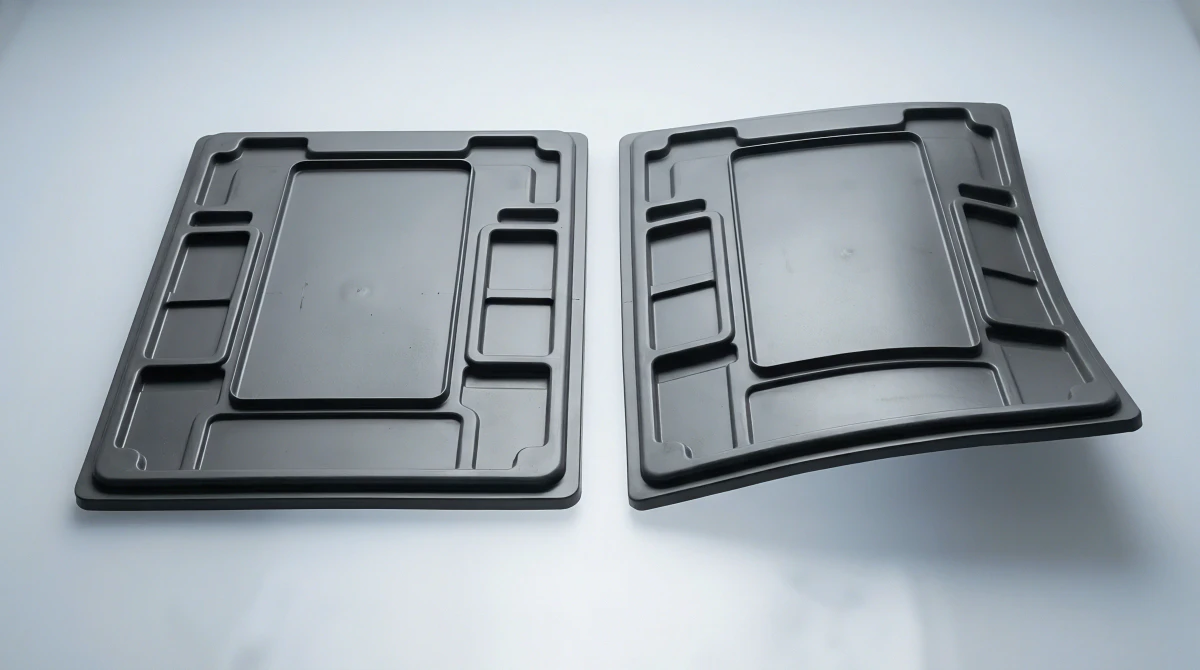
Large vacuum cast panels stay flat through a uniform thin wall, a slow cure, a conformer in post-cure and a temperature kept well below heat deflection.

What Sets Flatness and Warp on a Large Vacuum Cast PartFlatness on a large vacuum cast part is set by five conditions: the heat the resin releases as it cures, the wall thickness against the grade's maximum, how evenly and how long the part cures before demold, whether it is supported during post-cure, and the temperature it later works at. No resin maker, guide or study opened for this piece prints a flatness or warp tolerance for vacuum cast parts.

ISO 527 Tensile Values on Polyurethane Casting Resin Data Sheets

A tensile value on a casting resin sheet belongs to standard bars after one stated cure, so a requirement on parts is set on bars cast and cured with the batch.

What ISO 527 Covers on a Casting Resin Data SheetISO 527 is the international method for tensile properties of plastics, and casting resins fall inside it. The scope of ISO 527-1, as published by the Estonian standards body, sets out the general principles for determining tensile strength, tensile modulus and other aspects of the stress and strain relationship under defined conditions.

PP-Like and PE-Like Polyurethane Casting Resins for Vacuum Casting

PP-like and PE-like urethanes trade stiffness for elongation by grade, and their heat figures depend on cure, so the first cast part is tested in its real duty.

What PP-Like and PE-Like Mean on a Casting Resin Data SheetA PP-like or PE-like grade is a two- or three-component polyurethane formulated so that a part cast in a silicone mold behaves, in hand and in a snap fit, more like polypropylene or polyethylene than like a stiff ABS replica. The makers say so in their own words.

Silicone Molds, Pours and Lead Time for a Vacuum Cast Batch

A batch needs one silicone mold per set of copies, per resin and per color, and pours run one at a time through the chamber.

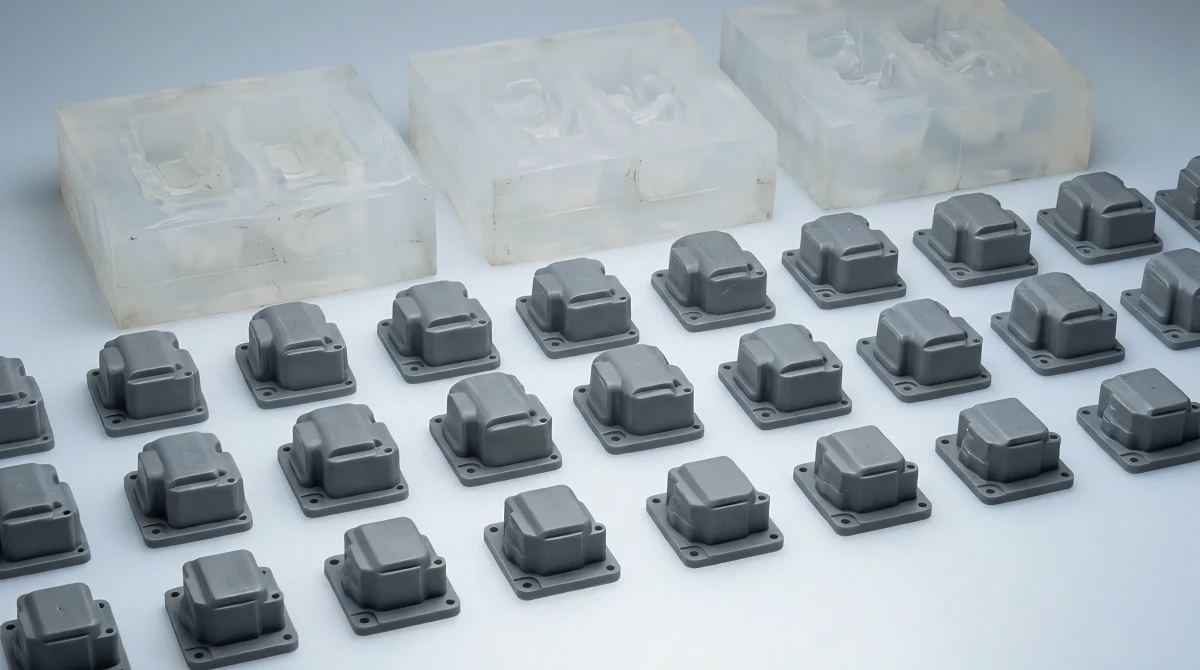
How Many Silicone Molds a Vacuum Cast Batch NeedsThe tool count is the quantity divided by the copies one tool gives, rounded up. Renishaw states that a mold can produce up to 50 parts before retooling and typically between 30 and 50 colour matched parts.

Shore Hardness Standards for Cast Polyurethane Parts

Shore hardness is a control number tied to a scale, a temperature, a cure state and a reading time, and a drawing callout needs all four.

Hardness Standards Behind a Cast Polyurethane Shore ValueThree documents appear most often around cast polyurethane. ISO 868 is the plastics method named on the resin sheets, ASTM D2240 is the American test method that reaches rubber and some plastics, and ISO 48-4 is the rubber method that covers softer grades.

Clear Polyurethane Casting Resin for Vacuum Casting

A clear polyurethane grade is chosen by section thickness first, and its post-cure has a printed ceiling that protects the color of the part.

How Clear a Casting Resin Is in Datasheet NumbersOn a datasheet, clear is a claim with two numbers behind it at most. PX522 is described as water clear, with a coefficient of light transmission of 89 percent measured by the laboratory LNE, and PX523 prints a refractive index of 1.511.

ABS-Like Polyurethane Casting Resins for Vacuum Casting

An ABS-like polyurethane resin is a stiff thermoset named for its use, and its datasheet numbers depend on post-cure, thickness and test method.

Why a Polyurethane Resin Is Called ABS-LikeThe phrase is a maker's shorthand, not a standard. Sika describes its SikaBiresin PX331 as having mechanical properties similar to thermoplastics like filled ABS, and Renishaw lists its 6230 as having properties similar to ABS.

Send the Drawing of Your Cast Part

Send the 2D drawing and the 3D file, with the quantity and the stage of the project. An engineer replies within 1 working day.

The quote form, the mutual NDA and the private folder for your files are on Protolis Atelier, with Vacuum Casting chosen.

Request a Quote