Cold Storage

Cold storage, for casting resins, is a spell of low temperature that can make a component crystallize in its can.

Every Cold Storage article of the Vacuum Casting Resources, newest first, each written from published standards, research and makers’ data.

Meaning

Cold storage, for casting resins, is a spell of low temperature that can make a component crystallize in its can. Both resin makers treat it as a fault to reverse before use, and both print how. The check belongs before weighing, every time a can comes out of a cold store.

Crystal Reversal

Sika reverses crystals by warming the affected component to at most 70 °C (158 °F) until they are gone. It goes back to working temperature before it is weighed. Renishaw’s method is 2 hours at 70 °C (158 °F), then a stabilizing period at 40 °C (104 °F). For its rubber-like 8020-2, Renishaw gives 2 to 4 hours at 70 °C (158 °F) followed by stirring.
Read More

Storage Range

Sika asks for storage between 15 °C and 25 °C (59 °F and 77 °F) in unopened containers. Renishaw keeps its opened cans capped in a 40 °C (104 °F) oven. Sika’s clear systems keep for 12 months unopened. A 2004 dissertation reports one workshop storing resin at 30 °C (86 °F) to prevent crystals.

Difference From Moisture

Crystallization is a separate fault from moisture, with a separate cure. Crystals respond to warming. Water-damaged resin keeps gassing however long it is pumped. Telling the two apart decides whether the can is restored or replaced.

Handling Order

The handling list for the ABS-like grades starts with a look at the polyol for crystals after cold storage. The component is warmed as its maker describes before anything is weighed. Then component B is shaken, both are weighed with an allowance for cup residue, and each is degassed alone.
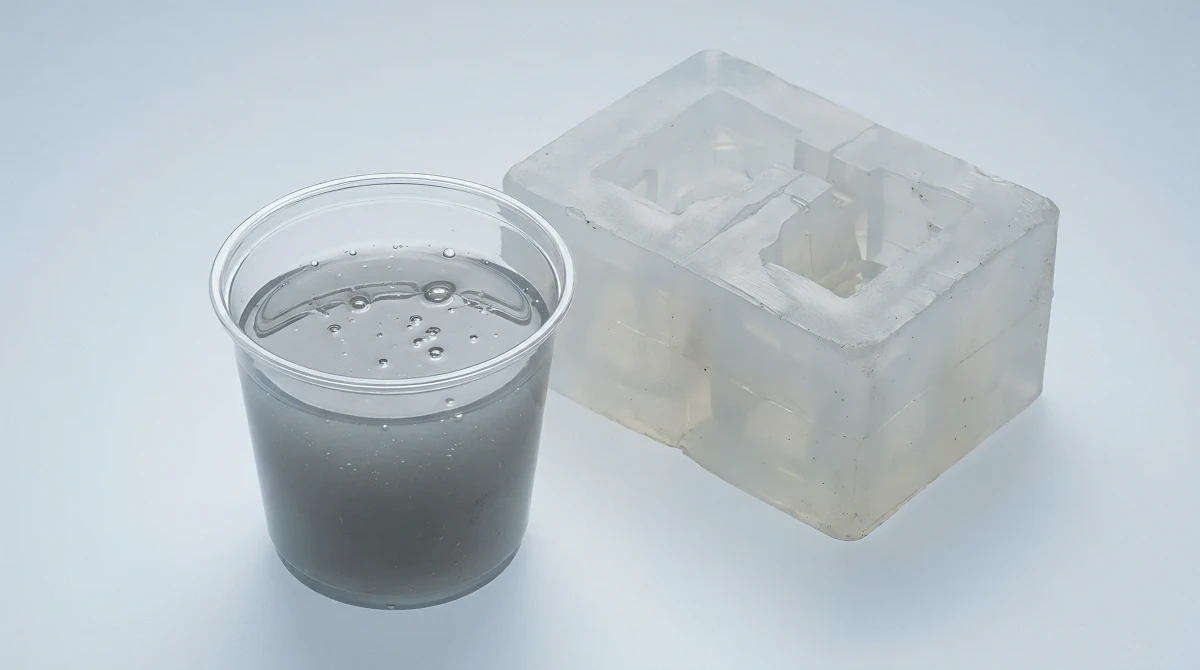
Degassing Silicone and Resin in Vacuum Casting

Each resin component is evacuated alone for about ten minutes, the silicone twice, and the air returns before the pot life ends.

Why Silicone and Resin Are Degassed Under VacuumMixing puts air into any liquid. Stirring two viscous components together folds the surface into the bulk, and a general guide from the mold supplier ArtMolds puts the air picked up by mixing at 5 % to 20 % of the volume, calling it the primary cause of bubbles in cast parts.

Clear Polyurethane Casting Resin for Vacuum Casting

A clear polyurethane grade is chosen by section thickness first, and its post-cure has a printed ceiling that protects the color of the part.

How Clear a Casting Resin Is in Datasheet NumbersOn a datasheet, clear is a claim with two numbers behind it at most. PX522 is described as water clear, with a coefficient of light transmission of 89 percent measured by the laboratory LNE, and PX523 prints a refractive index of 1.511.

ABS-Like Polyurethane Casting Resins for Vacuum Casting

An ABS-like polyurethane resin is a stiff thermoset named for its use, and its datasheet numbers depend on post-cure, thickness and test method.

Why a Polyurethane Resin Is Called ABS-LikeThe phrase is a maker's shorthand, not a standard. Sika describes its SikaBiresin PX331 as having mechanical properties similar to thermoplastics like filled ABS, and Renishaw lists its 6230 as having properties similar to ABS.

Send the Drawing of Your Cast Part

Send the 2D drawing and the 3D file, with the quantity and the stage of the project. An engineer replies within 1 working day.

The quote form, the mutual NDA and the private folder for your files are on Protolis Atelier, with Vacuum Casting chosen.

Request a Quote