Gate

A gate is the channel through which resin enters a silicone mold cavity, formed by a rod attached to the master before the mold is poured.

Every Gate article of the Vacuum Casting Resources, newest first, each written from published standards, research and makers’ data.

Meaning

A gate is the channel through which resin enters a silicone mold cavity, formed by a rod attached to the master before the mold is poured. Its size, number and position decide how the cavity fills and where a trimmed mark is left on every casting.

Size

The Free State dissertation sizes the gate by the resin it carries and the time allowed to pour it within the pot life: an 8 mm (0.31 in) gate for parts up to 50 g (1.8 oz) of resin and 10 mm (0.39 in) for 50 to 100 g (1.8 to 3.5 oz).
Read More

Position

The gate goes to the lowest point of the cavity, with risers leaving from the highest, and the master is sometimes tilted so that this is so. Loughborough’s guide adds a non-cosmetic surface, preferably into a thick wall.

Gate Shape

A small triangular web where the rod meets the master gives a gate that breaks off easily and needs little finishing. After demold, the feed, vents and any flash are trimmed with pliers or a knife.

Gate Faults

A gate on a cosmetic face leaves a mark on every part. A gate too small for the resin’s viscosity and pot life risks a short fill late in the pour. A gate feeding a thin wall directly makes filling harder than one feeding a thick section. Because the gate is part of the master, its choice is made before the silicone is poured and repeats on the whole batch.

Overmolding and Inserts in Vacuum Casting Step by Step

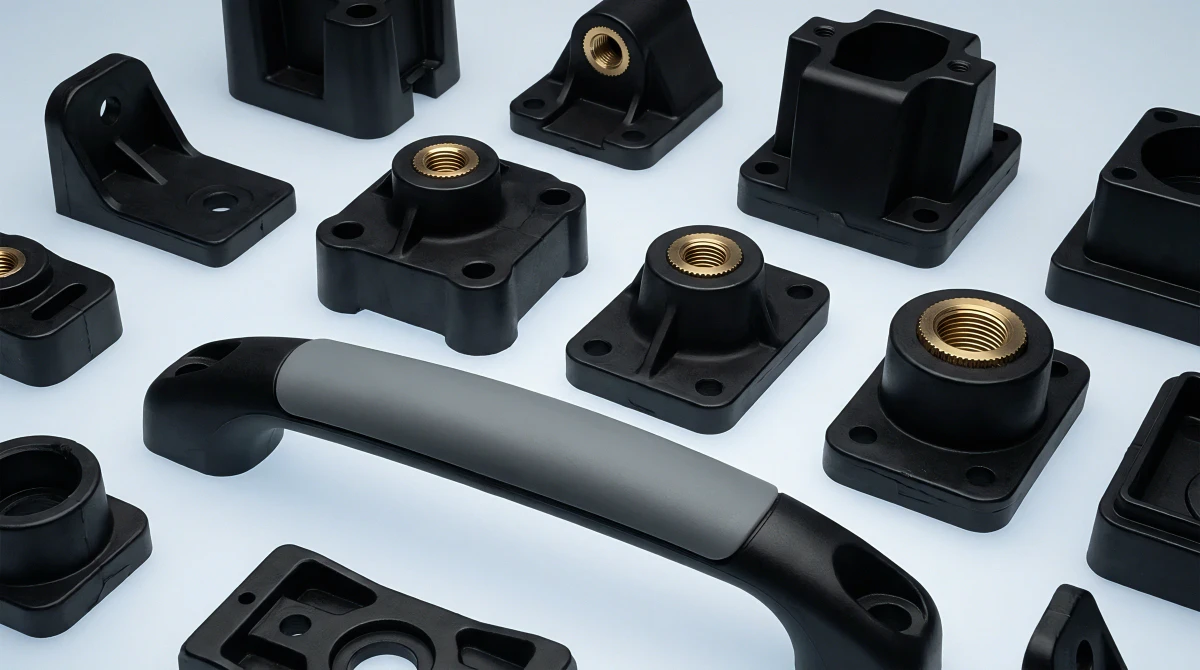
Inserts in a cast part are held by knurls and undercuts, located on pins in the silicone, and surrounded by resin mixed and poured under vacuum.

The Vacuum Casting Steps for a Part With InsertsA vacuum cast part with molded-in inserts is made in eight steps: the insert is chosen and shaped for mechanical retention, the master is prepared so the mold can locate it, the insert's surface is prepared, it is placed in the opened silicone mold, the mold is closed and preheated, the resin is degassed and mixed under vacuum, the mold is filled and vented, and the part is cured and demolded around the insert. An overmolded part adds a second mold and a second pour.
Making the Master Pattern for Vacuum Casting From SLA or CNC

The master is finished, sealed and fitted with its parting line, gate and risers before the silicone is poured, because the mold copies every mark into the batch.

What the Master Pattern Has to Deliver Before the Silicone Is PouredA master pattern for vacuum casting is the physical original from which the silicone mold is cast, and the mold reproduces it so faithfully that every cast part inherits its shape, its surface and its faults. Loughborough University's vacuum casting guide puts it plainly: the mold replicates the master extremely faithfully, so the master's surface finish and accuracy are what the moldings will have.

Surface Finish of Vacuum Cast Parts and How the Master Sets It

A vacuum cast part copies its master's roughness and comes out slightly smoother, so the finish is specified and measured on the master before the mold is poured.

How Closely a Vacuum Cast Surface Follows Its MasterA vacuum cast part's surface roughness is set by its master within about a tenth of the master's value, in the two studies on file. In the 2020 study by Mustafa and co-authors, parts cast from FDM, SLA and multi jet fusion (MJF) masters all came out smoother than the master, by 1.84 %, 9.62 % and 6.09 % respectively.

Degassing Silicone and Resin in Vacuum Casting

Each resin component is evacuated alone for about ten minutes, the silicone twice, and the air returns before the pot life ends.

Why Silicone and Resin Are Degassed Under VacuumMixing puts air into any liquid. Stirring two viscous components together folds the surface into the bulk, and a general guide from the mold supplier ArtMolds puts the air picked up by mixing at 5 % to 20 % of the volume, calling it the primary cause of bubbles in cast parts.

Linear Shrinkage of Cast Polyurethane Resins Per 100 mm

Printed shrinkage belongs to one bar and one cure, so the master is scaled from it as a starting point and the first article confirms each critical dimension.

Linear Shrinkage Read as Millimeters Per MeterLinear shrinkage is the fractional loss in length between the mold cavity and the cured part. A resin that fills a cavity 100 mm long and cures into a part that measures 99.3 mm has shrunk by 0.7 percent, which is the same as 7 mm per meter.

Send the Drawing of Your Cast Part

Send the 2D drawing and the 3D file, with the quantity and the stage of the project. An engineer replies within 1 working day.

The quote form, the mutual NDA and the private folder for your files are on Protolis Atelier, with Vacuum Casting chosen.

Request a Quote