Flexural Modulus

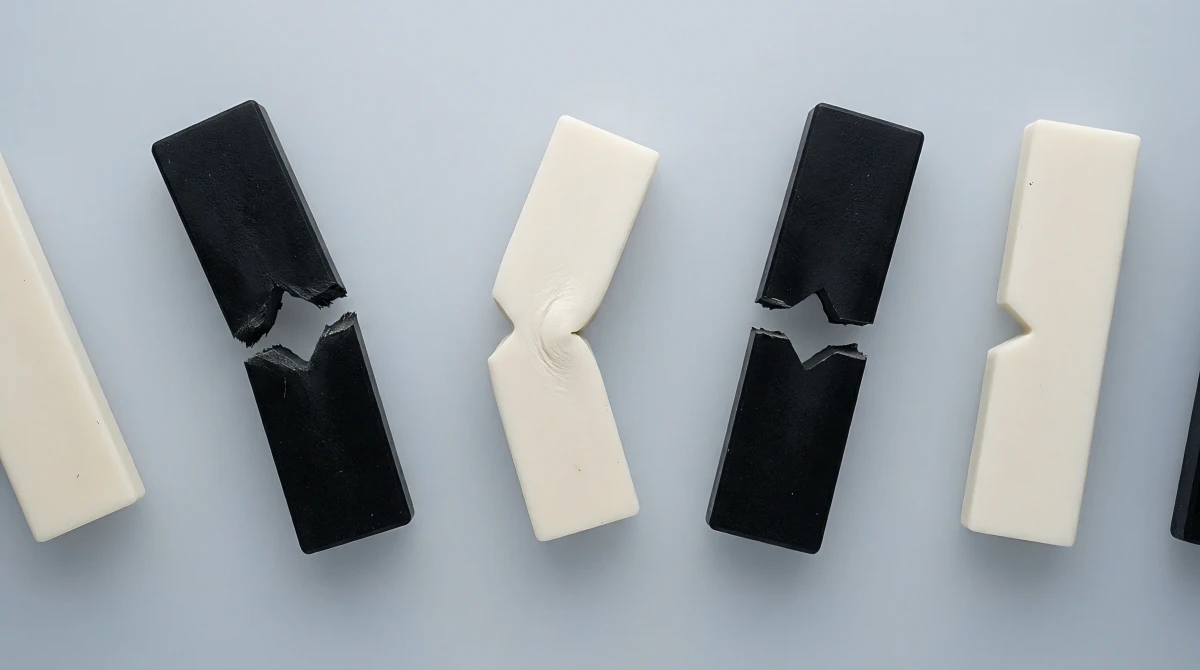
Flexural modulus is the stiffness of a material in bending, measured on a bar loaded across a span, as in ISO 178.

Every Flexural Modulus article of the Vacuum Casting Resources, newest first, each written from published standards, research and makers’ data.

Meaning

Flexural modulus is the stiffness of a material in bending, measured on a bar loaded across a span, as in ISO 178. On a casting resin sheet it is the clearest single measure of how rigid a cured part will feel. It also decides how far heat deflection figures can be compared between grades. Like every sheet value, it belongs to the post-cured specimen the footnote names.

Moduli by Grade

The rigid grades span a wide range. PX205 gives 500 MPa (73 ksi), the softest of the rigid grades. Renishaw 6230 gives 1,800 MPa (261 ksi), PX 223 HT 2,300 MPa (334 ksi) and Renishaw 8263 2,200 N/mm² (319 ksi). Clear PX522 reaches 2,400 MPa (348 ksi) and PX523 2,100 MPa (305 ksi). PX331 gives 3,700 MPa (537 ksi), the stiffest grade on file.
Read More

Heat Deflection Link

ISO 75-1 says true comparability of heat deflection data holds only for materials with the same room-temperature flexural modulus. ISO 75-2 repeats the point. With moduli from 500 MPa to 3,700 MPa (73 ksi to 537 ksi), that caveat applies directly to casting resins. Under load, soft PX205 gives way a full 35 °C (63 °F) below its glass transition. The stiff PX331 holds it to within 10 °C (18 °F).

Hardness Link

Hardness and stiffness do not rank the grades alike. PX523 matches PX331 at Shore D 86 with a modulus of 2,100 MPa (305 ksi) against 3,700 MPa (537 ksi). The hardness standards give no table that converts a reading into modulus. A part’s bending stiffness is therefore read from the flexural figure.

Brittleness Trade-Off

The stiff end of the ABS-like range is also the brittle one. PX331 reaches only 4 % elongation at break. A part that has to flex, such as a latch, looks at elongation as well as modulus.
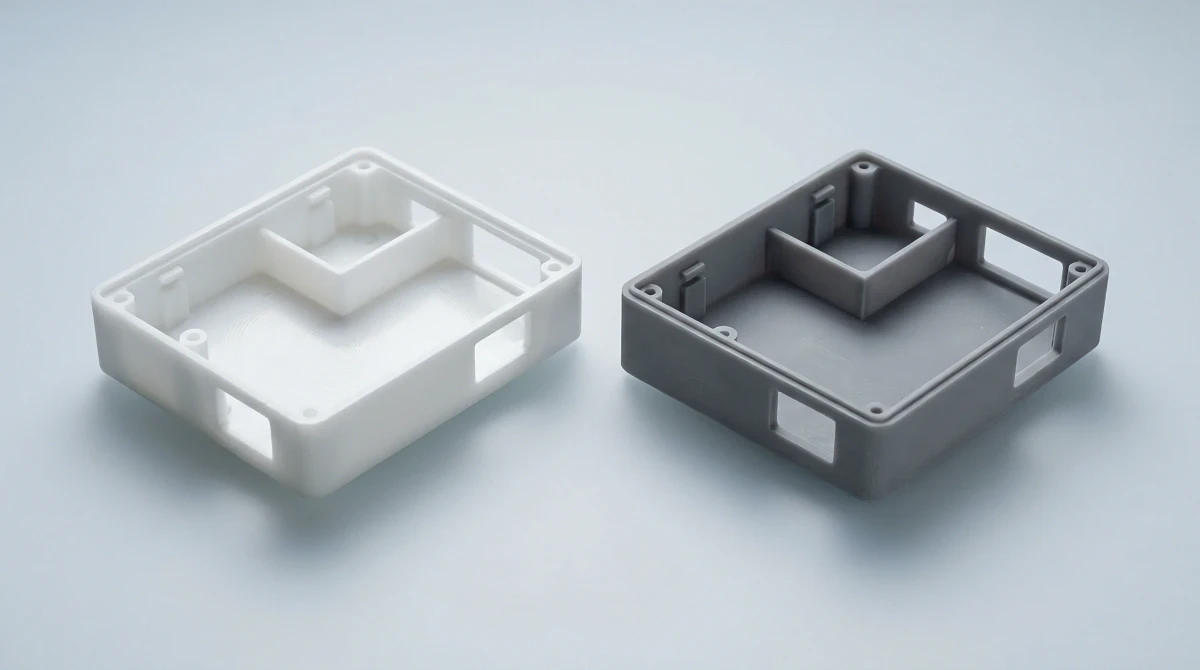
Making the Master Pattern for Vacuum Casting From SLA or CNC

The master is finished, sealed and fitted with its parting line, gate and risers before the silicone is poured, because the mold copies every mark into the batch.

What the Master Pattern Has to Deliver Before the Silicone Is PouredA master pattern for vacuum casting is the physical original from which the silicone mold is cast, and the mold reproduces it so faithfully that every cast part inherits its shape, its surface and its faults. Loughborough University's vacuum casting guide puts it plainly: the mold replicates the master extremely faithfully, so the master's surface finish and accuracy are what the moldings will have.

ISO 179 and ISO 180 Impact Strength on Cast Resin Data Sheets

Impact values on cast resin sheets are comparisons tied to method, notch, specimen and cure, so a part's toughness is set by tests on batch bars or the part.

What ISO 179 and ISO 180 Measure on a Cast ResinBoth standards measure how much energy a pendulum hammer loses breaking a small bar of plastic at a high strain rate. ZwickRoell, a maker of the testing machines, describes the principle in its pages on both methods: a hammer of specified energy and drop height strikes the specimen, does not swing back to its starting height, and the height difference is taken as the energy absorbed.

PP-Like and PE-Like Polyurethane Casting Resins for Vacuum Casting

PP-like and PE-like urethanes trade stiffness for elongation by grade, and their heat figures depend on cure, so the first cast part is tested in its real duty.

What PP-Like and PE-Like Mean on a Casting Resin Data SheetA PP-like or PE-like grade is a two- or three-component polyurethane formulated so that a part cast in a silicone mold behaves, in hand and in a snap fit, more like polypropylene or polyethylene than like a stiff ABS replica. The makers say so in their own words.

Shore Hardness Standards for Cast Polyurethane Parts

Shore hardness is a control number tied to a scale, a temperature, a cure state and a reading time, and a drawing callout needs all four.

Hardness Standards Behind a Cast Polyurethane Shore ValueThree documents appear most often around cast polyurethane. ISO 868 is the plastics method named on the resin sheets, ASTM D2240 is the American test method that reaches rubber and some plastics, and ISO 48-4 is the rubber method that covers softer grades.

Heat Deflection Temperature of Cast Polyurethane Under ISO 75 and ASTM D648

Heat deflection temperature ranks materials under one loaded test and does not set a service ceiling, so it is read together with post-cure and part geometry.

Heat Deflection as One Loaded Bar TestThe test bends a bar under a fixed load while the temperature climbs, and it records the temperature at which the bar has deflected by a set amount. ISO 75-1 describes the general method for determining the temperature of deflection under load, with flexural stress applied in three-point loading.

ABS-Like Polyurethane Casting Resins for Vacuum Casting

An ABS-like polyurethane resin is a stiff thermoset named for its use, and its datasheet numbers depend on post-cure, thickness and test method.

Why a Polyurethane Resin Is Called ABS-LikeThe phrase is a maker's shorthand, not a standard. Sika describes its SikaBiresin PX331 as having mechanical properties similar to thermoplastics like filled ABS, and Renishaw lists its 6230 as having properties similar to ABS.

Send the Drawing of Your Cast Part

Send the 2D drawing and the 3D file, with the quantity and the stage of the project. An engineer replies within 1 working day.

The quote form, the mutual NDA and the private folder for your files are on Protolis Atelier, with Vacuum Casting chosen.

Request a Quote