Izod

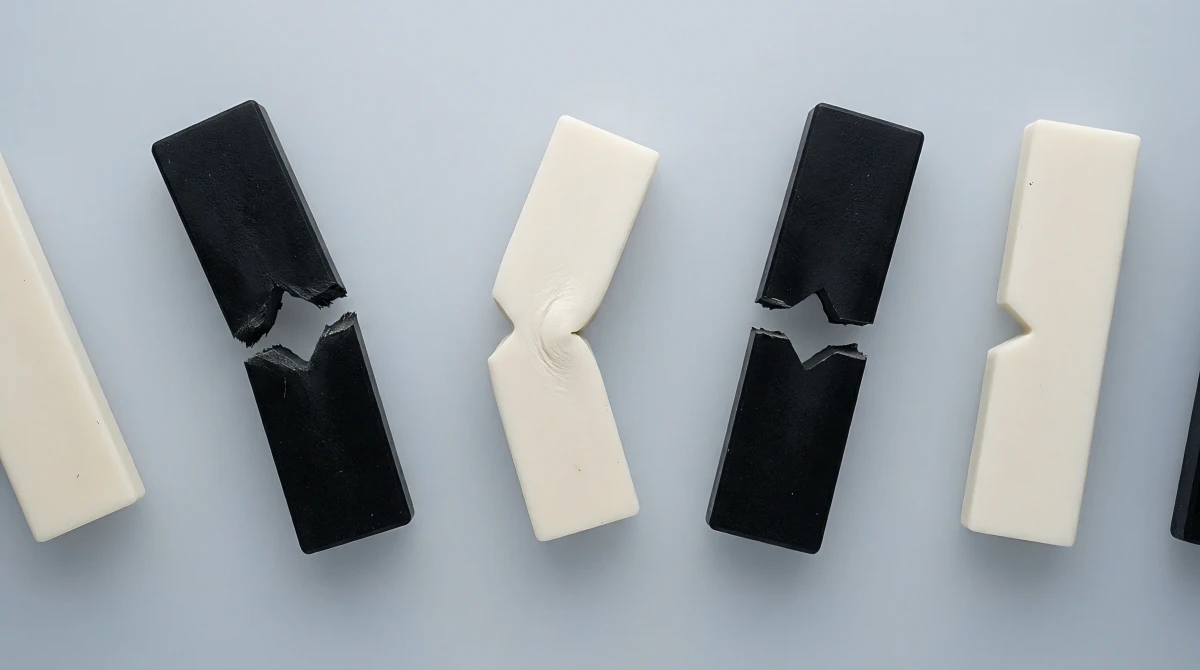
Izod is a pendulum impact test in which a plastic bar is clamped at one end and struck as a cantilever, with the energy it absorbs reported per unit of cross-section.

Every Izod article of the Vacuum Casting Resources, newest first, each written from published standards, research and makers’ data.

Meaning

Izod is a pendulum impact test in which a plastic bar is clamped at one end and struck as a cantilever, with the energy it absorbs reported per unit of cross-section. ISO 180 is the international version and ASTM D256 the American one. ZwickRoell, a maker of the testing machines, gives the ISO 180 specimen as 10 × 4 × 80 mm (0.39 × 0.16 × 3.15 in) and notes that Izod and Charpy deliver similar conclusions about a material’s impact strength.

Values on Casting Resin Sheets

Renishaw prints Izod figures to ISO 180 on its vacuum casting resins. The PP-like 8045 family reads 16, 16, 19 and 21 kJ/m² (7.6, 7.6, 9.0 and 10.0 ft·lb/in²) as its C component rises, and 8040 and 8060-2 both read 15 kJ/m² (7.1 ft·lb/in²). Sika’s North American sheets print notched Izod to ASTM D256, 6 kJ/m² (2.9 ft·lb/in²) for PX 1000.
Read More

ASTM D256 Differences

The two are not interchangeable. ISO 180 is based on ASTM D256 but uses different specimen dimensions, and the ASTM scope reports results per unit of width (J/m) or per area under the notch, while ISO reports per area in kJ/m². A value in J/m cannot be set beside a value in kJ/m² without the specimen’s dimensions.

Test Conditions

Izod tests to ISO 180 are normally run after conditioning at 23 °C (73 °F) and 50 % relative humidity to ISO 291, and the scope of ISO 180 adds that results from different specimen sizes, notches or preparation may not be comparable. Edgewise impact is the usual configuration, flatwise the less common one, and the sheets on file do not say which they used. For a cast part, an Izod figure ranks grades of one maker; a requirement on parts names the method, the notch and the bar.
ISO 179 and ISO 180 Impact Strength on Cast Resin Data Sheets

Impact values on cast resin sheets are comparisons tied to method, notch, specimen and cure, so a part's toughness is set by tests on batch bars or the part.

What ISO 179 and ISO 180 Measure on a Cast ResinBoth standards measure how much energy a pendulum hammer loses breaking a small bar of plastic at a high strain rate. ZwickRoell, a maker of the testing machines, describes the principle in its pages on both methods: a hammer of specified energy and drop height strikes the specimen, does not swing back to its starting height, and the height difference is taken as the energy absorbed.

PP-Like and PE-Like Polyurethane Casting Resins for Vacuum Casting

PP-like and PE-like urethanes trade stiffness for elongation by grade, and their heat figures depend on cure, so the first cast part is tested in its real duty.

What PP-Like and PE-Like Mean on a Casting Resin Data SheetA PP-like or PE-like grade is a two- or three-component polyurethane formulated so that a part cast in a silicone mold behaves, in hand and in a snap fit, more like polypropylene or polyethylene than like a stiff ABS replica. The makers say so in their own words.

ABS-Like Polyurethane Casting Resins for Vacuum Casting

An ABS-like polyurethane resin is a stiff thermoset named for its use, and its datasheet numbers depend on post-cure, thickness and test method.

Why a Polyurethane Resin Is Called ABS-LikeThe phrase is a maker's shorthand, not a standard. Sika describes its SikaBiresin PX331 as having mechanical properties similar to thermoplastics like filled ABS, and Renishaw lists its 6230 as having properties similar to ABS.

Send the Drawing of Your Cast Part

Send the 2D drawing and the 3D file, with the quantity and the stage of the project. An engineer replies within 1 working day.

The quote form, the mutual NDA and the private folder for your files are on Protolis Atelier, with Vacuum Casting chosen.

Request a Quote