Toughness

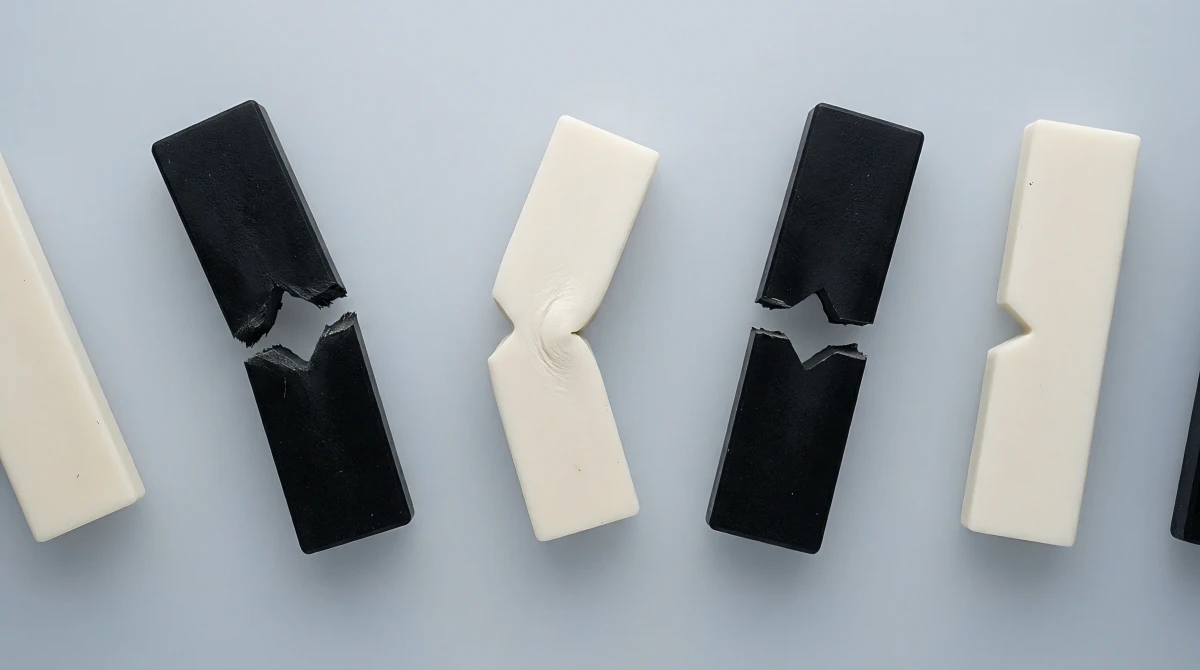
Toughness is a material's ability to absorb energy before it breaks, and on a casting resin sheet it appears as an impact value from a pendulum test such as ISO 179 Charpy or ISO 180 Izod.

Every Toughness article of the Vacuum Casting Resources, newest first, each written from published standards, research and makers’ data.

Meaning

Toughness is a material’s ability to absorb energy before it breaks, and on a casting resin sheet it appears as an impact value from a pendulum test such as ISO 179 Charpy or ISO 180 Izod. The ISO 180 scope describes the method as estimating brittleness or toughness within the limits of its test conditions.

Printed Values

Makers print toughness as a number in kJ/m², a “no break” or a “greater than”. Renishaw’s PP-like 8045 grades rise from 16 to 21 kJ/m² (7.6 to 10.0 ft·lb/in²) Izod as they soften. Sika’s rigid vacuum grades range from 25 and 26 kJ/m² (11.9 and 12.4 ft·lb/in²) for PX280 and PX331 to 70 and 71 kJ/m² (33.3 and 33.8 ft·lb/in²) for PX226 and PX221 in its brochure’s approximate values.
Read More

Trade With Stiffness

No grade on file is both the stiffest and the toughest. Sika’s stiffest rigid grade, PX245, prints less than half the impact energy of its HIPS-like PX221. On the PP-like side, Renishaw’s 8045 family gains toughness as it loses modulus. A part that has to survive a drop and stay stiff is a compromise chosen from both columns.

Test Limits

ISO 180 states that its results are not a source of data for design calculations, and ISO 179-2 that finished-product behavior cannot be predicted directly. Wall thickness, corner radii, inserts and the temperature of use all change how a cast part takes a blow. A toughness requirement is therefore proved on the part, or on bars cast with the batch and tested by a stated method at the temperature the part will see.
ISO 179 and ISO 180 Impact Strength on Cast Resin Data Sheets

Impact values on cast resin sheets are comparisons tied to method, notch, specimen and cure, so a part's toughness is set by tests on batch bars or the part.

What ISO 179 and ISO 180 Measure on a Cast ResinBoth standards measure how much energy a pendulum hammer loses breaking a small bar of plastic at a high strain rate. ZwickRoell, a maker of the testing machines, describes the principle in its pages on both methods: a hammer of specified energy and drop height strikes the specimen, does not swing back to its starting height, and the height difference is taken as the energy absorbed.

PP-Like and PE-Like Polyurethane Casting Resins for Vacuum Casting

PP-like and PE-like urethanes trade stiffness for elongation by grade, and their heat figures depend on cure, so the first cast part is tested in its real duty.

What PP-Like and PE-Like Mean on a Casting Resin Data SheetA PP-like or PE-like grade is a two- or three-component polyurethane formulated so that a part cast in a silicone mold behaves, in hand and in a snap fit, more like polypropylene or polyethylene than like a stiff ABS replica. The makers say so in their own words.

ABS-Like Polyurethane Casting Resins for Vacuum Casting

An ABS-like polyurethane resin is a stiff thermoset named for its use, and its datasheet numbers depend on post-cure, thickness and test method.

Why a Polyurethane Resin Is Called ABS-LikeThe phrase is a maker's shorthand, not a standard. Sika describes its SikaBiresin PX331 as having mechanical properties similar to thermoplastics like filled ABS, and Renishaw lists its 6230 as having properties similar to ABS.

Send the Drawing of Your Cast Part

Send the 2D drawing and the 3D file, with the quantity and the stage of the project. An engineer replies within 1 working day.

The quote form, the mutual NDA and the private folder for your files are on Protolis Atelier, with Vacuum Casting chosen.

Request a Quote