Critical Dimension

A critical dimension is a feature size the drawing marks as essential to fit or function, measured on every first article.

Every Critical Dimension article of the Vacuum Casting Resources, newest first, each written from published standards, research and makers’ data.

Meaning

A critical dimension is a feature size the drawing marks as essential to fit or function, measured on every first article. In vacuum casting such a dimension depends on the master, the resin’s shrinkage and the stage at which it is read. Shrinkage differs between features of one part, so each critical dimension is checked on its own. An average across features hides the one that drifted.

Feature-by-Feature Check

A 2004 dissertation found one cast specimen losing anywhere from 0.29 % to 1.55 %, depending on the dimension. Lengths and diameters responded to cure and mold temperature in opposite ways. In a 2020 study, the same casting settings made one cover dimension grow and another shrink. Each critical dimension is checked on the first article, in at least 2 directions.
Read More

Run Monitoring

Makers are silent on whether shrinkage holds steady as a tool ages. A check of one key dimension on the first, a middle and the last copy of a run shows it. The readings are recorded against the first article.

Process Change

When a part moves to an injection mold, the drawing’s critical dimensions carry over as the requirement. They are measured again on the molded first articles. The cast parts’ measured values serve as a reference only.

Master Measurement

The master is measured before the silicone is poured. The drawing can record which process made the master and what its critical features measured. Correcting the master one feature at a time, where a feature drifted, follows from the first article’s readings. A uniform scale cannot fix 2 features that shrink by different amounts.
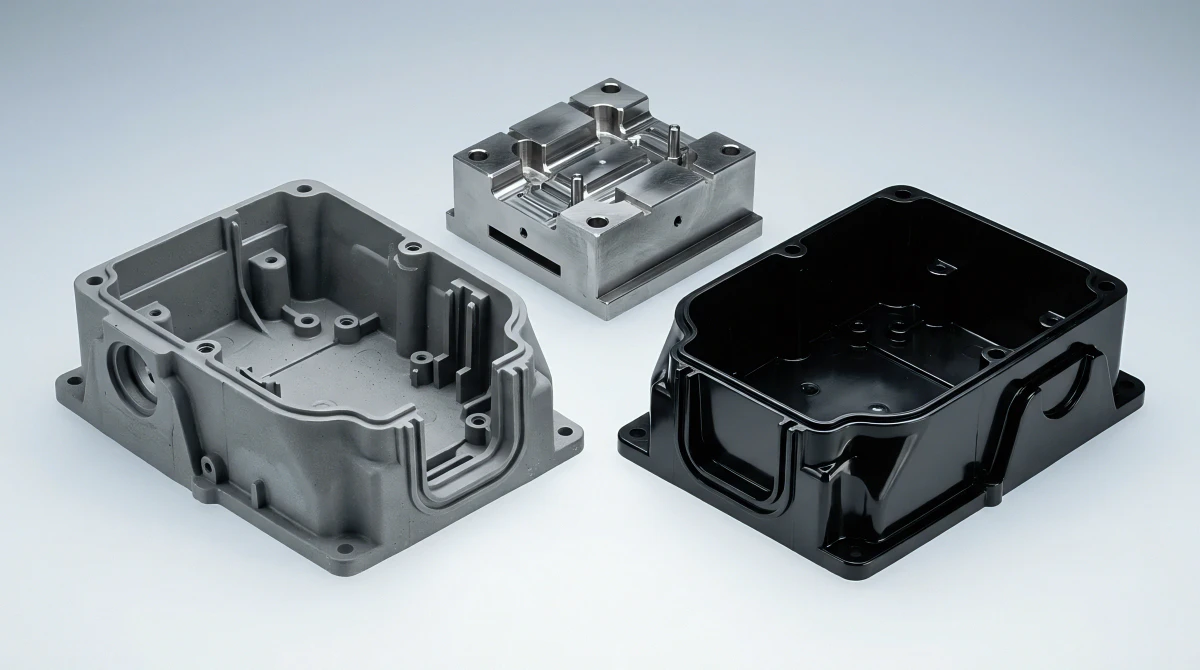
When a Vacuum Cast Run Should Move to an Injection Mold

Silicone molds carry a pilot, and a hard tool follows once the quantity, colors and repeat orders outgrow a handful of tools.

Where Silicone Tools Stop and the First Injection Mold StartsInjection molds are rated in classes by the construction they are built to and the cycles they are expected to give. The classification belongs to the plastics industry's trade body, PLASTICS, formerly the Society of the Plastics Industry, and its own text was not opened for this piece.

Linear Shrinkage of Cast Polyurethane Resins Per 100 mm

Printed shrinkage belongs to one bar and one cure, so the master is scaled from it as a starting point and the first article confirms each critical dimension.

Linear Shrinkage Read as Millimeters Per MeterLinear shrinkage is the fractional loss in length between the mold cavity and the cured part. A resin that fills a cavity 100 mm long and cures into a part that measures 99.3 mm has shrunk by 0.7 percent, which is the same as 7 mm per meter.

Dimensional Accuracy of Vacuum Cast Parts From SLA, FDM and MJF Masters

A cast copy follows its master within a small fraction of a millimeter, and the printed master is the larger source of error against the drawing.

How Accurate Vacuum Cast Parts Are in a Published StudyThe authors cast a battery cover for an enclosure, a thin-walled part 1.5 mm (0.059 in) thick with two measured dimensions: section A at 26.84 mm (1.057 in) and section B at 49.84 mm (1.962 in), both from the CAD model. They made three masters of it by three additive processes: fused deposition modeling (FDM) in ABS, stereolithography (SLA) in a detailed white resin, and multi-jet fusion (MJF) in polyamide.

Send the Drawing of Your Cast Part

Send the 2D drawing and the 3D file, with the quantity and the stage of the project. An engineer replies within 1 working day.

The quote form, the mutual NDA and the private folder for your files are on Protolis Atelier, with Vacuum Casting chosen.

Request a Quote